
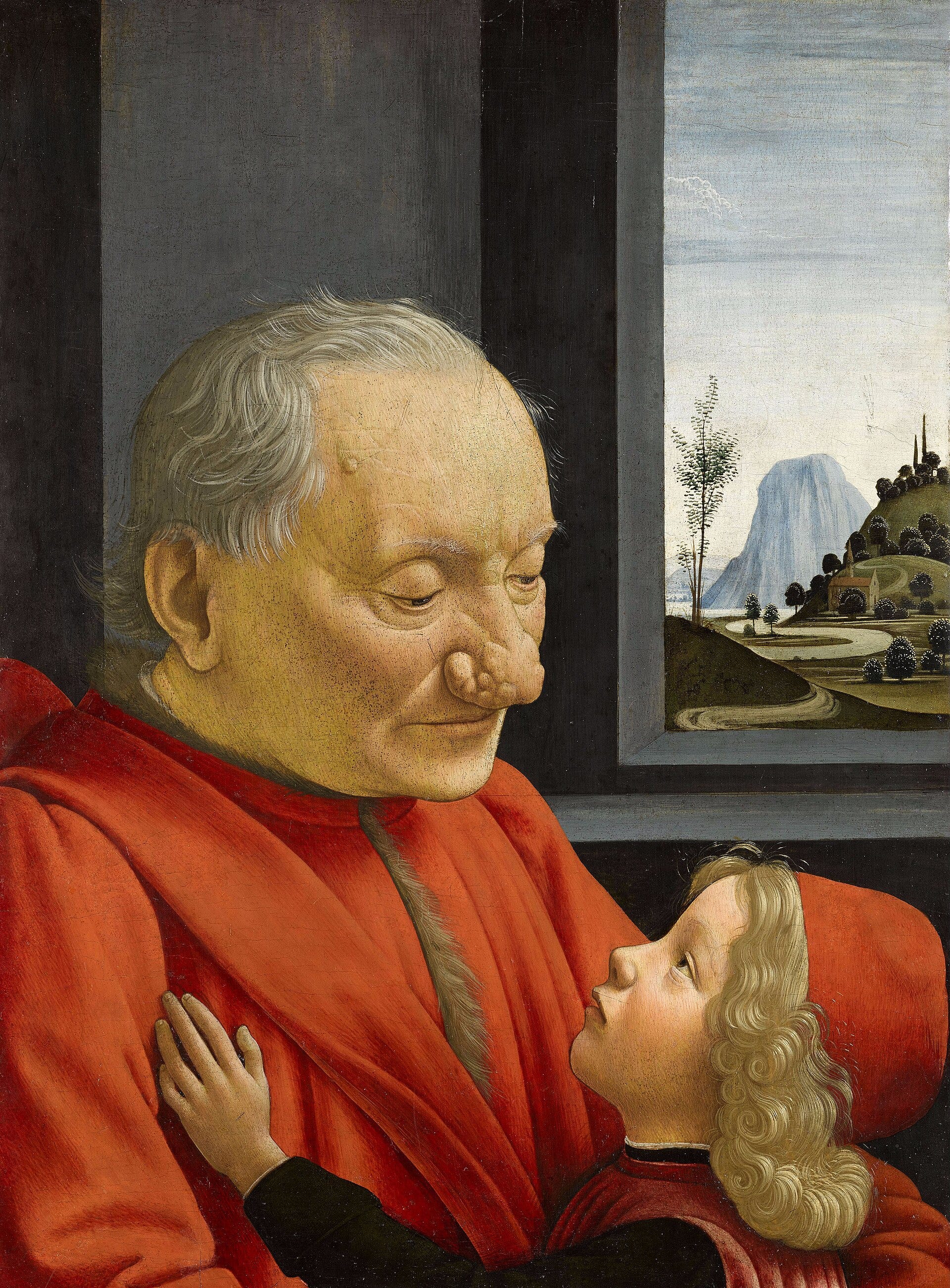
Domenico Ghirlandaio was a Florentine painter, born in 1449 and dead in 1494, who ran one of the largest fresco workshops in the city of the Medici. He painted the lives of the saints with the bankers who paid for them standing in the crowd, and he trained a thirteen year old named Michelangelo. His best known panel is a small portrait in the Louvre, an old man with a ruined nose and a boy in his arms.
In his chapels a Virgin is born in a paneled Florentine bedroom, and Saint Francis receives his rule in front of the Piazza della Signoria. The onlookers are the families who paid for the walls.
Cool Stories About Art is a newsletter to learn art the fun way.
Join 200,000+ readers and get:
10 new art stories / month
The entire archive of content (1,000+ articles)
Comment, ask questions, and chat with other readers
The pupil is the better known half of the story, and the contract that brought him to the shop is odd. On 1 April 1488 the boy's father, Lodovico Buonarroti, bound his thirteen year old son to Domenico and his brother David Ghirlandaio for three years, to learn to paint.
An apprentice's family normally paid the master. Here the shop was to pay: 24 florins over the three years, six in the first, eight in the second and ten in the third. On paper Michelangelo was a pupil, but the terms treat him as a boy who was already useful in the workshop.
Michelangelo told the story differently. His biographer Condivi, writing at his request, says he received no help from Domenico and calls the master envious, and Vasari answered by printing the contract in his second edition. The Fitzwilliam Museum adds that the fresco technique Michelangelo used on the Sistine ceiling is the one he learned in this shop. The shop that paid a child to learn was itself paid by the richest families in Florence, and what they bought was a place among the saints.
What You'll Discover
What his real name was.
Where he painted before Michelangelo.
Who is watching in the square.
The extra pay he waved away.
The nose he refused to hide.
What her portrait admits it lacks.