
A small town in western France turned down a canvas offered by its own native son, and a disaster at sea reached the Louvre under a title that named no ship. A critic's sneer handed a whole movement its name, and two words crossed out in an academy's minutes gave a new kind of painting its label.
Cool Stories About Art is a newsletter to learn art the fun way.
Join 200,000+ readers and get:
10 new art stories / month
The entire archive of content (1,000+ articles)
Comment, ask questions, and chat with other readers
How These Were Chosen
For more than two centuries, French painting meant painting judged in Paris. In 1648 the crown backed a Royal Academy of Painting and Sculpture, which trained artists and ranked subjects by prestige, with history painting at the top. Its exhibition, the Salon, was held at the Louvre. It was where the public saw new pictures, where critics wrote their reviews and where the state chose what to buy, so a painter who wanted a career needed that room.
Through the 1800s, painters who were turned away, or who would not wait, found other doors: dealers, showmen abroad and exhibitions they organized themselves, with no jury at all.
Every picture here passed in front of that system, whether the Academy, a Salon jury or a state buyer, or was shown at an exhibition artists set up outside it. Each painter appears once. The list runs from the 1630s to 1897 and stops in the late 1890s, when rival salons were taking over from the official one. What ties the twelve together is their first reception, so each entry tells how Paris met the picture when it was new.
12. Henri Rousseau, The Sleeping Gypsy (1897)
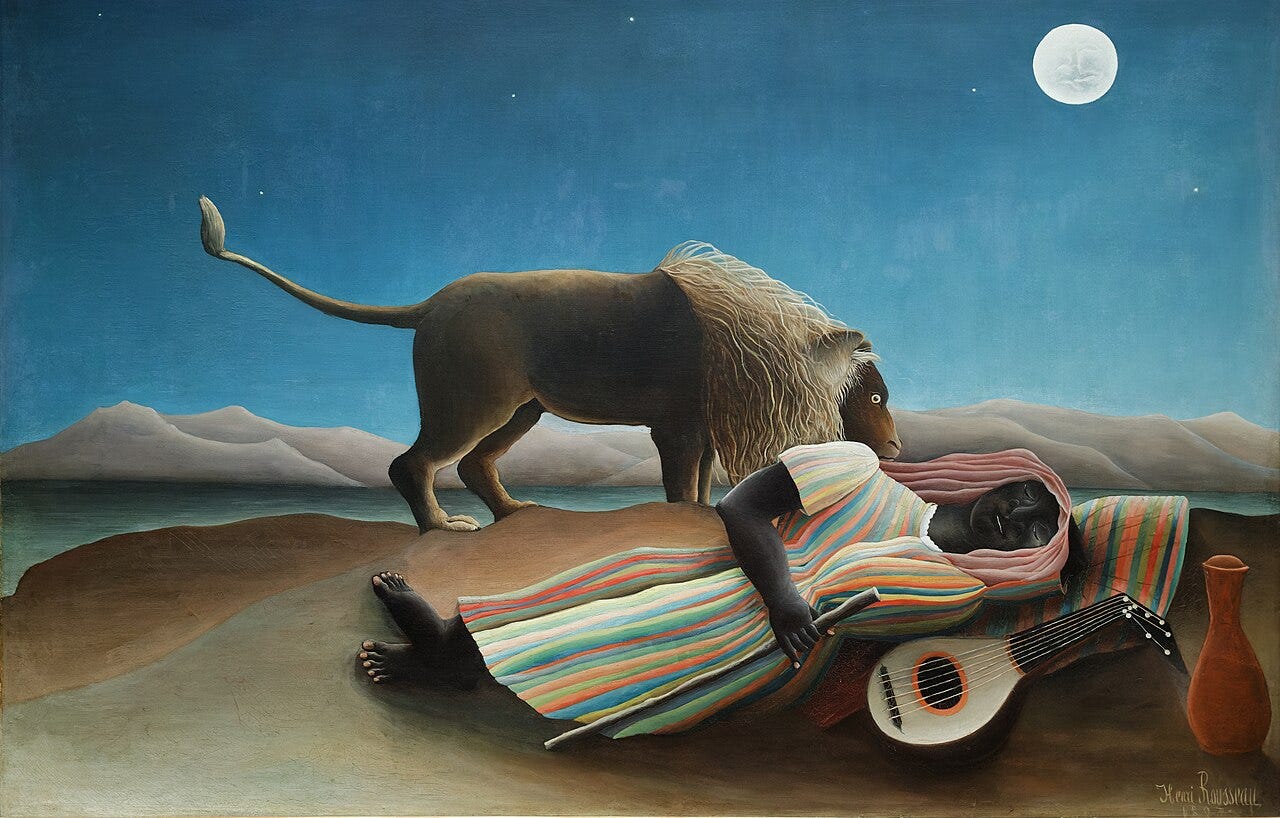
Moonlight falls on a woman asleep on desert sand, and a lion has stopped over her, its tail raised and its nose almost touching her hair. She wears a striped robe, a mandolin and a clay water jar lie at her side, and even asleep she keeps hold of her walking stick. Henri Rousseau painted The Sleeping Gypsy in Paris in 1897, and he had taught himself to paint.
Rousseau had come to painting late. For twenty two years he had worked at the octroi de Paris, the office that taxed goods entering the city, and the job earned him the nickname le Douanier, the customs officer. By 1897 he had left it to paint full time, and he showed The Sleeping Gypsy that year at the Salon des Indépendants, an exhibition with no jury and no prizes.
A show without a jury could not give him what he still wanted, which was official approval. In 1898 he offered the canvas to the mayor of Laval, the town in western France where he was born, and described it in his own words: a wandering mandolin player has fallen into a deep sleep beside her jar of drinking water, and a lion that happens by catches her scent and does not devour her.
He closed the description with a line of praise for his own work: "There is a moonlight effect, very poetic." Laval did not buy the painting, and it dropped out of public view for a quarter of a century.
It resurfaced in early 1924, when the critic Louis Vauxcelles found it with a charcoal merchant in Paris. By February it belonged to John Quinn, a New York lawyer who collected modern art, and the picture Laval had refused was on its way to the city where it hangs today.
At a Glance
Artist: Henri Rousseau (1844 to 1910)
Painted: 1897
Medium: Oil on canvas
Size: 129.5 × 200.7 cm (51 × 79 in)
Where to see it: Museum of Modern Art, New York
11. Georges Seurat, A Sunday on La Grande Jatte (1884 to 1886)
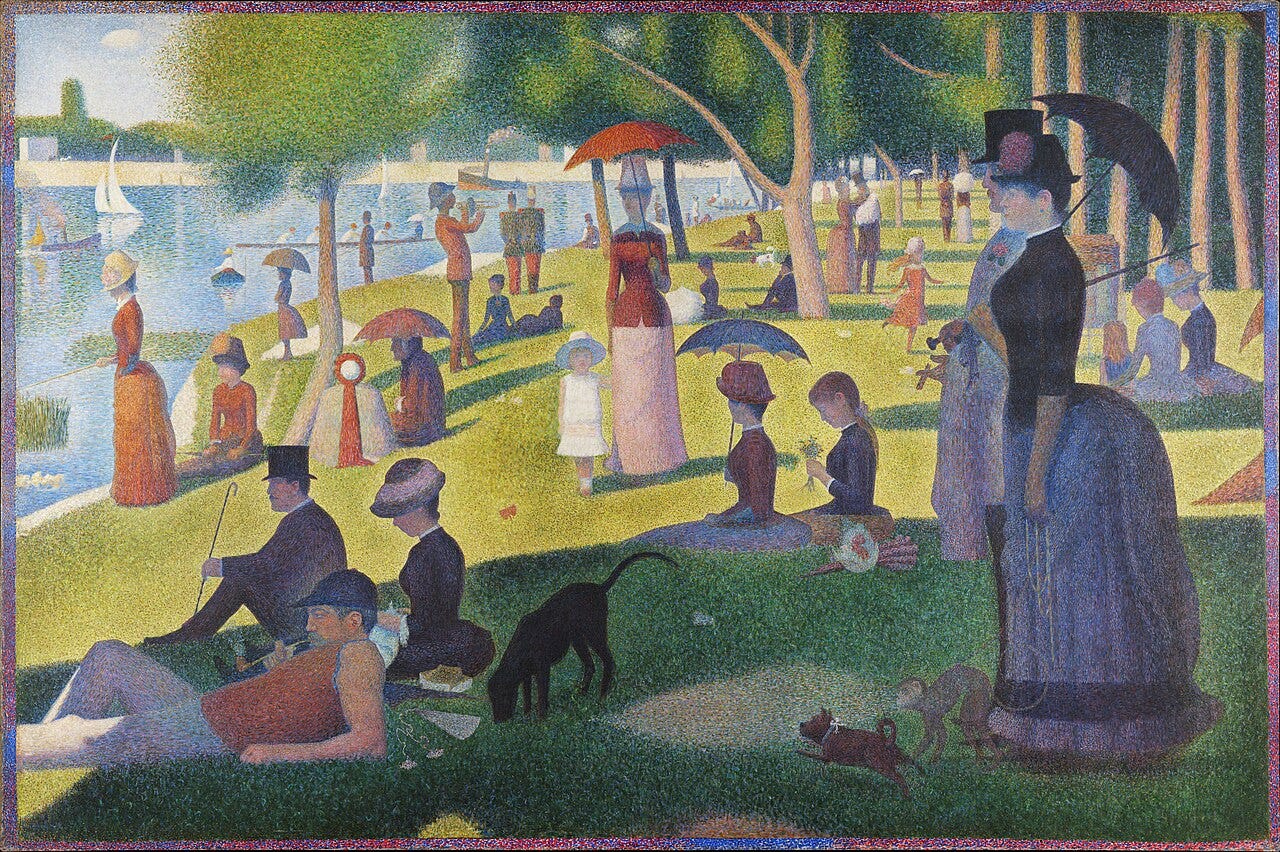
On the bank of an island in the Seine, just outside Paris, a lady in a bustle walks a small monkey on a leash beside a man in a top hat. Around them Parisians of every age take the Sunday air, a woman fishing at the water's edge, couples resting under parasols. Georges Seurat was twenty four when he began A Sunday on La Grande Jatte, and he worked on it from 1884 to 1886.