
A thief's fingers working behind a young man's back while he pays to hear his future. A farmer gripping his hat in both fists because a church bell caught him halfway through taking it off. A doctor curling his own fingers above a corpse to show what a tendon does. In the twelve pictures below, the hands tell more than the faces.

Cool Stories About Art is a newsletter to learn art the fun way.
Join 200,000+ readers and get:
10 new art stories / month
The entire archive of content (1,000+ articles)
Comment, ask questions, and chat with other readers
How These Were Chosen
Hands are said to be the hardest part of the body to paint, and a weak picture usually gives itself away there first. Renaissance workshops knew it: apprentices copied studies of hands for years before they were trusted with a face. The difficulty also had a price. Into the 1800s, a British portrait with room for the hands cost more than one that stopped at the head and shoulders.
Painters returned to hands anyway, because a hand can carry a meaning on its own. Before most people could read, the position of a hand worked like a word, and preachers and actors relied on the same gestures. A palm turned outward or a closed fist was enough to change what a picture said.
The works on this list had to pass two tests. The first was fame: each one turns up again and again in art history courses. The second was the hand itself, which in every picture carries the meaning, whether it blesses, grips, prays or reaches out.
The twelve run from 1434 to 1930. Half of them turn on a touch, between two people or between a hand and a body, and the other half on a hand alone.
12. Self-Portrait at Twenty-Eight, Albrecht Dürer (1500)
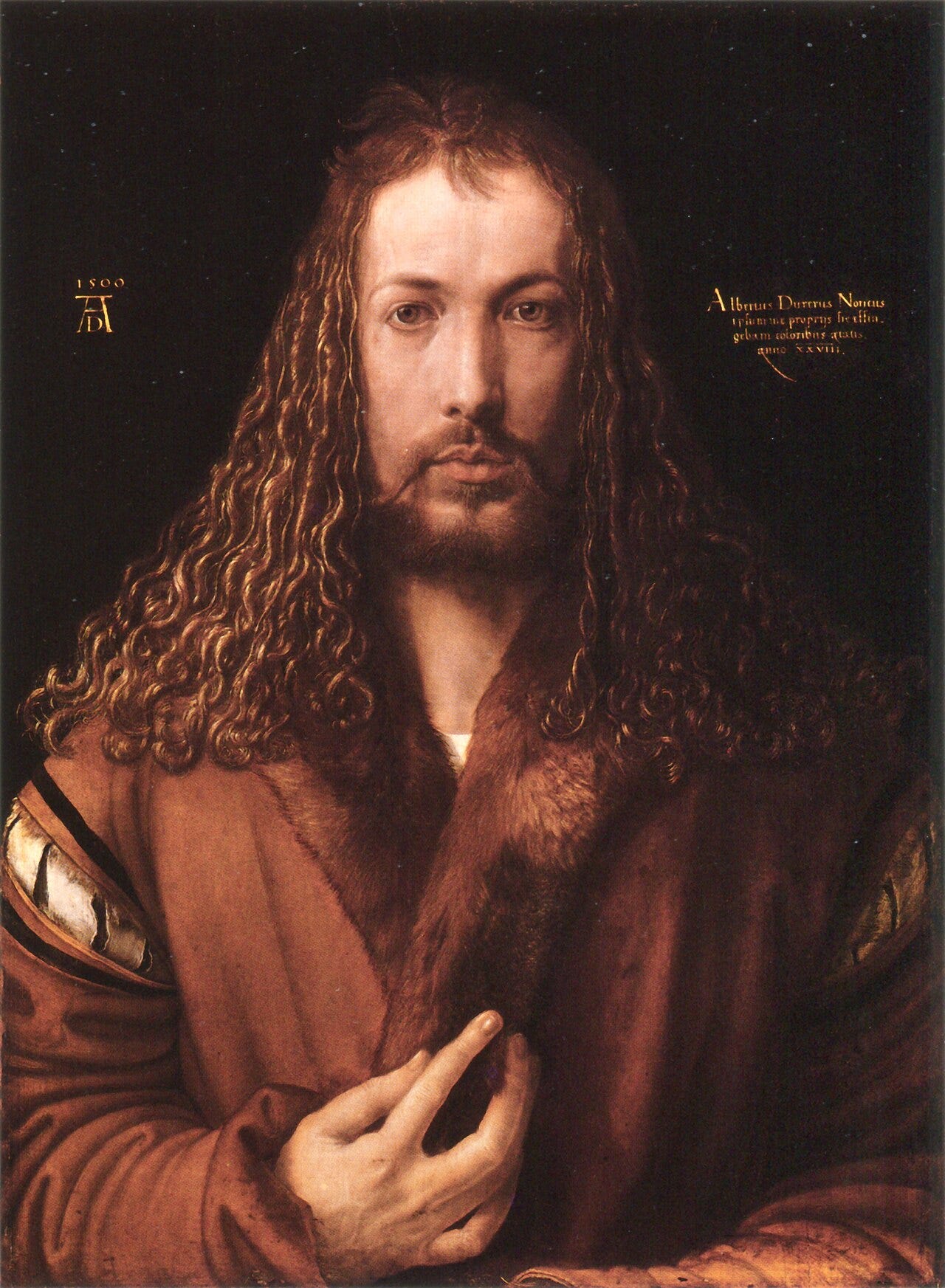
In the self portrait Albrecht Dürer painted in Nuremberg in 1500, his right hand rises to the fur collar of his coat, the fingers curled inward. He faces straight out of the panel, and a line of Latin beside his head gives his name, his city and his age, twenty eight.
That frontal pose was not a neutral choice. Until then, a centered face looking straight out belonged to images of Christ, and no German painter had used it for a portrait of himself. The hand sits where those images placed a hand raised in blessing, and many historians read it as an echo of that gesture.
For a man of Dürer's trade, the claim was a large one. In 1500, painting in Germany still counted as a craft, and a painter was paid by the job, the way a joiner was paid for a table. Learned men were scholars and poets. Dürer painted this panel for himself, with no patron to please, and signed it in Latin, as an author would.
The hand makes the same argument. Dürer painted the fur under his fingers almost hair by hair, so the proof of his skill lies right beside the hand that produced it.
At a Glance
Artist: Albrecht Dürer (1471 to 1528)
Painted: 1500, Nuremberg
Medium: Oil on lindenwood panel
Size: 67.1 × 48.9 cm (26.4 × 19.3 in)
Where to see it: Alte Pinakothek, Munich
11. The Angelus, Jean-François Millet (1859)
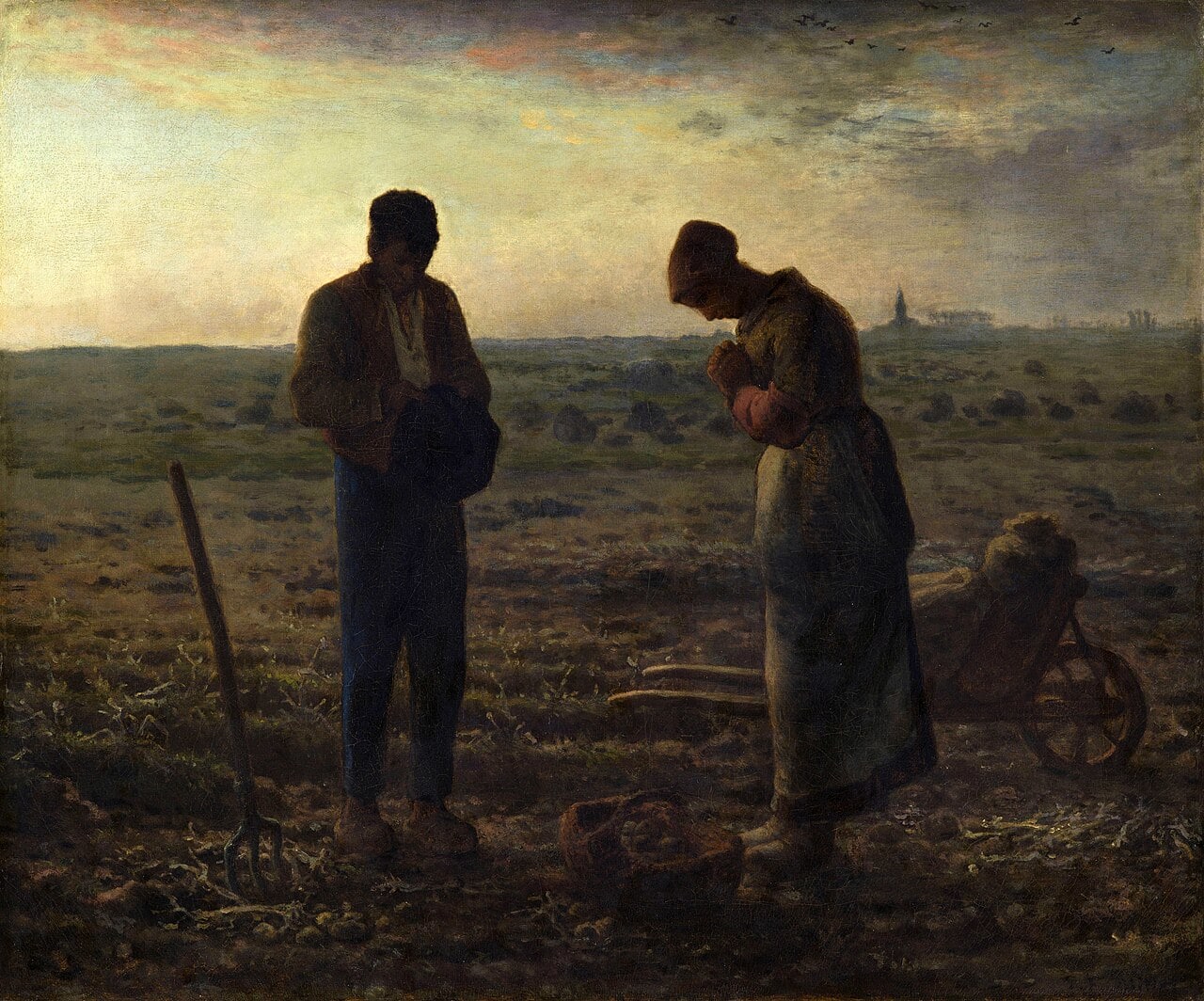
At dusk, in the middle of a flat field, a man and a woman stand still with their heads bowed in The Angelus, painted by Jean-François Millet between 1857 and 1859 in the village of Barbizon. A church bell rings somewhere in the distance, and both have stopped work to say the prayer that gives the picture its name.