
For centuries, painters proved their skill on the naked male body. The twelve works below span more than four centuries, from a Florence workshop to a Baltic beach, and each had its own reason to show a man unclothed. One cost a Philadelphia teacher his post. One gave a faceless student model a second life in photography. One cleaned every sore from a murdered journalist's skin.
Cool Stories About Art is a newsletter to learn art the fun way.
Join 200,000+ readers and get:
10 new art stories / month
The entire archive of content (1,000+ articles)
Comment, ask questions, and chat with other readers
A male nude is a picture whose real subject is a man's naked body. Two centuries ago, it was also the final exam of a painter's training. In the academies, a male model held one pose for hours while the students drew him, and turning each muscle from light into shadow on a flat surface proved that a student knew his trade. The grand subjects of painting, saints, martyrs and the heroes of myth, all depended on that skill.
The reason was practical. Clothes hide most of what makes a pose hard to draw. A bare body shows every joint and every shift of weight, which makes it the hardest figure to get right and the surest place to prove a skill.
To make this list, a work had to answer one question clearly: why is this man naked? The answers change with the centuries. The oldest works find the reason in religion and Greek myth, the middle ones in the studies owed to an academy, the most recent on a beach, at a swimming hole or in a bathroom. The naked man also had to be the subject of the work, not a figure in the background. The countdown runs from 1907 back to 1512.
One thread ties many of the twelve together: the study room. Several were sent home from Rome by young prize winners as proof of their progress, and several of their makers learned the body by cutting open the dead.
The excuse. Most come with an alibi, a myth, a Bible story or an anatomy study. A few near the top simply wash or swim.
The price. A nude man could cost a career. One painter lost his teaching job over a loincloth.
12. Edvard Munch, Bathing Men (1907)
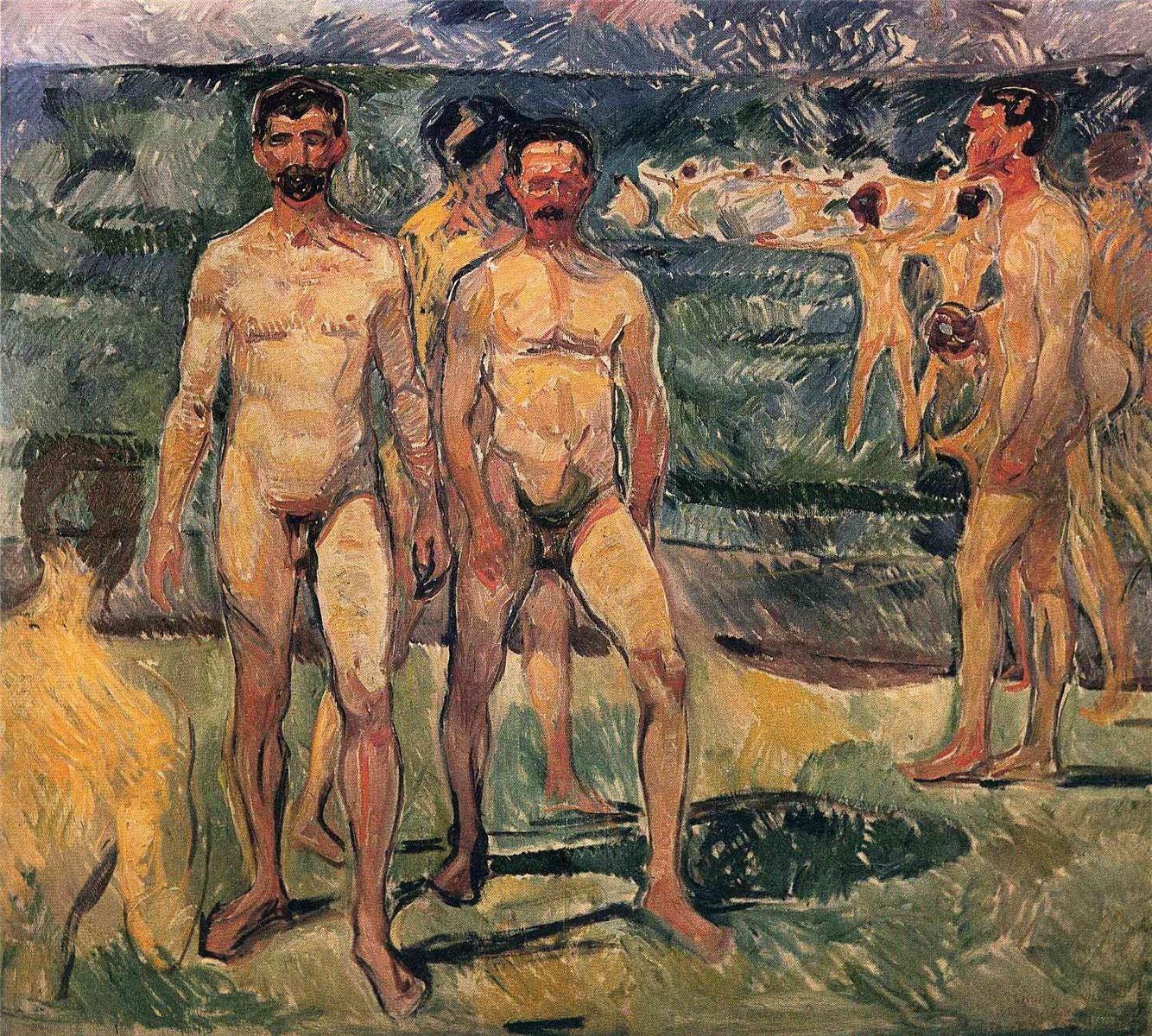
Two naked men walk up a beach toward the viewer, while other bathers wade in the sea behind them. Edvard Munch painted them in the summer of 1907 at Warnemünde, a small resort on Germany's Baltic coast.
The trip explains the mood of the picture. Munch had left Berlin that spring, worn down by drink and quarrels, and came to the coast for the sea air and a quieter life. For a while the plan worked, and Bathing Men records that stretch of health in loose, diagonal strokes, warm skin set against cool greens and blues.
What Munch changed was the scale. A canvas more than two meters wide was the size of history painting, the place for gods and generals. He gave it to men from a seaside town instead, and the one on the left looks straight out of the picture without making any move to cover himself.
The calm did not outlast the following year. In October 1908, exhausted again, Munch checked himself into a clinic in Copenhagen run by Dr Daniel Jacobson. He stayed about eight months, then went back to Norway and settled in Kragerø, on the coast.
At a Glance
Artist: Edvard Munch
Painted: 1907 to 1908, Warnemünde, Germany
Medium: Oil on canvas
Size: 206 × 227 cm (81 × 89 in)
Where to see it: Ateneum Art Museum (Finnish National Gallery), Helsinki
11. Thomas Eakins, The Swimming Hole (1885)
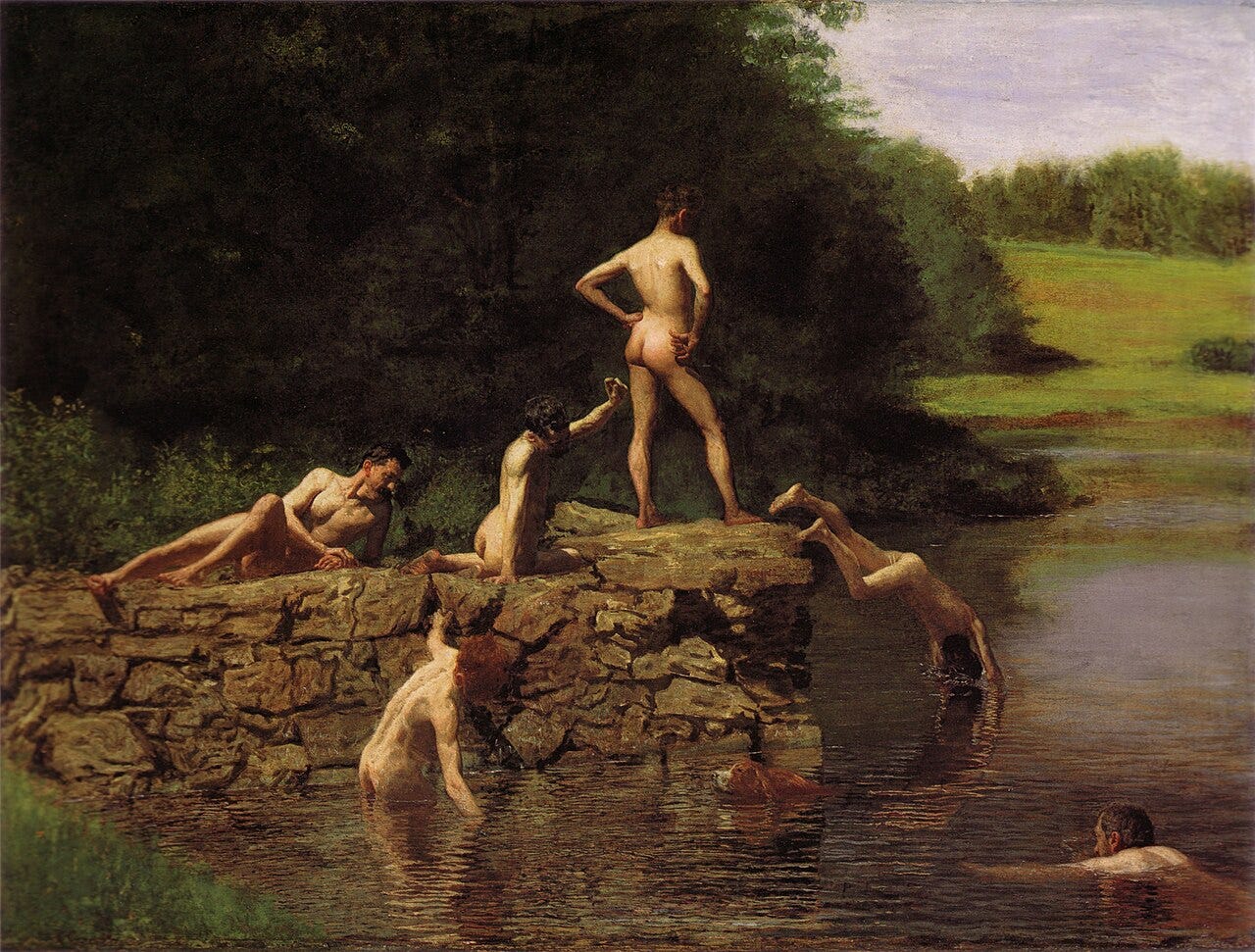
On a stone ledge above a lake, five young men take the sun, one diving in headfirst, another climbing out. A sixth swims toward them at the lower right with his dog Harry. That swimmer is the painter, Thomas Eakins, who made The Swimming Hole in Philadelphia in 1885 from photographs he had taken of his students at Dove Lake, outside the city.