
A shipwreck painting shows a vessel lost at sea, usually with a hull on the rocks or on her side, a broken mast, and people in the water with others trying to reach them. Some show the moment the ship breaks apart, others the long wait afterward.
Many of these pictures go back to a real ship, with a date and a count of the dead. Some painters saw a wreck themselves. Others built theirs in the studio, from reports or memory.
Cool Stories About Art is a newsletter to learn art the fun way.
Join 200,000+ readers and get:
10 new art stories / month
The entire archive of content (1,000+ articles)
Comment, ask questions, and chat with other readers
How These Were Chosen
A work got in on at least one of these grounds: the wreck is real and can be named and dated, survivors or rescuers fill the scene, or the painter worked from studies made on the spot. Storm scenes in which no ship is lost stayed out.
12. Albert Bierstadt, Wreck of the "Ancon" in Loring Bay, Alaska (1889)
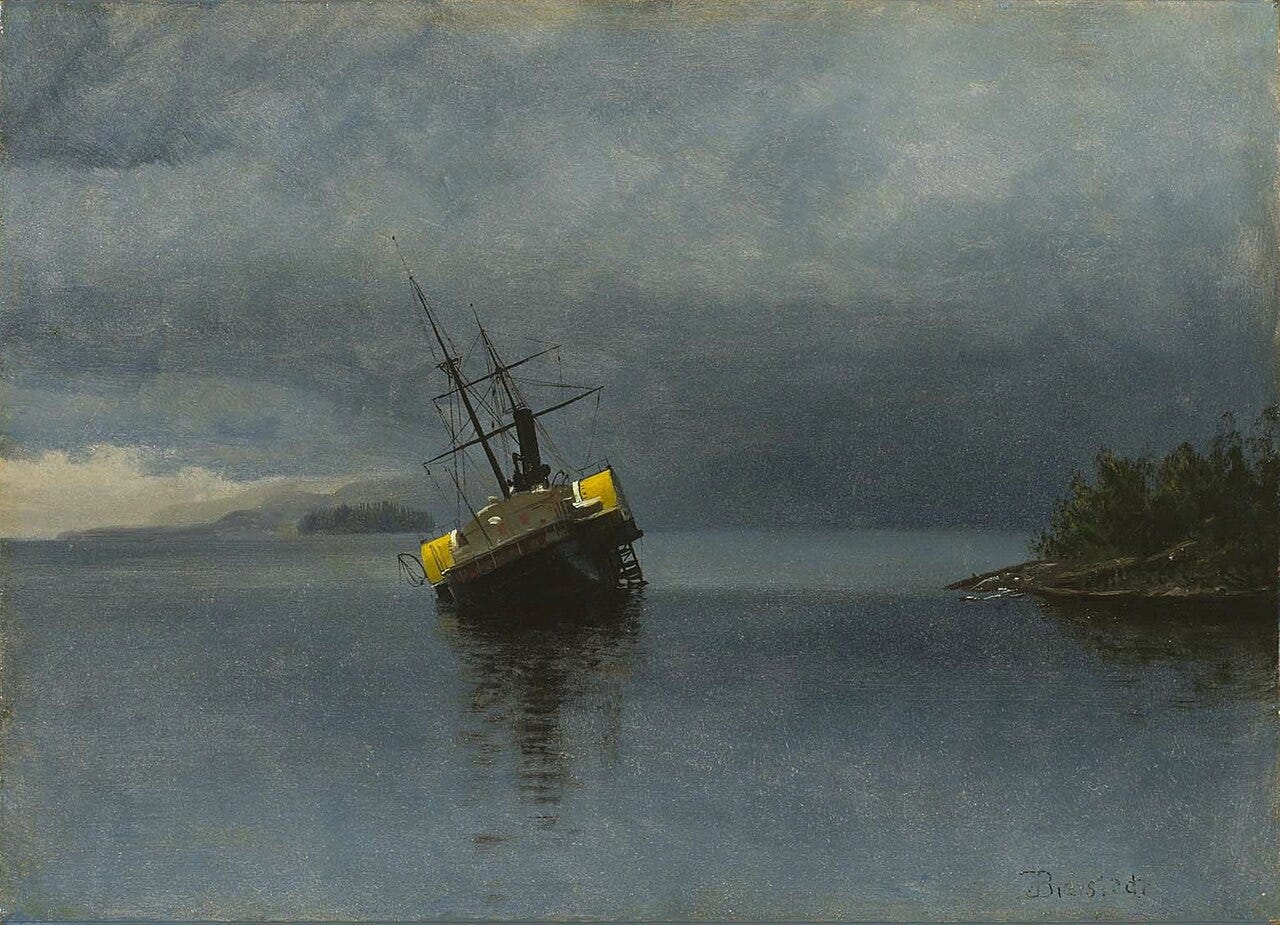
A paddle steamer lists on a reef in a gray, windless bay, her funnel and masts tilted toward the shore. Albert Bierstadt, best known for his giant canvases of the Rockies and Yosemite, made this small oil study of the wreck in 1889. He did not have to imagine the wreck.
He had been a passenger on board.
The Ancon was a wooden sidewheel steamer launched in 1867. At Loring she tied up overnight at the wharf of a salmon saltery to take on cases of fish. She cast off at 3 a.m. on August 28, 1889, and ran onto a reef inside the harbor, a few hundred feet from shore.
Passenger accounts blame the mooring lines. The tide was ebbing. The stern line was let go too early, and the current pushed the ship sideways up the bay.
As the water fell, she settled on the rocks and broke in two. Cabin doors jammed under the strain, and some passengers climbed out through their windows.
Nobody died. Small boats ferried everyone ashore. The Alaska Packing Company, which owned the cannery, lodged them in its buildings, in private homes and in the houses of the Tlingit, the Native people of that coast.
Bierstadt wrote to his wife that he had had "a narrow escape." The Smithsonian American Art Museum says he had come north looking for "wild places in the mountains." Stranded at Loring, he filled two books with drawings and made about sixty color studies.
The water is so still that the tilted hull and funnel repeat upside down beneath the ship.
Nothing on that surface hints at a storm, and the record agrees: the Ancon was lost to a handling mistake in a sheltered harbor.
Two thirds of her cargo was saved, including 13,835 cases of canned salmon and gold bullion from the Juneau mines. The ship was never repaired. Her hulk was burned so that it would not become a danger to other vessels.
At a Glance
Artist: Albert Bierstadt (1830 to 1902), German-born American
Painted: 1889
Medium: Oil on paper mounted on Masonite
Size: 35.9 × 50.2 cm (14.1 × 19.75 in)
Where to see it: Museum of Fine Arts, Boston
About This Painting
Did Albert Bierstadt paint anything else on his 1889 Alaska trip?
Yes. Bierstadt's Alaskan Coast Range, in the Smithsonian American Art Museum in Washington, is an oil sketch that the museum thinks was probably made on the spot during the same journey.
How did the Ancon's passengers leave Loring?
The steamer George W. Elder reached Loring on her regular Alaska run on September 1, 1889. So late in the season she carried few passengers, which left room for everyone from the Ancon, crew included.
Who owned the Ancon when she was wrecked?
The Ancon belonged to the Pacific Coast Steamship Company, whose predecessor had taken her over in 1875. Her captain on the last voyage was David Wallace.
11. J. M. W. Turner, A Disaster at Sea (about 1835)
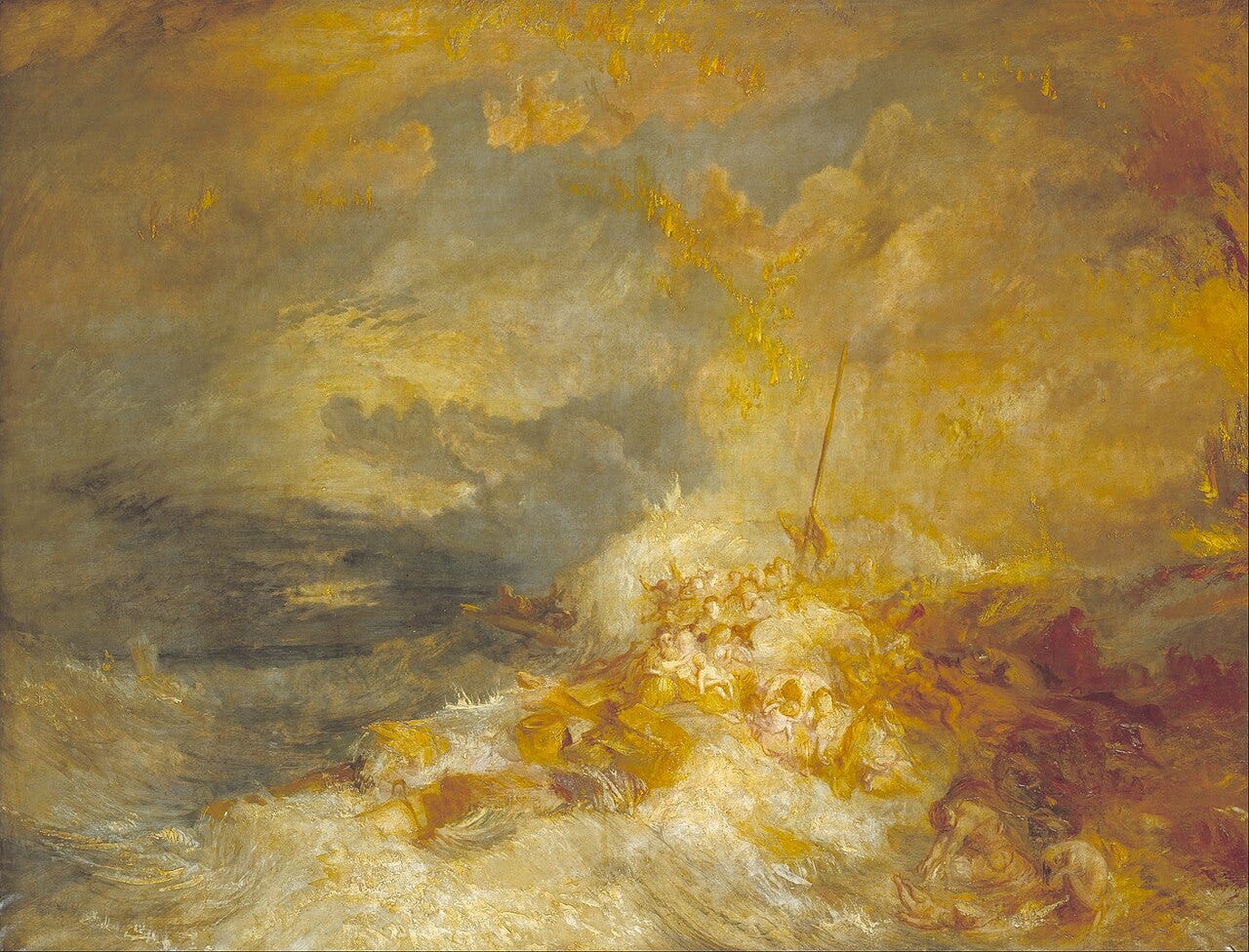
A broken mast still stands in a white, churning sea, and around it a crowd of women and children clings to the wreckage. J. M. W. Turner painted A Disaster at Sea around 1835, on a canvas more than two meters wide that Tate in London now owns.
He never exhibited it, and Tate considers it probably unfinished. Many of the bodies in the center are just thin strokes of pink and red. Tate's catalogue names the event behind them: the wreck of a British convict ship off Boulogne, on the French coast, in 1833.