
Few sculptures here still stand where their makers left them. Outside the Panthéon, a plaster painted to look like bronze was set up to judge a statue's effect, and someone vandalized it. A marble giant crossed Florence on rails, moving only in the cool of early morning, and a stone arm turned up in a Roman stonecutter's workshop almost four centuries after the rest of its group was found.
Cool Stories About Art is a newsletter to learn art the fun way.
Join 200,000+ readers and get:
10 new art stories / month
The entire archive of content (1,000+ articles)
Comment, ask questions, and chat with other readers
How These Were Chosen
A statue is made for a place: a square, a doorway, a fountain, a sanctuary, a palace courtyard. Its maker decides how high the figure will stand, which side people will come from and how close they can get, and those choices belong to the work as much as the face or the pose.
Places, however, do not stay the same. Rain and pollution eat into bronze and marble, floods and wars damage them, and new owners want them somewhere else. Over the centuries many statues were taken indoors, cast again, replaced outdoors by a copy, or put back together from pieces found years apart.
The twelve here, four in each of Rome, Florence and Paris, were chosen because where each one stands today, and how it came to be there, is part of the story the statue tells. Some never left their spot, and some were carried across a sea to a museum.
One case comes back in more than one city. Where a famous figure once stood in the open air, there is often a copy today, and the original survives indoors, sometimes only a short walk away.
12. Paris: Auguste Rodin, The Burghers of Calais (1884 to 1895)
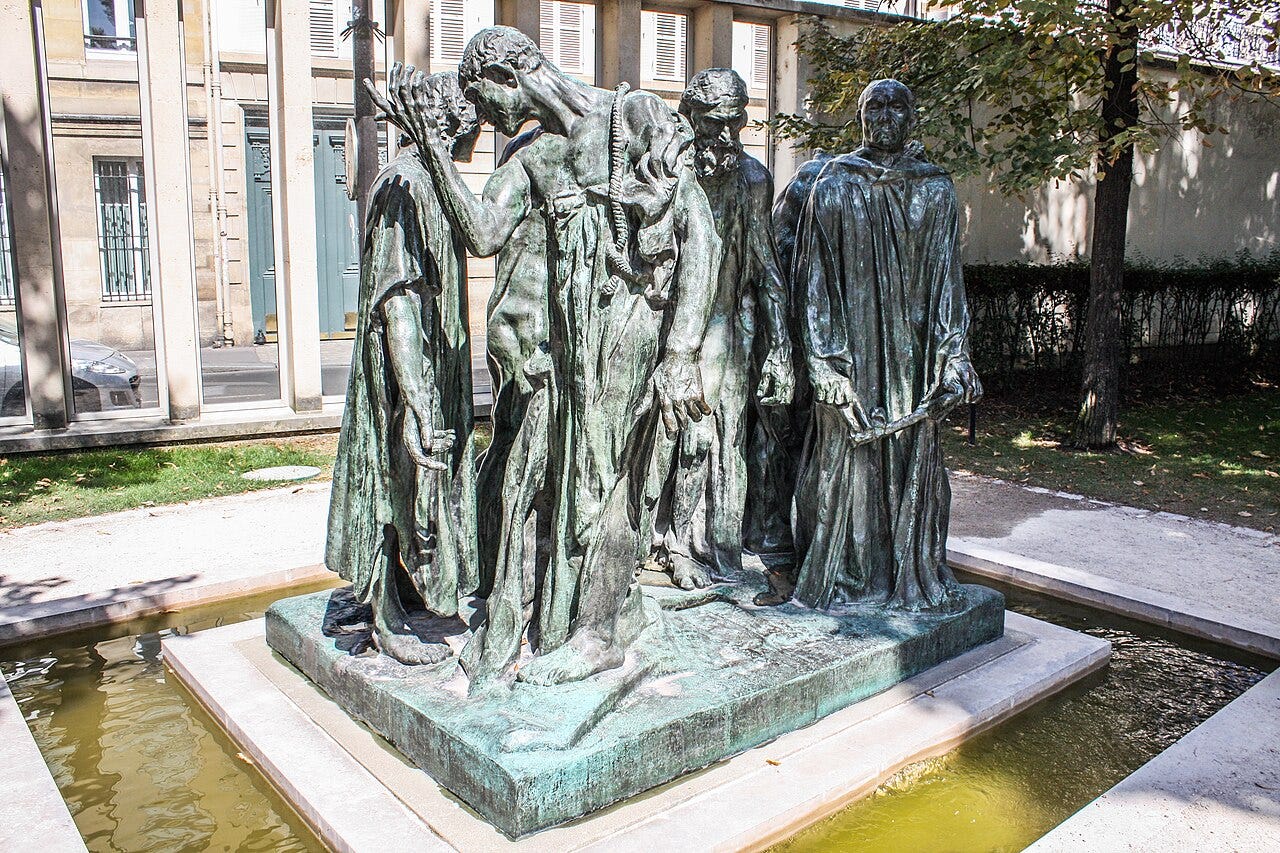
Six bronze men walk barefoot, ropes around their necks, on a very low base. Auguste Rodin made The Burghers of Calais for the town of Calais, in northern France, and this cast is in the garden of the Musée Rodin in Paris. How high that base should stand was the quarrel behind this monument.
The ropes come from a siege. In 1347, after about a year, Calais surrendered to the English king Edward III, and the chronicler Jean Froissart wrote that the king demanded six leading citizens, barefoot, ropes around their necks, the keys of the town in their hands. The queen of England begged for their lives, and they were spared.
Calais remembered the six more than five centuries later. In September 1884 its mayor, Omer Dewavrin, proposed a monument to them paid for by a national subscription, and Rodin, who received the commission, set the six men together as equals, with no leader raised above the others.
Once the six stood as equals, the height of the base became the next question, and it divided Rodin and the town for years. In 1893 he proposed placing the group almost at ground level, right on the paving stones of the square, like a living rosary of suffering and sacrifice.
Calais did not follow him. On June 3, 1895, the town unveiled the bronze on a compromise pedestal, well above the paving stones he had asked for.
That pedestal did not have the last word. The monument moved in 1924 and again later, and today it stands in front of the town hall of Calais on a much lower base, closer to what Rodin had asked for.
The Paris group, cast from his model in 1926, nine years after his death, stands in the garden only a little above the ground, a long way down from the pedestal Calais first gave it.
At a Glance
Artist: Auguste Rodin (1840 to 1917)
Made: Commissioned 1884, finished 1889, unveiled in Calais 1895. The Musée Rodin bronze was sand cast in 1926.
Medium: Bronze
Where to see it: Musée Rodin, 77 rue de Varenne, Paris, in the sculpture garden along the rue de Varenne. The garden group is a bronze cast made from Rodin's model in 1926, after his death. The first cast is in Calais.
11. Paris: Auguste Rodin, The Thinker (1880 to 1904)
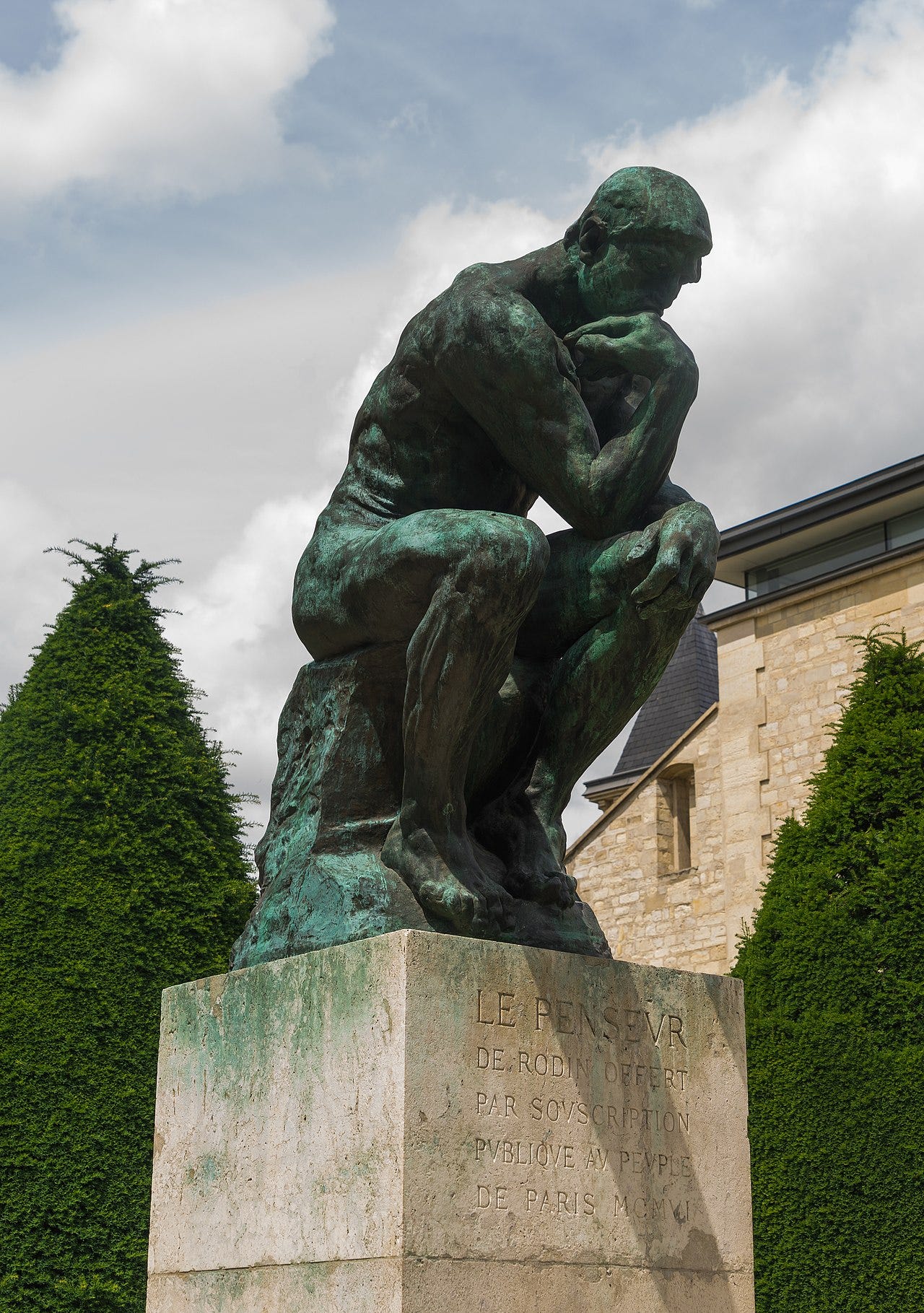
Chin on the back of his right hand, a naked man sits on a rock and leans forward. Auguste Rodin first modeled The Thinker in 1880 as a small figure to crown The Gates of Hell, a monumental door, and he called it The Poet: Dante himself, looking down on the circles of Hell.