
A painter arrested as a spy takes his revenge with a side of beef. Elsewhere, a bride may neither eat nor speak at her own wedding feast, a hunting lunch for a king gives champagne what a museum calls its first appearance in a painting, and a Venetian painter has to explain to the Inquisition why one of his guests is picking his teeth with a fork.
Cool Stories About Art is a newsletter to learn art the fun way.
Join 200,000+ readers and get:
10 new art stories / month
The entire archive of content (1,000+ articles)
Comment, ask questions, and chat with other readers
How These Were Chosen
A meal suits a painter for practical reasons. A table lines people up side by side, so a whole group fits into one picture, and the order of that group becomes visible: who sits at the head, who stands, who carries the dishes in. The food brings everything a still life offers, from the shine of oysters and silver to the weight of a loaf of bread. And a meal tells a story on its own, since it begins, reaches its high point and ends, which leaves the painter free to choose the moment.
The paintings below were chosen for what happens at the table. In each of them, the food or the service can be seen and plays a part, whether it is a dish being carried in, a cork flying through the air or a plate still empty. Each meal also comes with a story that can be traced, in the artist's letters, in a trial record, in a critic's review, or under the paint itself, where conservators have found what was changed. Pictures in which a table is only part of the furniture were left out.
Read in order, the twelve share a smaller thread. At many of these tables, someone does not eat: a cook carrying the dish, servants watching, a bride kept from her own feast, a groom who stays away.
12. Norman Rockwell, Freedom from Want (1943)
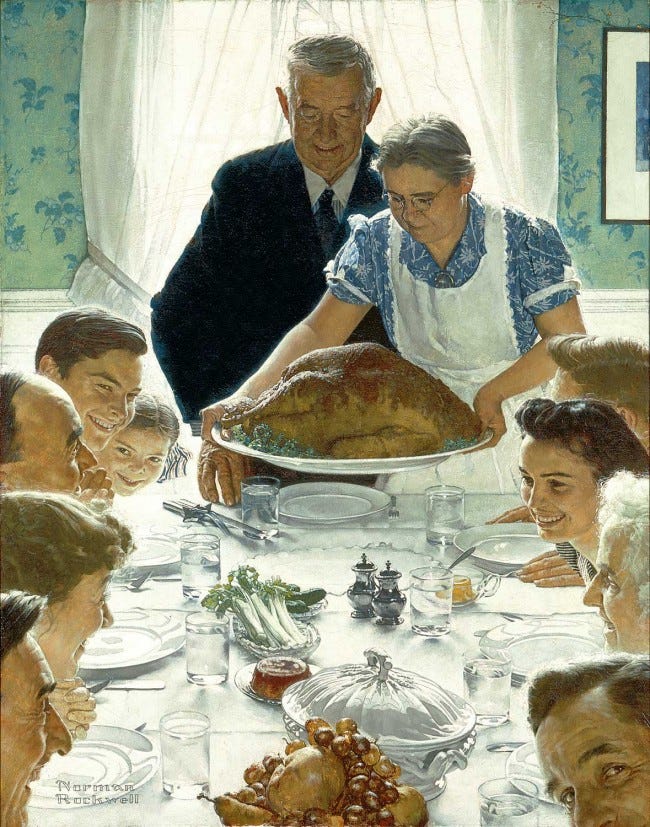
The plates are still empty in Norman Rockwell's Freedom from Want. A woman in an apron sets a roast turkey down at the head of a family table, and nobody has picked up a fork yet. The whole picture hangs on that instant, just before the meal begins.
The scene belongs to wartime. In his State of the Union address of 1941, President Franklin Roosevelt had named four freedoms: freedom of speech, freedom of worship, freedom from want and freedom from fear. Rockwell painted one picture for each, and The Saturday Evening Post ran this one on March 6, 1943. The Post had given him eight weeks for the series. The four pictures took him seven months.
Part of that time went into a family that never sat down together. Rockwell lived in Arlington, Vermont, and he asked neighbors and members of his own family to pose in his studio, one at a time. The woman holding the platter was Mrs. Thaddeus Wheaton, the cook of the Rockwell household.
Since the guests were painted one by one, the table had to hold them together, and Rockwell made the job hard: white plates on a white tablecloth, with clear glasses of water beside them. The gleam of the china and the transparency of the water fill the center of the picture, between the turkey and the faces, so that the eye rests first on what has not yet been served. I think that is why the picture still reads as a promise: the meal has not started.
At a Glance
Artist: Norman Rockwell (1894 to 1978), American
Painted: 1943
Medium: Oil on canvas
Size: 116.2 × 90.2 cm (45.75 × 35.5 in)
Where to see it: Norman Rockwell Museum, Stockbridge, Massachusetts
About This Painting
What did Roosevelt mean by freedom from want?
In his speech of 1941, Roosevelt described it as economic understandings that would secure to every nation a healthy peacetime life for its inhabitants everywhere in the world.
Who was Carlos Bulosan?
A Filipino immigrant, poet, novelist and labor organizer. He wrote the essay that ran beside Rockwell's painting in The Saturday Evening Post on March 6, 1943.
11. Jean-François de Troy, The Oyster Lunch (1735)
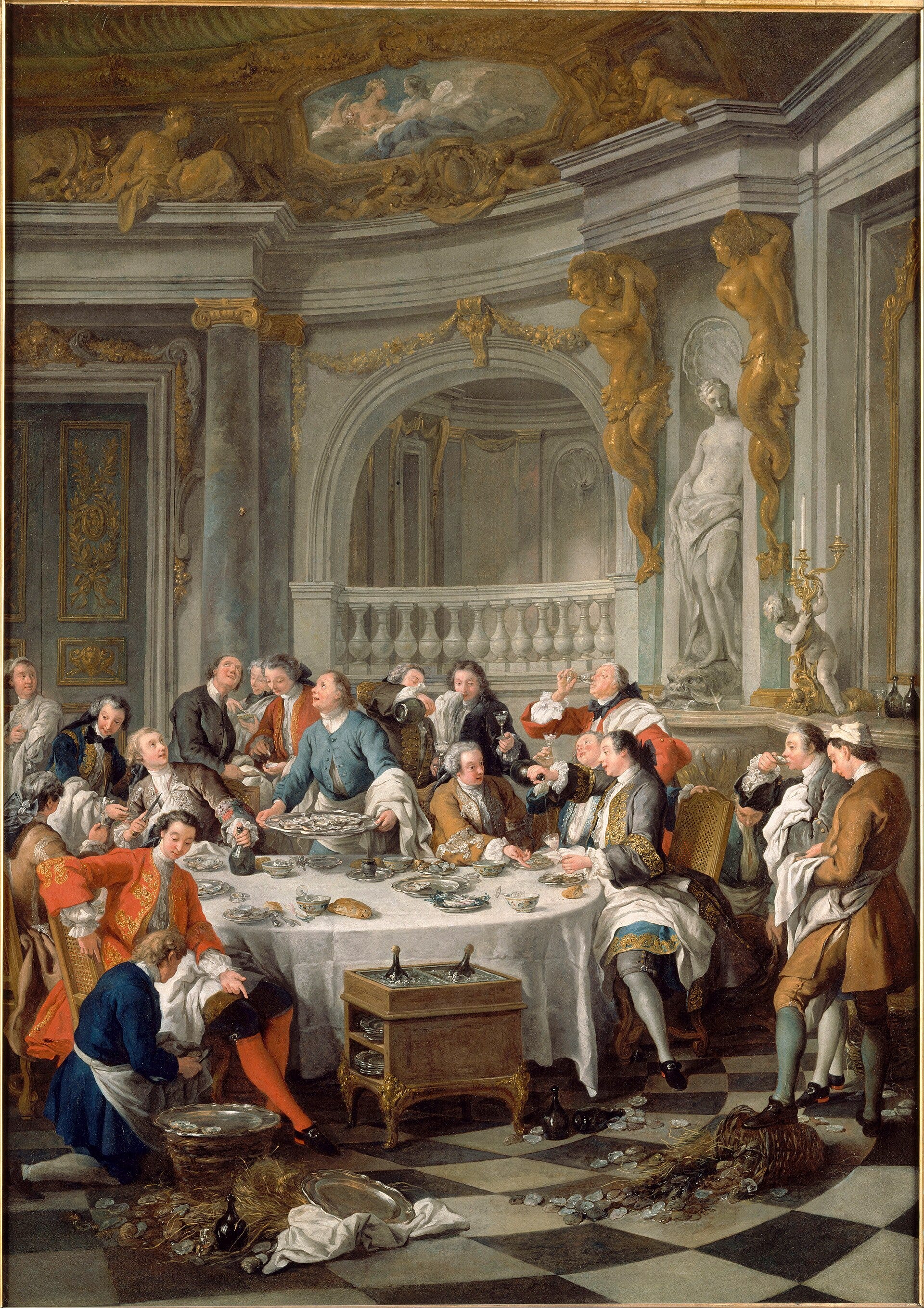
A champagne cork shoots into the air above a round table of gentlemen eating oysters in Jean-François de Troy's The Oyster Lunch.