
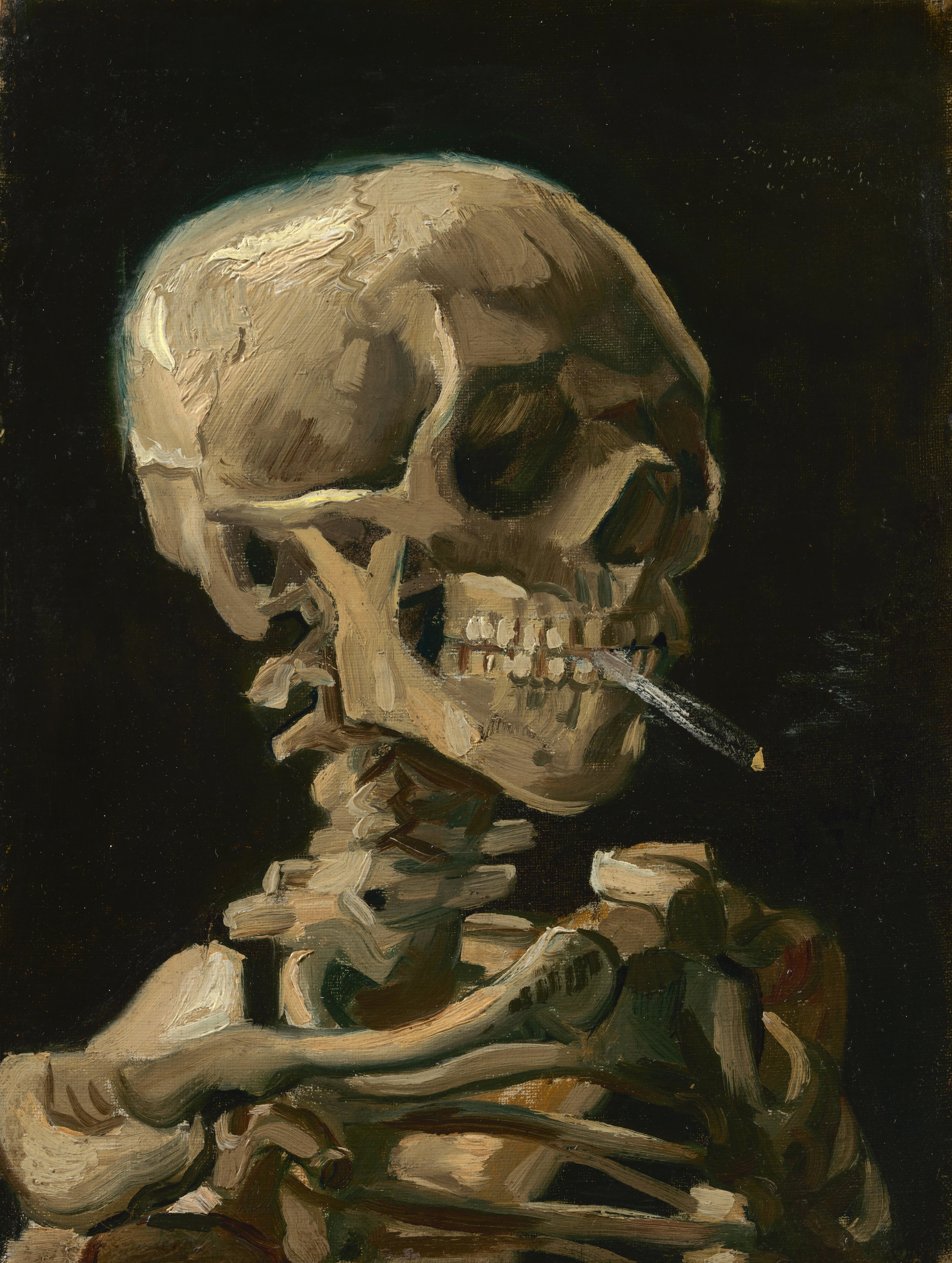
One of these skulls was painted as a student joke, with a cigarette between its teeth. Another is paved with diamonds and was announced as sold for £50 million, in a sale that never took place. One old painter left the skull out altogether and stood himself between a clock and a bed. For five centuries, artists have kept finding new ways to repeat one warning.
Cool Stories About Art is a newsletter to learn art the fun way.
Join 200,000+ readers and get:
10 new art stories / month
The entire archive of content (1,000+ articles)
Comment, ask questions, and chat with other readers
How These Were Chosen
A memento mori is a picture, or an object, made to remind its viewer of death. The Latin phrase means "remember that you will die." Painters most often gave that message to a human skull, and sometimes set an hourglass, a candle or a clock beside it.
The skull keeps coming back for two reasons. The first is meaning: it lets a painter say something serious with ordinary things laid on a table or held in a hand. The second is craft. A skull is a hard, rounded form, full of hollows and edges, and painting it well demands real control of light and volume.
The twelve works below span nearly five centuries, and each one earns its place by doing something different with the same warning. In some it sits beside a prayer, in others among expensive possessions, and in others still it turns up in a self-portrait, a studio exercise or a joke. A picture that only repeated what an earlier one had already said stayed out, however famous.
The ranking climbs toward the best-known pictures, but read in order of date they also show who carries the warning. For a long time it belongs to saints, scholars and still lifes. From the nineteenth century on, painters increasingly turn it on themselves and on their own studios, and by the end it has become an object with a price.
12. Damien Hirst, For the Love of God (2007)
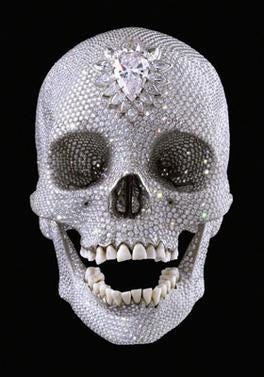
Between the platinum jaws of For the Love of God sits a row of real human teeth. They are the only part of the skull that is neither metal nor stone, since everything else glitters under 8,601 diamonds. Damien Hirst unveiled the piece in London in 2007, and it is the only sculpture on this list.
It began with a real skull, which Hirst obtained from a London taxidermist. Radiocarbon dating places it between 1720 and 1810, and it probably belonged to a European man of about thirty-five.
The London jewelers Bentley & Skinner cast that skull in platinum and covered the cast with diamonds weighing 1,106 carats in all. The largest, a pear-shaped pink stone of 52.4 carats, sits in the middle of the forehead. The dead man's own teeth were then set back into the jaws.
In the older pictures on this list the skull is plain bone, set beside riches to make them look vain. Hirst reversed the idea and made death itself look like wealth, so the price soon mattered as much as the object. In August 2007, White Cube, the London gallery that showed the skull, announced that it had sold for £50 million to an anonymous group of investors, with Hirst keeping a share.
That sale was never what it seemed. In January 2022, Hirst said he still owned the skull, together with White Cube and investors he did not name, and that it was sitting in storage in London. The record sale announced fifteen years earlier had never actually taken place.
At a Glance
Artist: Damien Hirst (born 1965)
Made: 2007, London
Medium: Platinum, diamonds and human teeth, cast from a human skull of the eighteenth century
Size: Life size, cast from an adult human skull
Where to see it: Owned by the artist, White Cube and private investors, and kept in storage in London. It was last shown to the public at Tate Modern in 2012.
11. Andy Warhol, Skulls (1976)
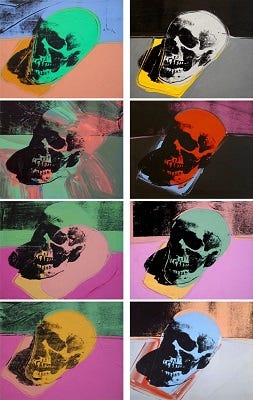
Six small canvases repeat the same skull in black, each one on a different flat color, each with a long shadow stretching out behind it. Andy Warhol made this group in 1976, and the skull itself was real: he had bought it at a flea market in Paris.