
A painter in Lorraine who attacked the tax officials sent to his door. A duke who opened a painting each time he wanted to look at his coins. A scale said for three centuries to be weighing gold, until a close look found both of its pans empty. These twelve pictures follow money from a Florentine chapel wall to a New York studio.
Cool Stories About Art is a newsletter to learn art the fun way.
Join 200,000+ readers and get:
10 new art stories / month
The entire archive of content (1,000+ articles)
Comment, ask questions, and chat with other readers
Money is hard to paint. A coin is small and flat, it shines like every other gilded thing in a room, and the one thing that matters about it, its value, cannot be seen at all. So painters put it in someone's hand: a merchant counting, a woman testing a coin on a scale, an official holding out his palm. The coin stays tiny, and the picture becomes about what people do with it. A gesture over a table is enough to show greed, duty, fear or honesty without a word of text, which is why the subject has lasted.
So the choice here was strict. A painting made it only if the money is visible on the canvas, as coins, gold, a banknote or a contract, and if the scene turns on it. Pictures that show wealth through fine clothes or rich rooms were left out, because they show what money buys rather than the money itself. A purse lying in a corner was not enough either.
Two subjects come back again and again across these pictures. One is the small balance that checked whether a coin still held its full weight of metal, which appears in three of them. The other is tax: five of the pictures involve a payment owed to a ruler, a town or a temple, or the men who collect it.
12. Woman Holding a Balance, Johannes Vermeer (about 1664)
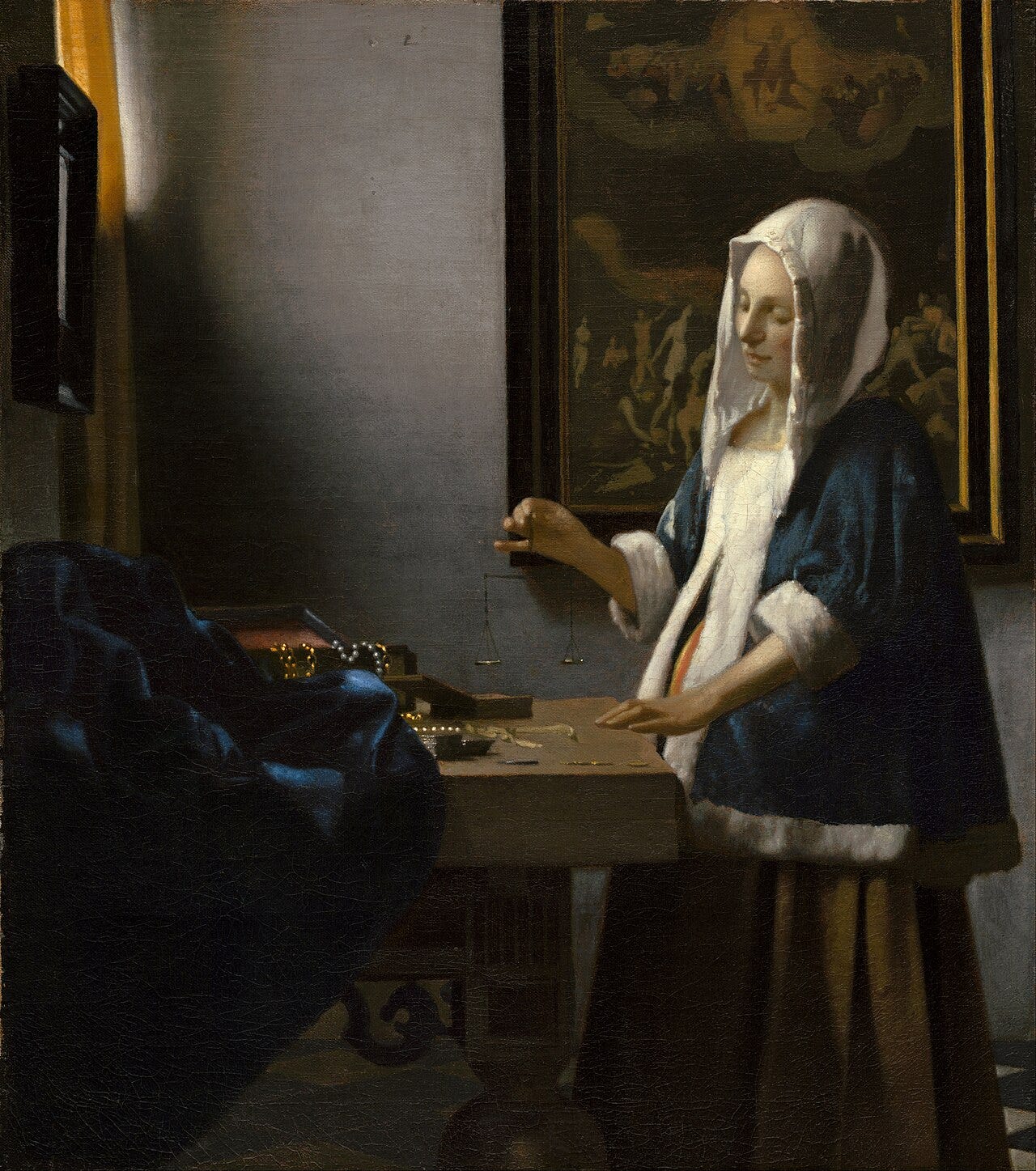
Between her thumb and forefinger, a young woman holds a small balance above a table scattered with strings of pearls and a few gold coins. Johannes Vermeer painted her in Delft around 1664, and for more than three centuries people misread what she was doing.
The first record of the picture is an Amsterdam auction catalogue of 1696, which lists it as "a young lady weighing gold." The title Woman Weighing Gold stuck. Only a magnified examination of the paint brought the mistake to light: both pans of her balance are empty.
With the pans empty, the question becomes what she is weighing. The answer hangs on the wall behind her, a large painting of the Last Judgment, with Christ at the top raising his arms over the dead who rise to be judged. Christian art often showed that final judgment as a weighing, with the archangel Michael holding scales to measure each soul. Vermeer placed her small household scale just below its frame.
Arthur Wheelock, for decades a curator at the National Gallery of Art in Washington, takes those empty pans as the real subject. In his reading, the picture is about balance itself, the virtue of moderation that Vermeer's century called temperance.
The way Vermeer built the room supports him. X-rays of the canvas show a tiny pinhole just to the left of her fingers. Vermeer fixed a pin there and ran strings from it to lay out the perspective, so that every line of the room leads to the empty scale.
He was not the only Dutch painter of those years to set a woman and a balance at a table. The other picture, number 10, has been measured against this one ever since.
At a Glance
Artist: Johannes Vermeer (1632 to 1675)
Date: About 1664
Medium: Oil on canvas
Size: 39.7 × 35.5 cm (15.6 × 14 in)
Where to see it: National Gallery of Art, Washington, D.C.
About This Painting
What does the mirror in Vermeer's Woman Holding a Balance symbolize?
A mirror hangs on the wall near the window. In the art of the period, mirrors often stood for vanity or for self-knowledge, and the National Gallery of Art leaves open which of the two Vermeer had in mind.
11. Dollar Sign, Andy Warhol (1981)
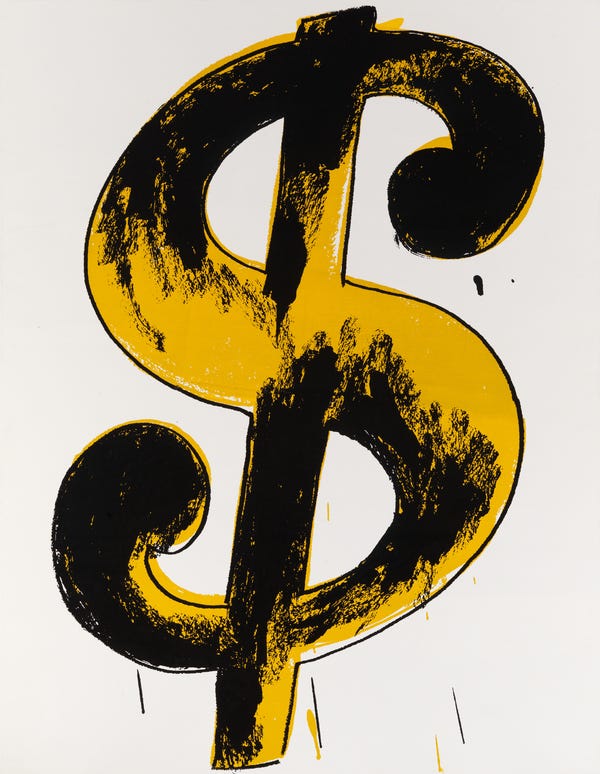
Nothing but a dollar sign fills this tall white canvas. Its strokes were drawn first by hand, in marker and ink, and then printed onto the canvas. Andy Warhol made it in New York in 1981.