
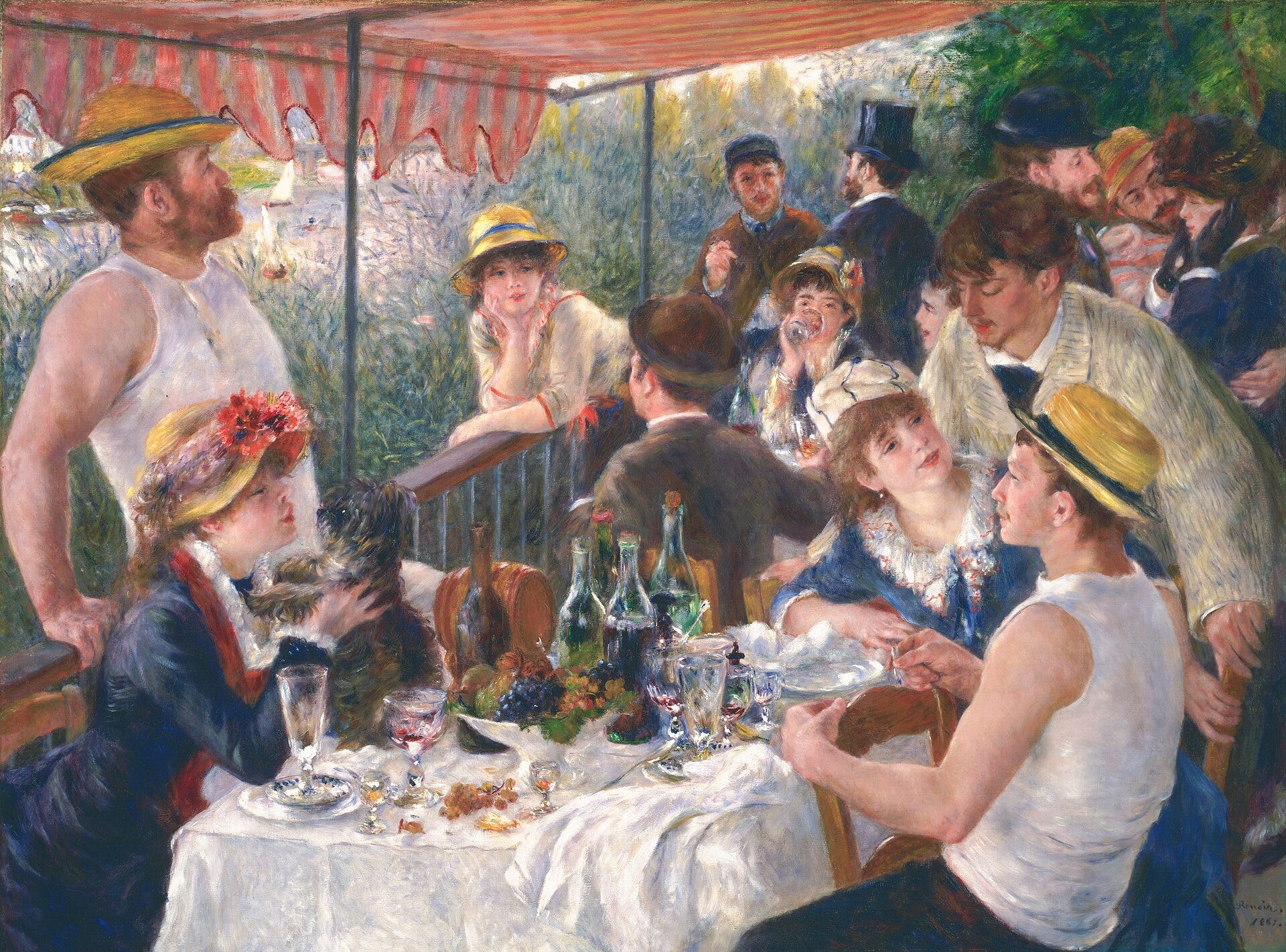
Pierre-Auguste Renoir (1841 to 1919) was a French painter and one of the founders of Impressionism, remembered for sunlit scenes of dances, boating parties and bathers. Born poor in Limoges, he began by painting decorations on porcelain, painted Luncheon of the Boating Party in 1880 and 1881, and worked on through crippling arthritis at Cagnes-sur-Mer until he died there on 3 December 1919.
He kept working long after his hands had stopped obeying him. Rheumatoid arthritis bent his fingers and put him in a wheelchair, and still he painted. Shortly before he died he was carried on a chair into the Louvre to see one of his portraits hung there.
Cool Stories About Art is a newsletter to learn art the fun way.
Join 200,000+ readers and get:
10 new art stories / month
The entire archive of content (1,000+ articles)
Comment, ask questions, and chat with other readers
The legend says his brushes were tied to his hands. A film made at his house in Cagnes-sur-Mer in 1915 shows something more awkward: he clamps the brush between his thumb and the fist of his right hand, with a piece of fabric across the palm to protect the skin. Accounts still differ on whether anything was ever tied.
By 1911 he was largely confined to a wheelchair, and around 1911 and 1912 his arms grew so weak that for a time he could not paint at all. He fell into a depression. In 1915 he had a studio built in the garden so that he could work outdoors again.
The hand that held that brush had started at the bottom of the trade, painting decorations on plates and cups. How a porcelain painter ended up among the old masters of the Louvre is a story of a riverside bathing spot where he and Monet found a new way to paint, a restaurant balcony full of his friends and a trip to Italy that shook his confidence in everything he had done.
What You'll Discover
Where a tailor's son learned to paint.
What he and Monet tried on a river.
Who owned the Moulin de la Galette.
Who sits at the table.
What Raphael did to his style.
Who held the clay for him.