
Some paintings are known less from the canvas than from their copies. One was put to work for a soap maker. Another was drafted into an American fight over national health insurance, and a third was waved under the noses of a film crew. None of them had been painted for that.
Cool Stories About Art is a newsletter to learn art the fun way.
Join 200,000+ readers and get:
10 new art stories / month
The entire archive of content (1,000+ articles)
Comment, ask questions, and chat with other readers
How These Were Chosen
A reproduction here means any copy of a painting made to travel beyond the canvas: an engraving sold by a print shop, a color supplement in a newspaper, a postcard, a calendar, a stamp, an advertisement.
For centuries, such copies were slow to make, because copying a canvas meant cutting it by hand into wood or metal. Photography and color printing made them cheap. From the late nineteenth century, a single picture could reach millions of walls.
Once copies were cheap, printers and advertisers looked for particular images: ones that read at a glance, survived being shrunk to the size of a stamp, and showed something people were glad to have at home or on a product.
Those uses shaped the selection. A painting qualified here on one of two grounds, both of them on record. Either its image was put to work outside art, in advertising, on posters, on products or in prints sold in large numbers, or another artist, writer or filmmaker built a well-known work on it. A painting known mainly from art books did not qualify.
No one keeps an official count of reproductions, so the order is my own judgment. One pattern runs through the twelve. For several of them, the copies came first and the fame followed, and their image hung in classrooms, kitchens and shop windows long before most people saw the canvas.
12. Cassius Marcellus Coolidge, A Friend in Need (1903)
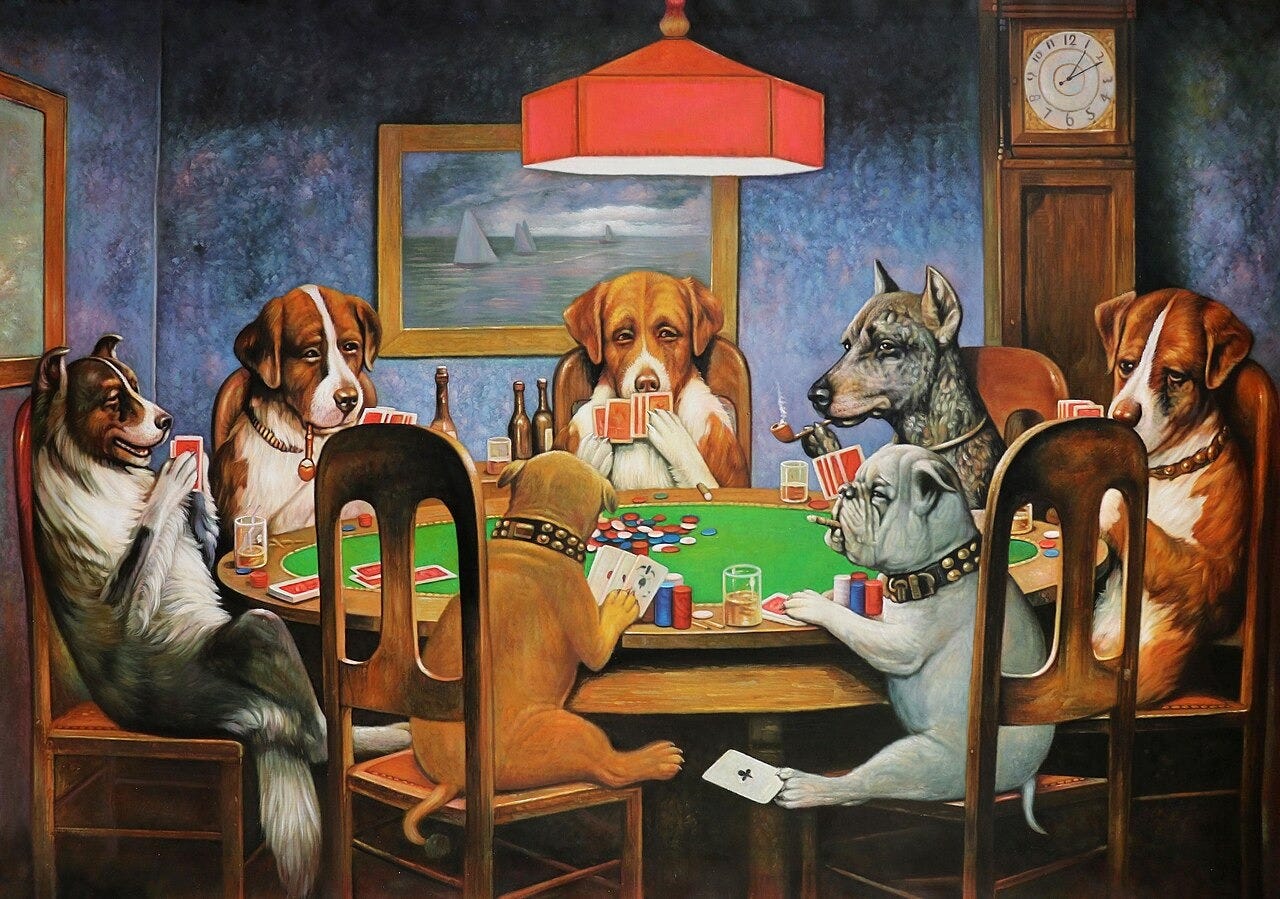
Under the edge of the poker table in A Friend in Need, a bulldog slips an ace to the dog beside him while the other players look elsewhere. The picture dates from 1903, and its painter, Cassius Marcellus Coolidge, never meant it for a gallery.
Coolidge worked at the cheap end of the picture business, and his dogs were a commission from Brown & Bigelow, a firm in St. Paul, Minnesota.
Brown & Bigelow sold what it called remembrance advertising: calendars and small objects printed with a client's name and meant to stay in the customer's home. For that trade the firm got sixteen dog scenes from Coolidge, and several of them put the dogs around a card table, drinking and smoking like men at a club.
The cheat in A Friend in Need was built for that use. The ace passes below the table, out of sight of every dog, and the only witness is whoever has the calendar on the wall.
Because they were made for calendars, Coolidge's originals were treated as worth little for about a century. That changed in February 2005, when Doyle New York sold two other scenes from the series as a pair for $590,400, more than ten times the high estimate. Afterward, the auction house said it was flooded with people asking what their own prints were worth.
At a Glance
Artist: Cassius Marcellus Coolidge (American, 1844 to 1934)
Painted: 1903
Medium: Oil on canvas
Size: Not publicly documented
Where to see it: Location of the original not publicly documented
About This Painting
What is the most famous image of Dogs Playing Poker?
A Friend in Need is the scene most often cited and reproduced on its own. An essay in Emerging Infectious Diseases, the CDC's journal, notes that it is usually treated as a standalone work although it is the fourth in Coolidge's series, and that copies of it turn up in bars, television shows, movies and music videos.
11. John Everett Millais, Bubbles (1886)
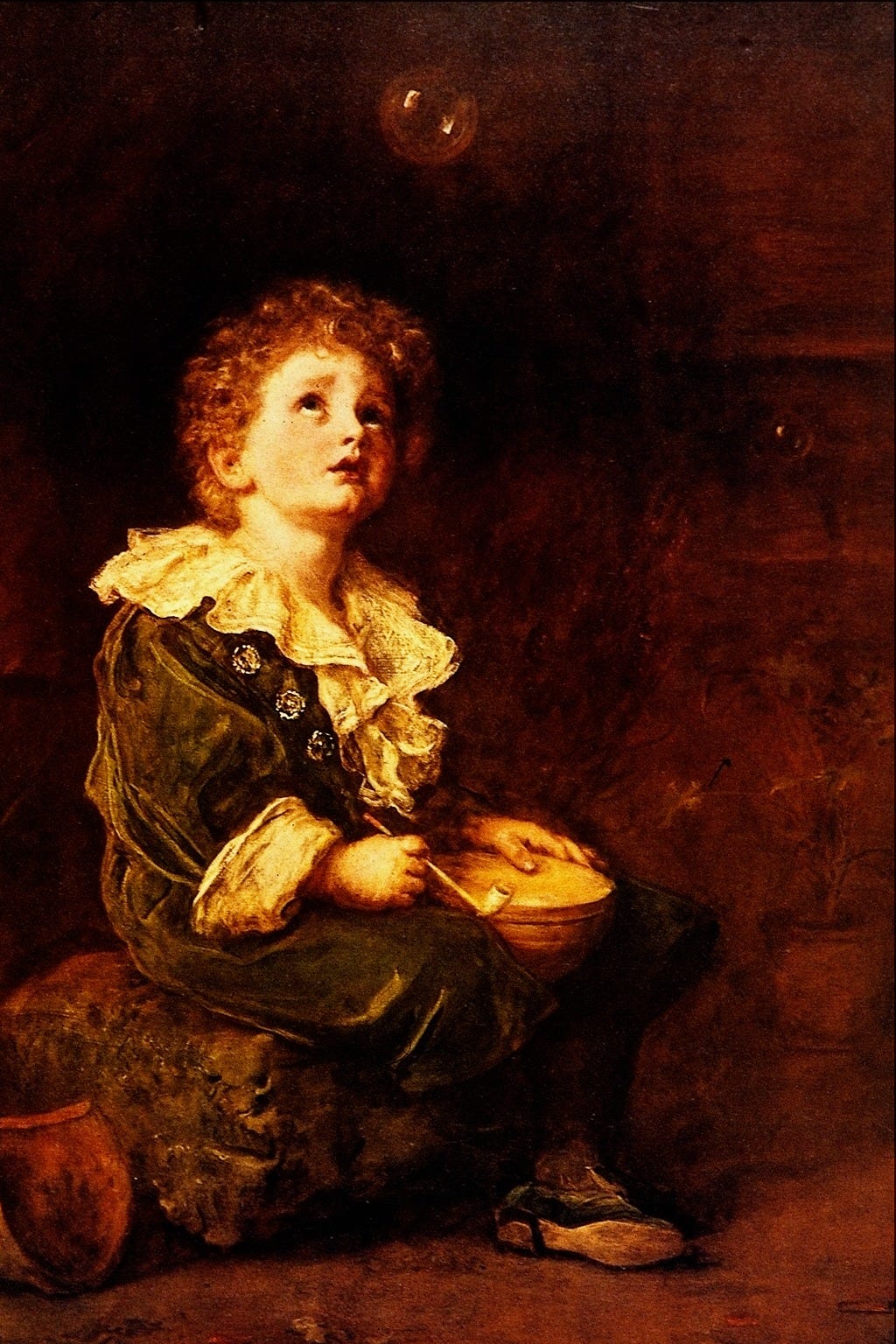
In Bubbles, a wide-eyed small boy looks up at a soap bubble he has just blown, a pipe in his hand and a bowl of suds in his lap. The boy was the grandson of John Everett Millais, who painted him in 1886 for his own pleasure and learned that the picture would sell soap only when a soap manager walked into his studio holding the proofs.