
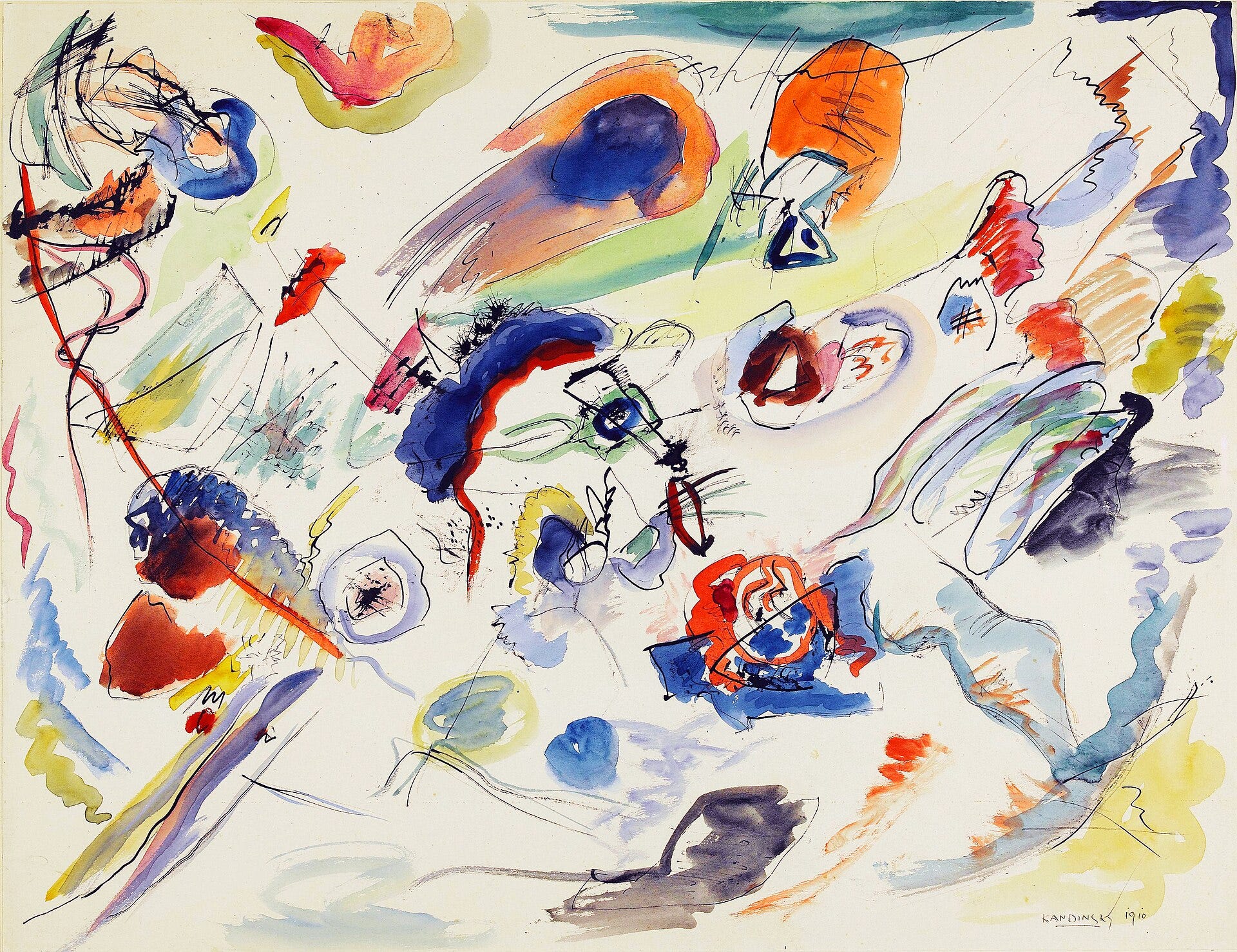
Wassily Kandinsky was a Russian painter, born in Moscow in 1866 and dead near Paris in 1944, who is credited with painting some of the first purely abstract pictures. He trained as a lawyer, left a university career at thirty to study art in Munich, and wrote the book that explained abstraction. The picture people look for is the small watercolor that started it all, signed 1910, and its date is now in doubt.
He signed that sheet 1910 and wrote aquarelle abstraite on the back, and for decades museums presented it as the first abstract work in the history of painting.
Cool Stories About Art is a newsletter to learn art the fun way.
Join 200,000+ readers and get:
10 new art stories / month
The entire archive of content (1,000+ articles)
Comment, ask questions, and chat with other readers
The date is the problem. The Centre Pompidou, which keeps the sheet, now puts it in 1913 and reads it as a sketch for Composition VII, the large oil Kandinsky finished that autumn. Its handling of space looks like his 1913 paintings, and its lines move on their own, setting a rhythm instead of outlining shapes, a freedom that appears in his work only from 1911.
So either it was an early study that he carried through to the big canvas, or he made it just before finishing the oil and wrote an earlier date on it himself. The Pompidou does not choose between the two. Either way, the picture that carries the label of the first abstract work may be three years younger than its signature says.
He also had competition for the title. In Stockholm, Hilma af Klint was painting fully abstract canvases as early as 1906. What Kandinsky did that nobody else did was explain abstraction, in a book and in a teaching career that took him to the Bauhaus.
What You'll Discover
What a haystack did to him.
Who kept his early paintings safe.
What his studio showed him at dusk.
What he thought black meant.
Why no country could keep him.