
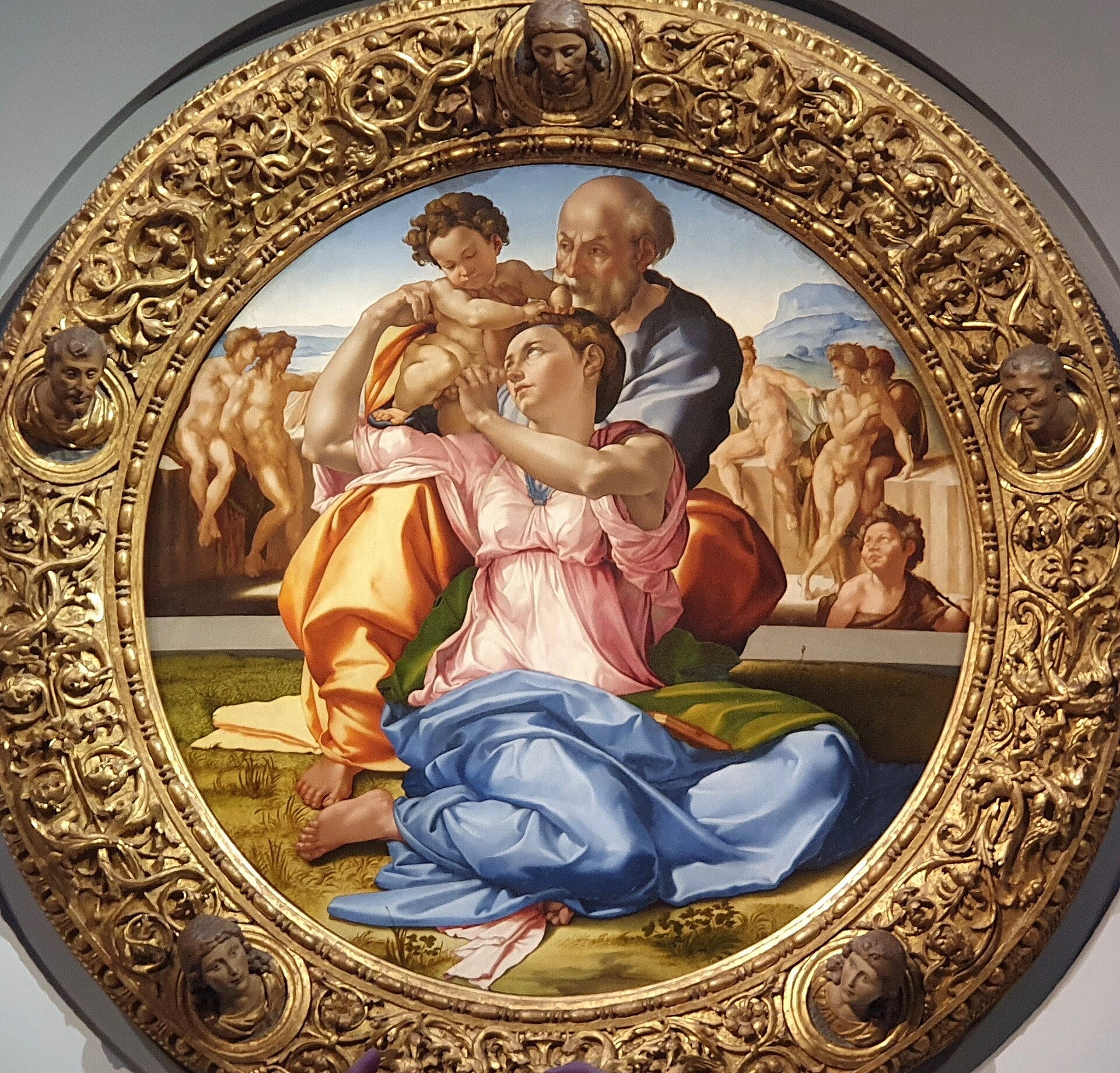
A tondo is a painting or a relief made in the shape of a circle. The form became fashionable in Florence in the fifteenth century, mostly for images of the Madonna and Child that families hung in their homes. The best-known example is Michelangelo's Doni Tondo, a Holy Family painted for a Florentine merchant and now in the Uffizi.
The name is short for rotondo, Italian for round. Around 1430, Florentines already used it loosely for any round object in a house, a plate as well as a painting, and English has kept both the word and its Italian plural, tondi.
Cool Stories About Art is a newsletter to learn art the fun way.
Join 200,000+ readers and get:
10 new art stories / month
The entire archive of content (1,000+ articles)
Comment, ask questions, and chat with other readers
A circle is a hard shape to compose in. A rectangle gives the painter corners and straight edges, so a figure can stand upright, a floor can run level and a wall can close off the background. A circle offers none of that. Every figure sits close to a curved edge, and anything straight looks cut off.
Michelangelo's answer in the Doni Tondo was to make the figures turn. Saint Joseph passes the Christ Child to Mary, and the three bodies twist into one compact group, shaped like a dome, that fills almost the whole height and width of the circle.
Michelangelo was not the first painter to face this problem. When he painted the Doni Tondo, Florentine artists had been working inside the circle for about half a century, and the round format had come to them from a household object, the tray brought to a mother after a birth.
What You'll Discover
The birth tray behind the round picture.
Why the circle suited the Virgin Mary.
Glazed babies on a Florentine hospital.
A marble Michelangelo never finished.
How Raphael made the circle look natural.
The harem scene cut into a circle.