
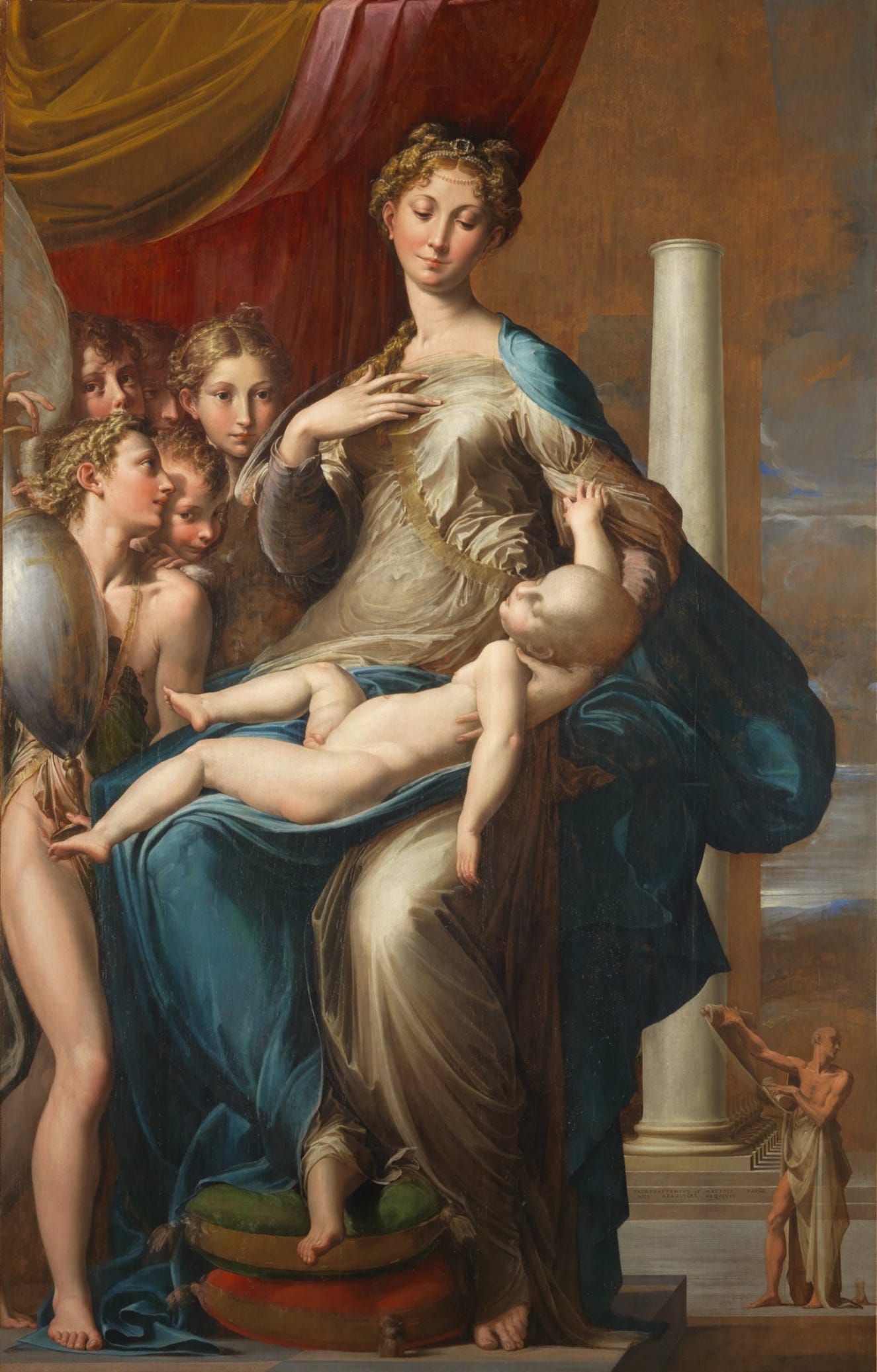
Mannerism is the style of Italian painting that followed the High Renaissance, from about 1520 to 1600. Its painters took the balanced, natural figures of Raphael and Michelangelo and stretched them, twisted them and packed them into shallow spaces under unreal colors, in search of elegance rather than truth to nature. Its best-known example is the Madonna with the Long Neck, begun in 1534 by Parmigianino and now in the Uffizi in Florence.
In that picture, the Virgin's neck and fingers are far longer than any real woman's, and the Christ Child asleep across her lap is far too large for a baby. Parmigianino knew perfectly well how to draw a body in proportion. He lengthened this one on purpose, and the word Mannerism was later attached to pictures like it.
Cool Stories About Art is a newsletter to learn art the fun way.
Join 200,000+ readers and get:
10 new art stories / month
The entire archive of content (1,000+ articles)
Comment, ask questions, and chat with other readers
None of the painters who made these pictures called themselves Mannerists. The noun did not exist in the sixteenth century. It comes from maniera, the Italian word for style or manner, and for Giorgio Vasari, the painter who wrote the first great history of Italian artists, maniera was praise. In his Lives of the Artists, he counted it among the qualities that made the painters of his own century better than those before them.
The next century turned that praise around. In 1672 the Roman critic Giovan Pietro Bellori attacked the painters who, in his view, had stopped studying nature and spoiled art by imitating other artists. In 1792 the Italian historian Luigi Lanzi was the first to use the noun for the whole period, and he defined it as a distortion of the truth.
For more than a century after Lanzi, the painters of the Long Neck were treated as the weak heirs of Raphael and Michelangelo, men who had copied the masters badly. It took the twentieth century to look at them again.
What You'll Discover
Why one altarpiece looks cut from folded paper.
A self-portrait painted on a curved panel.
The twisting pose borrowed from Michelangelo.
How a French king imported the style.
Why modern painters rediscovered El Greco.