
Perspective is the method painters use to make a flat surface look deep. Its best-known form, linear perspective, rests on two things everyone has noticed. Objects look smaller the farther away they are, and parallel lines that run away from us, like the edges of a road, seem to draw together until they meet at a single point on the horizon, called the vanishing point.
A painter who aims every receding line at that point can make a wall look like a window, and that is the illusion perspective was invented to produce.
The word comes from the Latin perspicere, “to look through” or “to look closely at.” In the Middle Ages, perspectiva was the name of a science, optics, the study of light and sight. Italian painters borrowed it, as prospettiva, for their new way of drawing space.
Cool Stories About Art is a newsletter to learn art the fun way.
Join 200,000+ readers and get:
10 new art stories / month
The entire archive of content (1,000+ articles)
Comment, ask questions, and chat with other readers
Painters had not always wanted that window. For most of the Middle Ages, the size of a figure showed how important it was, not how far away it stood, so a Virgin could tower over the angels around her throne. Around 1300, Giotto gave his figures solid bodies and set them in a space with some depth, but he built that space by eye, without a rule that held the whole picture together.
The rule came from Florence in the early fifteenth century, and it is credited to an architect, Filippo Brunelleschi. Nothing he made to demonstrate it has survived. His two perspective panels are lost, and most of what is known about them comes from a biography written decades later, which describes a painted church, a hole and a mirror.
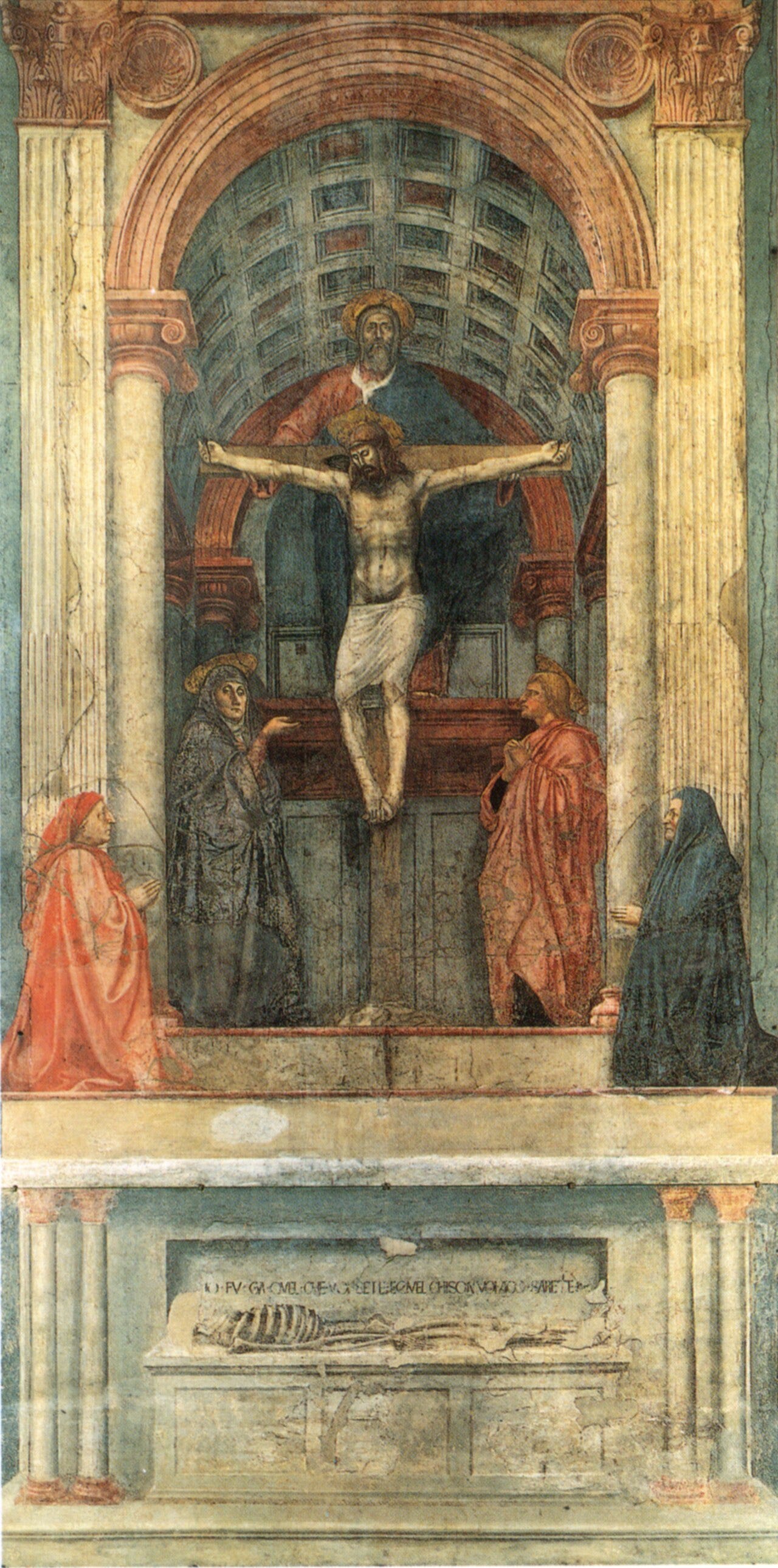
Within a generation, the rule had a written method and a fresco in a Florentine church to show what it could do. Painters then spent the next centuries finding out where it worked, where it failed and how far it could be pushed.
What You'll Discover
How a peephole and a mirror worked.
What Alberti meant by an open window.
Where Masaccio put his vanishing point.
Why distant mountains turn blue.
What Leonardo hammered into a wall.
How Cézanne bent the rules.