
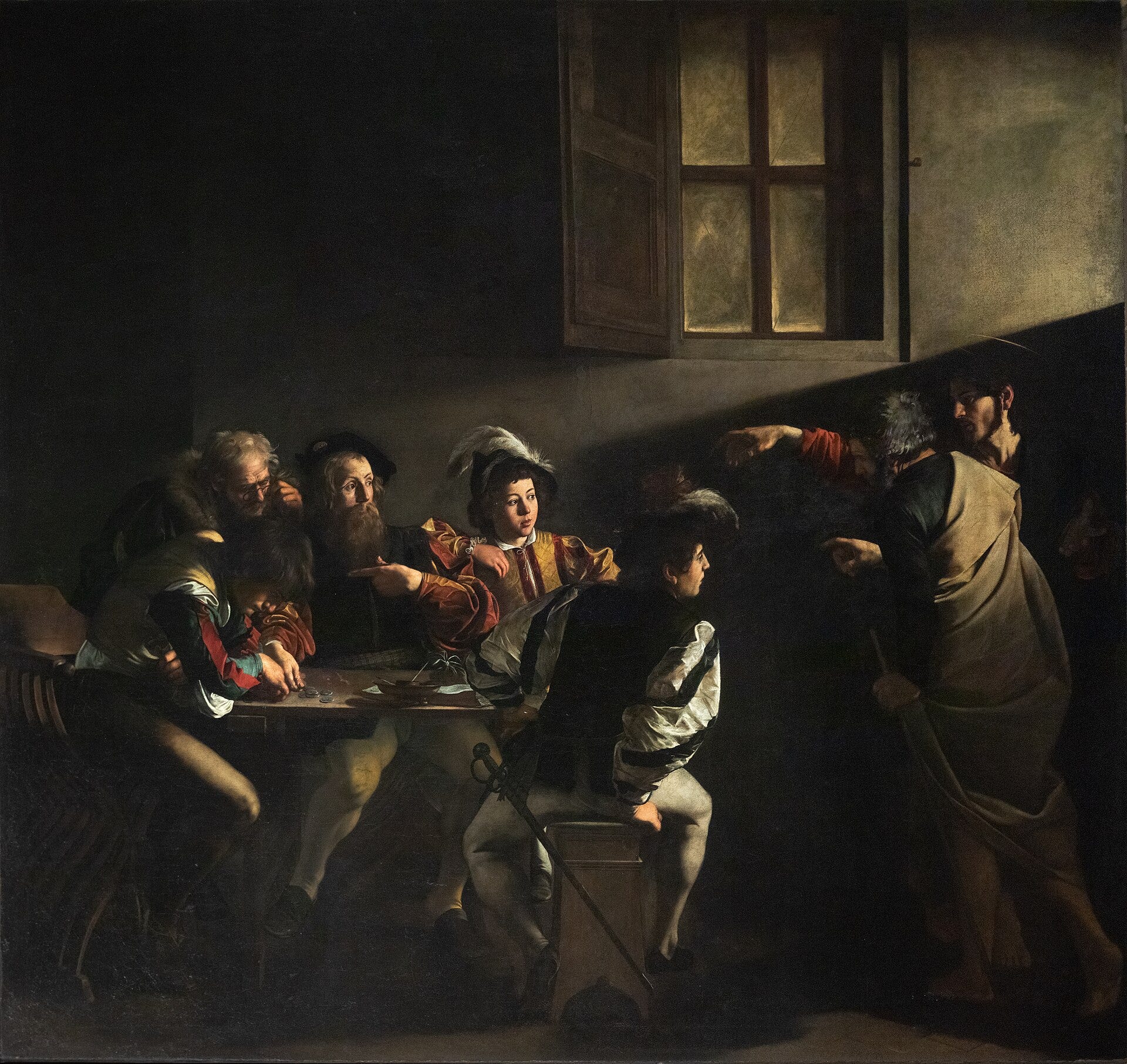
Tenebrism is a way of painting in which darkness covers most of the picture and a single hard light picks out a few faces, hands and objects. Between the lit parts and the shadow there is almost no transition. A cheek is bright, and a little further away the background is black. Caravaggio made this way of painting famous in Rome around 1600.
The word comes from the Italian tenebroso, "dark," which comes from the Latin tenebrae, "darkness." The best place to see what it means is a chapel in the church of San Luigi dei Francesi in Rome, where Caravaggio's Calling of Saint Matthew still hangs. A beam of light enters the picture from the right and falls on the faces of a group of men sitting at a table. Christ, who has just come in, points toward them. Most of the room is in shadow, though the wall and a window can still be made out. In Caravaggio's later paintings, even those disappear.
Cool Stories About Art is a newsletter to learn art the fun way.
Join 200,000+ readers and get:
10 new art stories / month
The entire archive of content (1,000+ articles)
Comment, ask questions, and chat with other readers
Caravaggio never heard the word tenebrism. In English it is recorded only from 1959. One of the best-known early descriptions of his dark pictures came from the writer Giovan Pietro Bellori in 1672, more than sixty years after the painter's death, and Bellori meant it as criticism.
He wrote that Caravaggio "never brought his figures out into the daylight" and kept them instead in "the dark brown atmosphere of a closed room." He also recorded what the painter's rivals said about him. In their version, the darkness was a limit Caravaggio could not get past, and they had a word for the room he painted in.
What You'll Discover
What his rivals called his dark room.
How the darkness was built on the canvas.
Where tenebrism ends and chiaroscuro begins.
How his last paintings grew even darker.
Who carried it from Rome to Spain.
Where the same light turned up in 1972.