
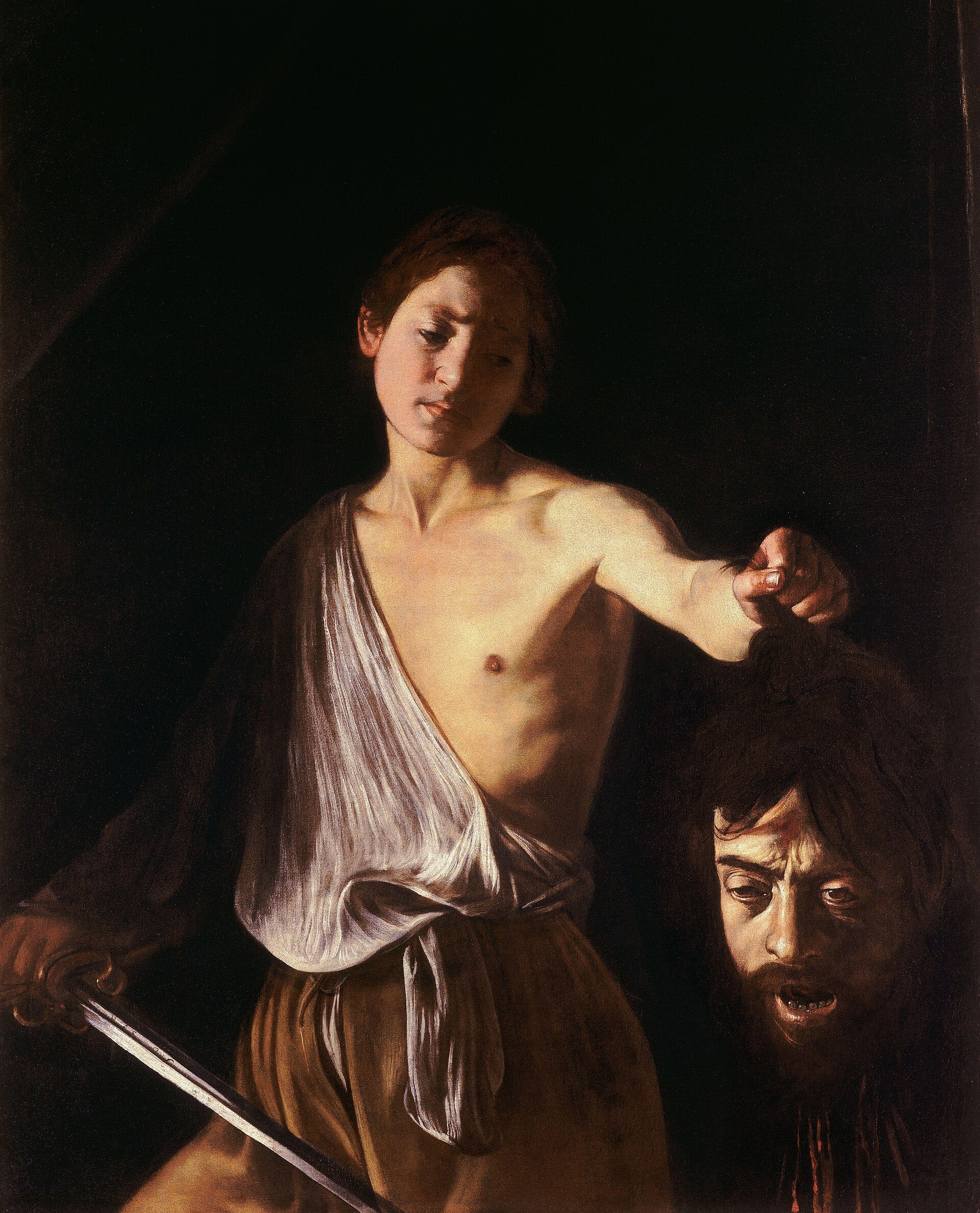
Caravaggio gave Goliath his own face because he was a condemned man pleading for his life. In May 1606 he killed a man in Rome and was sentenced to beheading, and the painting is usually read as a gift to the cardinal who could win him a pardon.
The sentence amounted to an open bounty: anyone who recognized him could carry it out legally. For the four years he had left, Caravaggio moved from Naples to Malta, then to Sicily, then back to Naples. The canvas that carries his face now hangs in the Galleria Borghese in Rome. A young David holds a severed head by the hair, and the head is the painter's own.
Cool Stories About Art is a newsletter to learn art the fun way.
Join 200,000+ readers and get:
10 new art stories / month
The entire archive of content (1,000+ articles)
Comment, ask questions, and chat with other readers
That is the usual version, and it is a good story. It is also less solid than it sounds. The Galleria Borghese itself says only that it is "possible" the painting was sent to the cardinal as a request for pardon, and its catalogue leaves the date open: 1606 or 1607, or else 1609 or 1610.
Some critics go earlier still, to 1605 or 1606, which puts part of that range before the killing. A face painted before the sentence cannot be a plea against it. And the first document that places the canvas in the cardinal's collection is a payment for its frame in 1613, three years after Caravaggio was dead.
I find the confession the most moving reading anyone has offered. I also think nobody can prove it.
What You'll Discover
Who first said the head is his.
Who posed for David.
What the letters on the blade say.
Who really asked for the painting.
What happened on the road to Rome.