
Among these twelve pictures of witches are a woman in yellow whom the painter's own sister and the foundation that owns her read in opposite ways, a canvas that waited behind a curtain to surprise its visitors, and a Salem scene that quietly slips in a search carried out in Boston decades earlier.
Cool Stories About Art is a newsletter to learn art the fun way.
Join 200,000+ readers and get:
10 new art stories / month
The entire archive of content (1,000+ articles)
Comment, ask questions, and chat with other readers
How These Were Chosen
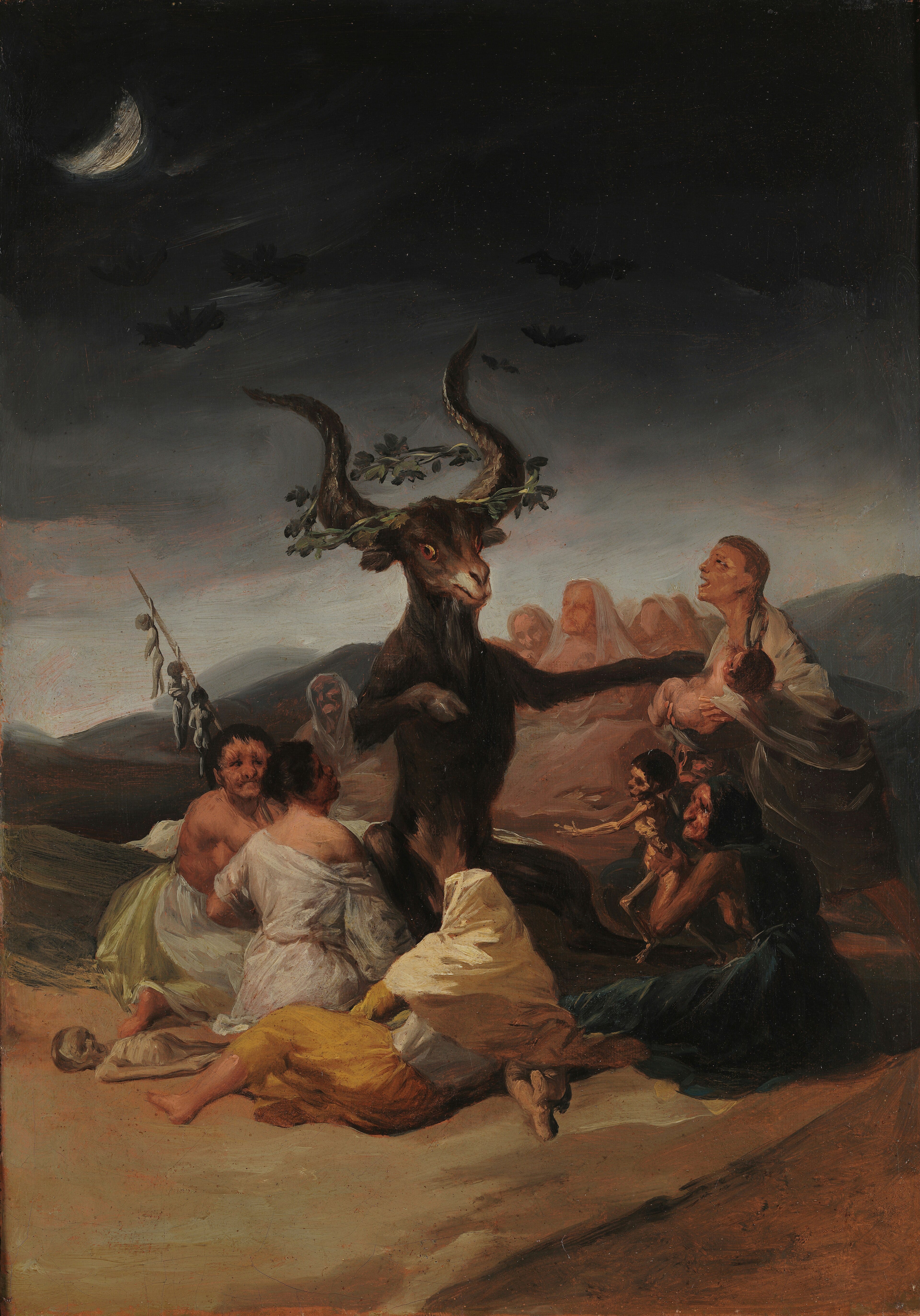
No artist ever watched a witch at work. The witch of Western art was born during the witch hunts, and painters and printmakers pictured what the accused were said to do in secret, working from trial reports, plays, ancient poems and older prints.
Across these pictures, the same props keep coming back: a pot or a cauldron over a fire, a broom, a black cat, bats and a moon. The witch herself is usually naked, and she is either old and ugly or young and desirable.
That combination suited painters well. A witch scene let an artist paint nudes, night, fire and monsters in a single picture, and from the 1600s on, private collectors commissioned them for their own rooms.
Each work here had to pass one of three tests. It shows how a witch was believed to work, down to her tools and ingredients, or it draws on a real witch trial, or later artists kept borrowing its figures. The list includes two prints, kept because the painters who came after drew on them.
Seen together, the twelve keep returning to the same choice between the hag and the beauty. Some artists split the witch in two inside one room, others set a single old face among young bodies, and by the end of the 1800s a critic could praise a witch for being pretty.
12. Evelyn De Morgan, The Love Potion (1903)
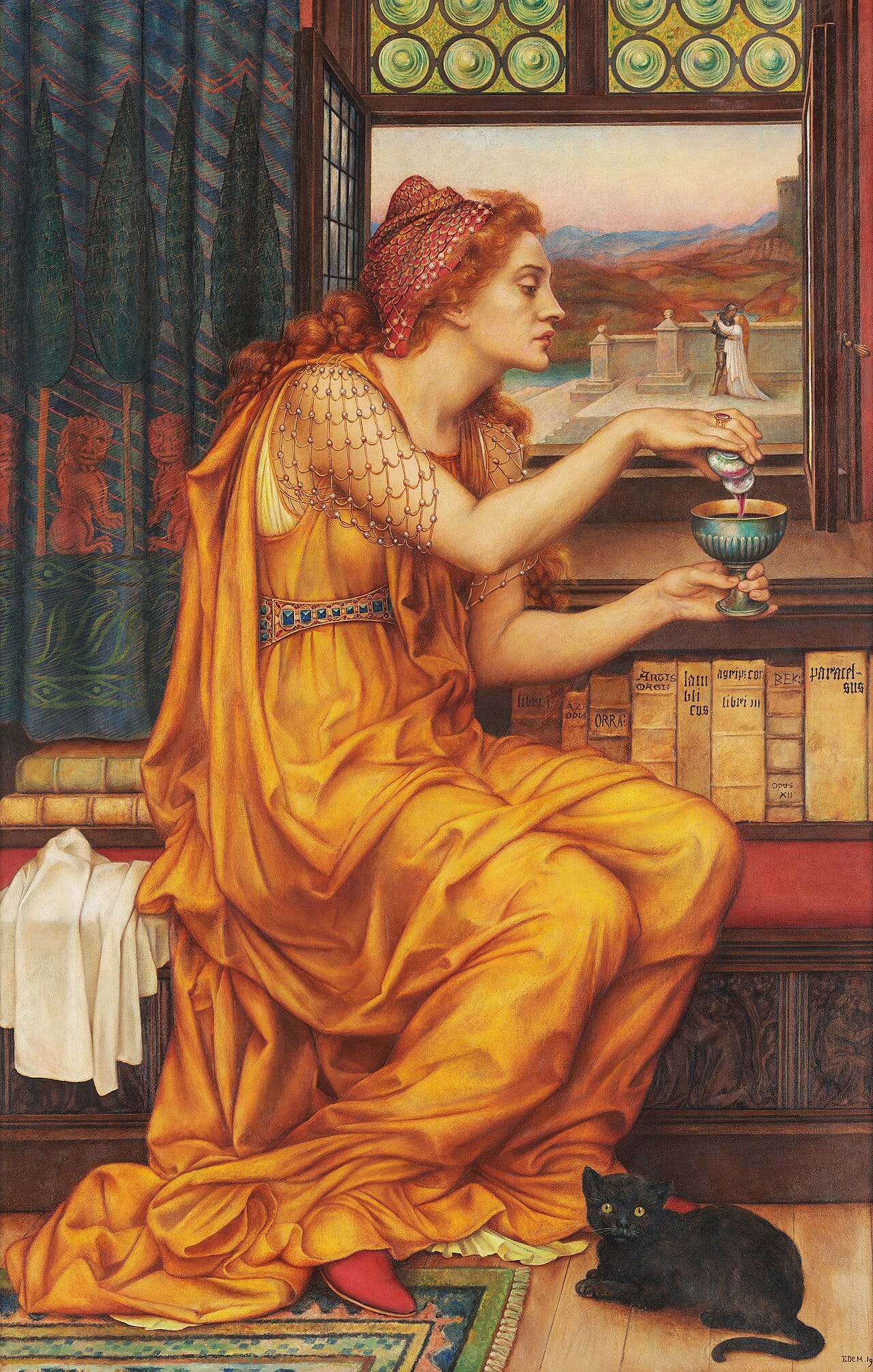
In a heavy gold-yellow gown, a woman sits beside an open window and tilts a small flask over a goblet, letting a thin red stream run into the cup. A black cat lies on the floorboards at her feet, a row of old bound books fills the low shelf beside her, and far off through the window a couple embraces on a terrace. Evelyn De Morgan signed and dated the canvas in 1903, and the two parties closest to it have read the woman in opposite ways.
The first reading came from the painter's own family. Mrs. Stirling, De Morgan's sister, wrote a catalog of the De Morgan collection of pictures and pottery, and in it she described "a witch in bright yellow, with a callous, cruel face, mixing a potion to upset the lovers who are seen on the terrace in the distance." The volumes on the shelf were, for her, "books upon Black Magic."
The second reading comes from the De Morgan Foundation, which owns the picture today. It calls Mrs. Stirling's description a mistake and sees a learned alchemist at work in a bright study. Its evidence sits on the very shelf the sister described.
De Morgan lettered most of the spines herself, so the titles can still be read. Mrs. Stirling named only one, the volume marked "Paracelsus," after the Renaissance physician and alchemist. One volume away stands Agrippa von Nettesheim, the sixteenth-century physician who wrote De occulta philosophia, and right beside him Iamblichus, a Neoplatonist philosopher.
To my eye, those books favor the Foundation. A woman reading Agrippa and Iamblichus looks more like a student of hidden knowledge than the cruel matchbreaker of the sister's catalog. The Foundation goes further still and reads even the black cat at her feet as a play on the old stereotype of the diabolical sorceress.
At a Glance
Artist: Evelyn De Morgan (1855 to 1919)
Painted: 1903
Medium: Oil on canvas
Size: 104.1 × 52.1 cm (41 × 20.5 in)
Where to see it: De Morgan Foundation, shown at Cannon Hall in Barnsley, Watts Gallery and Wightwick Manor
11. John William Waterhouse, Circe Offering the Cup to Ulysses (1891)
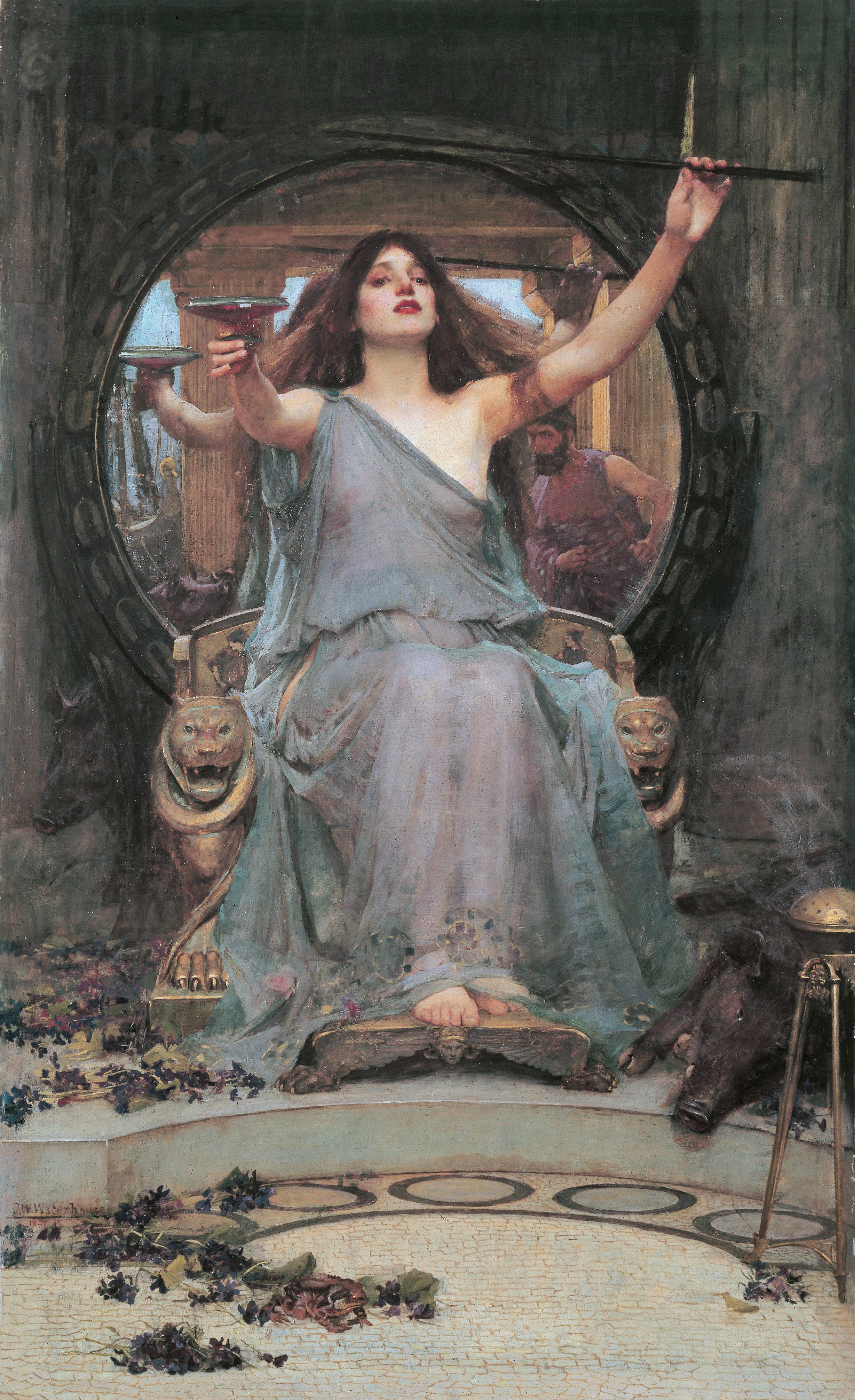
Circe holds a shallow cup straight out toward the viewer, her other arm raising a long wand above her head. She is the sorceress of Homer's Odyssey, seated here on a gilded throne with a black boar lying at its foot, and in the round mirror behind her a bearded man is walking in. John William Waterhouse painted her in 1891. The man in the mirror is Ulysses, and the cup is meant for him.