
Dickens gave A Christmas Carol ghosts that resist the pencil: a dead man's face that appears in a door knocker, a spirit whose head gives off a jet of light that has to be snuffed out with a cap. For seventy years, the book's illustrators kept returning to the same scenes, and some of them found that the surest way to draw a ghost was to hide it.
Cool Stories About Art is a newsletter to learn art the fun way.
Join 200,000+ readers and get:
10 new art stories / month
The entire archive of content (140+ articles)
Comment, ask questions, and chat with other readers
Ghosts on the Page
A Christmas Carol, published in London at Christmas 1843, is built on four ghostly visits. Jacob Marley, Scrooge's dead business partner, comes first, and he announces the three Spirits who follow: the Ghosts of Christmas Past, Christmas Present and Christmas Yet to Come.
The trouble for an illustrator begins with how closely Dickens describes them. Marley is transparent. The first Spirit is a child and an old man at once. The last never shows its face or says a word. Every artist who took on the book had to decide how to draw a ghost that the text itself keeps half out of sight.
The choice of works follows from that difficulty: each one puts a ghost on the page, or a scene that a ghost makes Scrooge watch. Several illustrators drew the same moments, so the same ghost often comes back, redrawn decades later by another hand.
12. Sol Eytinge Jr., Marley's Face (1868)
The face in the door knocker wears spectacles, and its features are almost those of Scrooge himself. Sol Eytinge Jr. made this small wood engraving, Marley's Face, in 1868 for an American edition of A Christmas Carol, and it shows a moment that most illustrators of the book left alone.
The scene comes early in the story. Scrooge returns home on Christmas Eve, puts his key in the lock and sees, in place of the knocker, the face of Jacob Marley, his business partner, dead for seven years. A moment later the knocker is a knocker again. John Leech, who illustrated the first edition in 1843, passed over it and drew Scrooge by his fire after Marley's visit instead.
Eytinge's edition was born of a journey. James T. Fields, of the Boston publishers Ticknor and Fields, commissioned it for the reading tour Dickens was to make in the United States, a tour the Civil War had delayed for years. Dickens landed in Boston on November 19, 1867, and in early December, at Tremont Temple, he read the Carol aloud to an American audience for the first time.
That tour gave Eytinge a close view of the author. He drew Dickens's portrait along the way, saw him off at the New York pier when he sailed home in April 1868, and earned his praise for "a delicate perception of beauty, a lively eye for character". The book appeared in December 1868 with thirty-three of his engravings.
In the knocker, Eytinge gives the dead partner and the living one nearly the same features, so that the warning Marley brings that night, about what Scrooge will become, already shows on the door.
At a Glance
Artist: Sol Eytinge Jr. (1833 to 1905)
Made: 1868
Medium: Wood engraving
Size: 12.6 × 9.4 cm (5 × 3.7 in)
Where to see it: The Ticknor and Fields edition of A Christmas Carol (Boston, 1868), for example at the British Library, London
11. Fred Barnard, "What do you call this?" said Joe. "Bed-curtains?" (1878)
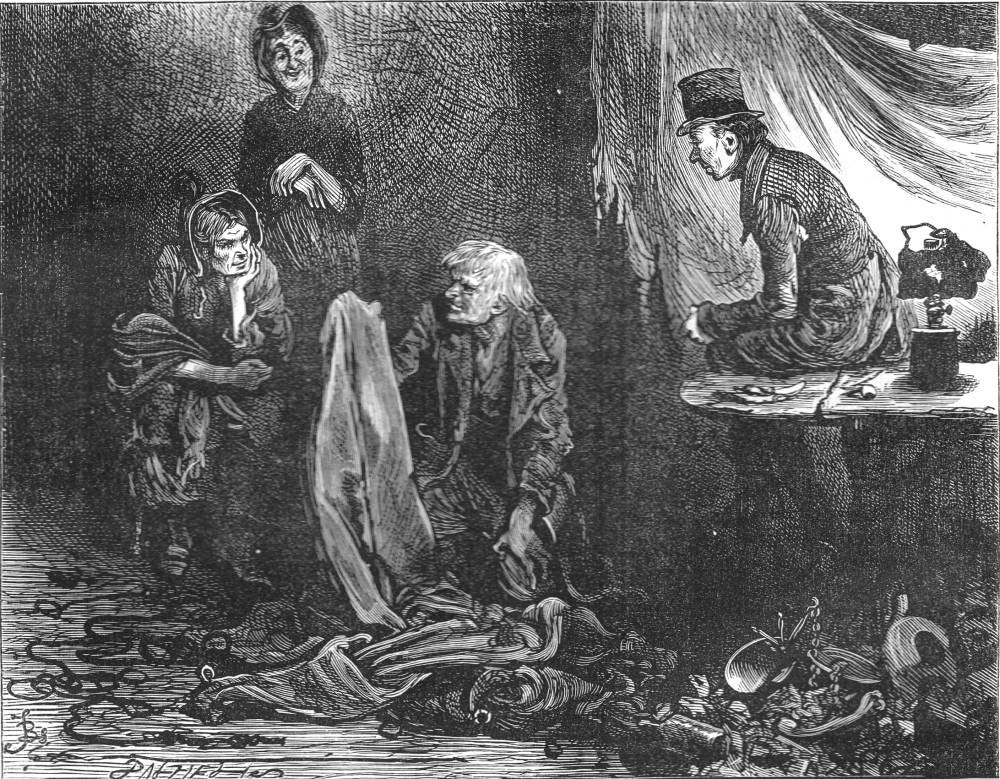
Three people walk into a junk dealer's shop in a poor London street, each with a bundle taken from the rooms of a man who has just died: his charwoman, his laundress and the undertaker's man. The dealer, Old Joe, holds up the bed-curtains, taken down, rings and all, while the body still lay in the bed. Scrooge watches from a corner, led there by the last of the Spirits, without knowing whose bed it was.