A Sunday Afternoon on the Island of La Grande Jatte
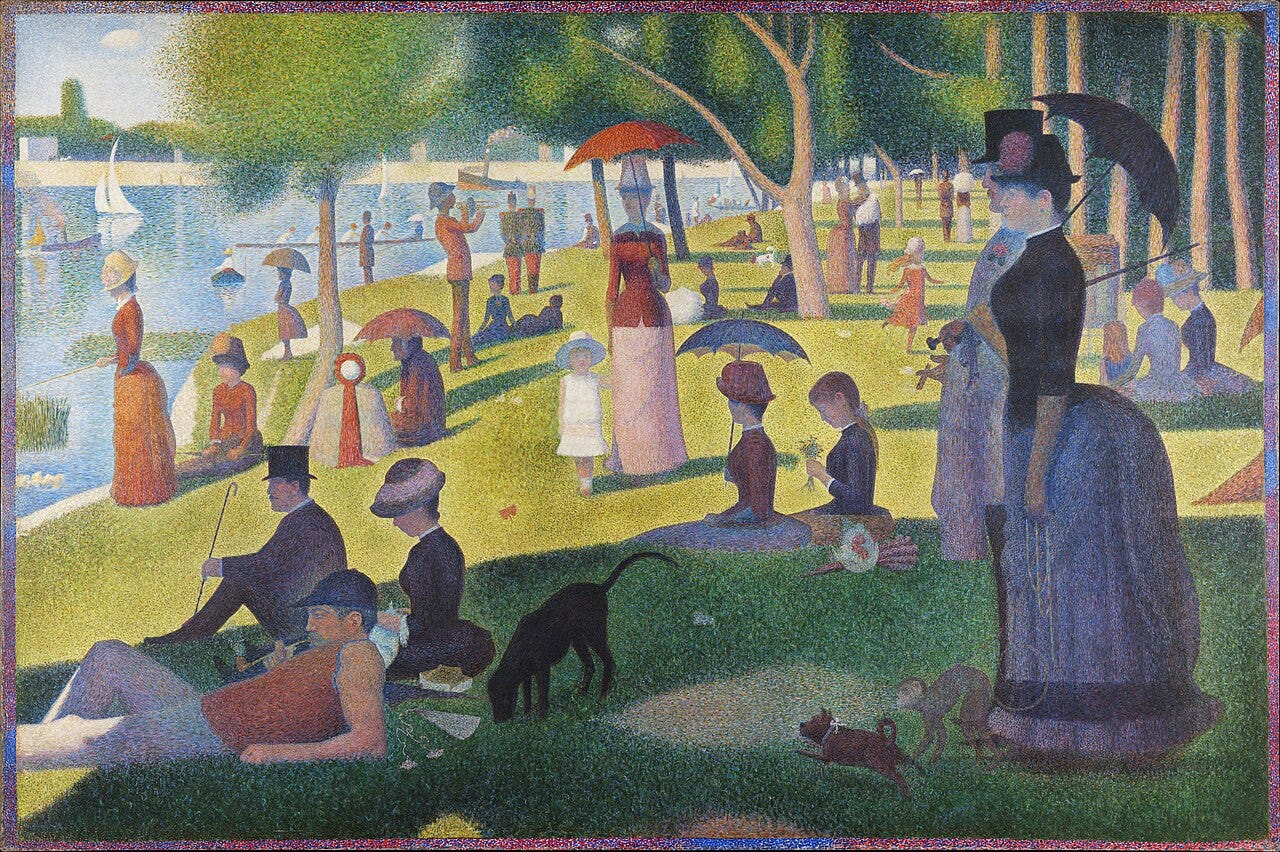
A Sunday Afternoon on the Island of La Grande Jatte is an 1886 painting by Georges Seurat, in the Art Institute of Chicago. It shows Parisians relaxing by the river, and it is built entirely from tiny dots of pure color that your eye, not the paint, mixes into a scene.
Seurat spent two years placing them.
It is the picture that launched Pointillism, and it hides a rude joke in plain sight. Here is how the dots work, how long it took, and the pun most visitors walk straight past.
A painting made of dots
Stand close and the picture dissolves into thousands of separate specks: a dot of blue beside a dot of yellow, a fleck of orange next to a fleck of violet.
Step back and those specks fuse. The blue and yellow become green grass, the flecks become the glow of afternoon light.
Seurat did not mix his colors on the palette. He placed pure hues side by side and let them blend in the viewer's eye instead, a method he based on the new color science of his day.
The result is a technique called Pointillism, and this is the painting that introduced it to the world. He believed color mixed by the eye stays brighter than color mixed on the brush.
Two years, and a frame of dots
This was not a quick afternoon sketch of an afternoon. Seurat worked on it for about two years, from 1884 to 1886, making dozens of preliminary drawings and small painted studies of the site and the figures before touching the final canvas, which is roughly two by three meters.
He was so committed to his system that he even painted the border in dots. A few years after finishing the scene he added a band of red, orange and blue specks around the edge, to ease the eye from the painting into its frame rather than let the colors end on a hard line.
The dots do not stop at the scene; they run right to the edge.
The rude joke in the corner
Now the pun. On the right, a fashionable woman strolls with a gentleman, and on a leash she holds a small monkey. It looks like a stylish pet, and it is also a dirty joke.
Art historians have long read that monkey as a visual pun. The French word for a female monkey, singesse, is said to have doubled in period slang for a woman of loose morals.
On that reading, by putting a monkey on a leash beside this elegant couple, Seurat hints that the respectable Sunday crowd is not quite as respectable as it looks, that among the families and courting couples on the island are women for hire and the men who pay them.
The whole tidy, frozen scene has a needle of social satire buried in it.
Why it caused an uproar
When Seurat showed it at the last Impressionist exhibition in 1886, it split the room. The Impressionists had made their name on speed and spontaneity, catching a fleeting moment with loose, quick strokes.
Seurat did the opposite: his people stand stiff and still, frozen like figures on an ancient frieze, every dot calculated.
Some critics found it cold and mechanical, a scene of Parisians turned to statues. Others saw the future, and I am firmly with them.
This deliberate, scientific Post Impressionism was a direct challenge to the movement it grew out of, and it made the young Seurat the leader of a new avant garde overnight.
In Chicago, and a Broadway musical
A Sunday on La Grande Jatte is in the Art Institute of Chicago, which has owned it since 1926, and it almost never travels: it is too large, too fragile and too central to the collection to lend.
It is not for sale. In 1984 the painting inspired a whole Broadway musical, Stephen Sondheim's Sunday in the Park with George, which imagines Seurat placing every dot and won the Pulitzer Prize for Drama, giving the picture a life on stage a century after it scandalised Paris.
The color science behind the dots
Seurat did not invent his method by feel. He read the color theorists of his day, the chemist Michel Eugene Chevreul and the American physicist Ogden Rood, and built the picture on their laws.
The key idea is simultaneous contrast: a color placed next to its opposite makes both look more intense, so a dab of orange beside a dab of blue does more work than either alone.
He disliked the nickname Pointillism and preferred to call his system Divisionism, or chromoluminarism. The point was luminosity: he believed light itself could be rebuilt on canvas by dividing every tone into its pure components and letting the eye reassemble them.
To me it is less a painting than an optical machine that happens to show a park.
A frozen crowd, and the class it shows
Count the park and you find a whole society on its day off: around fifty figures, a scatter of boats on the river, three dogs and that one monkey.
There are top hatted gentlemen, a soldier or two, a nurse, an oarsman stripped to his vest, a woman fishing.
What unsettles people is how still they all are. The figures stand in rigid profile, like an Egyptian frieze, nobody quite touching, nobody quite alive.
Some read it as a gentle satire of respectable Sunday leisure, a middle class turned to statues in its own park. Seurat never said, and the calm is exactly what keeps the argument open.
The park that is browner than he painted it
The picture you see at the Art Institute is not quite the one Seurat finished. Some of the pigments he used, certain bright yellows above all, have darkened and dulled over more than a century, so the grass now reads browner and heavier than the fresh, luminous green he laid down.
Conservators have studied the change closely, and it is one reason the real canvas can feel graver than a bright reproduction.
A Sunday on La Grande Jatte, quick answers
What is A Sunday on La Grande Jatte about? Parisians relaxing on a Sunday on an island in the Seine. Seurat painted it in dots of pure color and hid a note of social satire in the crowd.
Why was it controversial? It rejected the loose spontaneity of Impressionism for a slow, scientific method of tiny dots, with stiff frozen figures. Critics found it cold and mechanical.
What technique is it? Pointillism, or Divisionism. Pure colors are placed in small dots side by side and blended by the viewer's eye rather than on the palette.
Who painted it and when? Georges Seurat, between 1884 and 1886.
Where is the original? The Art Institute of Chicago.
If this painting pulled you in, you will love these too:
Twelve famous portraits and the real people, the faces behind the paintings
The Last Supper, detail by detail, the detail hiding at that table
Six women, one monster, what Picasso did to the women who loved him
The painter who died before anyone caught up
Seurat guarded his method fiercely and worked in near silence, and he did not have long to enjoy the storm he had started. He died suddenly in 1891, of an infection, at just thirty one, only five years after finishing La Grande Jatte.
He left barely a handful of large paintings. The man who taught the world to see with dots was gone before most of the art world had even decided whether he was a genius or a crank, and the picture settled the argument for him.
You can see A Sunday on La Grande Jatte in person at the Art Institute of Chicago. For more by the artist, browse the Metropolitan Museum collection.
Questions from the island
What technique did Seurat use? He used Pointillism, building the whole scene from countless tiny dots of pure color that blend in the viewer eye.
What does the painting show? Parisians of every class strolling and resting on an island in the Seine on a Sunday afternoon.
How long did it take? About two years, from 1884 to 1886, with dozens of preparatory studies.
Where is it? It hangs in the Art Institute of Chicago.
Who painted it? Georges Seurat, the young leader of Neo Impressionism, who died only a few years later at 31.