
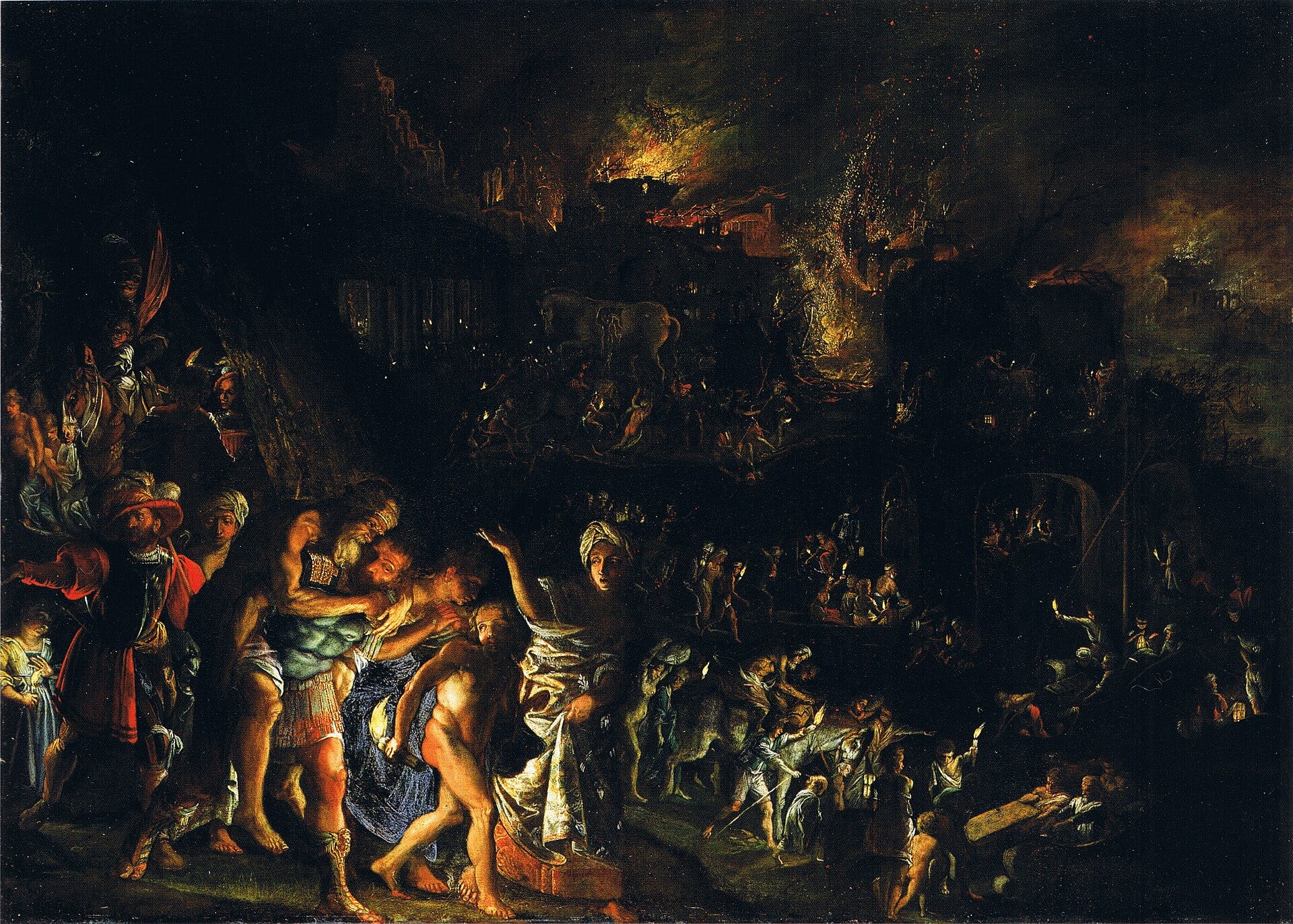
Adam Elsheimer (1578 to 1610) was a German painter who spent his last ten years in Rome. He became famous for tiny paintings on copper, often lit at night by fire or moonlight, like The Sack of Troy and The Flight into Egypt.
Cool Stories About Art is a newsletter to learn art the fun way.
Join 200,000+ readers and get:
10 new art stories / month
The entire archive of content (140+ articles)
Comment, ask questions, and chat with other readers
Only about forty pictures by Adam Elsheimer are known today, many of them smaller than a sheet of letter paper. In his lifetime they stayed with a handful of collectors, yet Peter Paul Rubens, soon the most famous painter of northern Europe, owned at least four of them. Elsheimer himself died in Rome at thirty-two, owing money to his friends.
Adam Elsheimer was born in 1578 in Frankfurt, a great merchant city of Germany, known for its trade fairs and its book trade. He was one of the ten children of a master tailor.
The tailor's house stood a few steps from the church that displayed the Heller Altarpiece, a work by Albrecht Dürer, the most famous German painter, who had died fifty years before Elsheimer was born. An altarpiece is the large picture that stands above the altar of a church.
The boy learned to paint with Philipp Uffenbach, a Frankfurt painter of altarpieces. Elsheimer would one day become famous for the opposite: tiny pictures, made for the private rooms of collectors.
At twenty, Elsheimer left Frankfurt for Italy, by way of Munich, where he is recorded in 1598. Early in 1600, he entered Rome through the Porta del Popolo, the great northern gate of the city, and settled in the streets near the gate, where many foreigners lived.
Rome was the pope's city. Painters from all over Europe came there to study its ancient statues and the frescoes of Raphael and Michelangelo.
Elsheimer soon made friends among the Germans and the Flemings of Rome, the people of Flanders, today part of Belgium. Two of them would stay close to him: Johann Faber, a German who was the pope's doctor, and Paul Bril, a Flemish painter of landscapes.
In 1601, a Flemish painter of his own age arrived in Rome, the young Peter Paul Rubens. Rubens became Elsheimer's friend and admired his small pictures, but Rubens also scolded his friend for painting so few of them.
How could a painter whom Rubens admired so much end his life short of money?
In the rest of the story
What Rubens wrote to the pope's doctor a few weeks after Elsheimer died.
Who spread Elsheimer's pictures across Europe while he sank into debt.
What hung on the wall of Elsheimer's bedroom when he died.
Which Dutch painter answered one of Elsheimer's coppers with a picture of his own.