
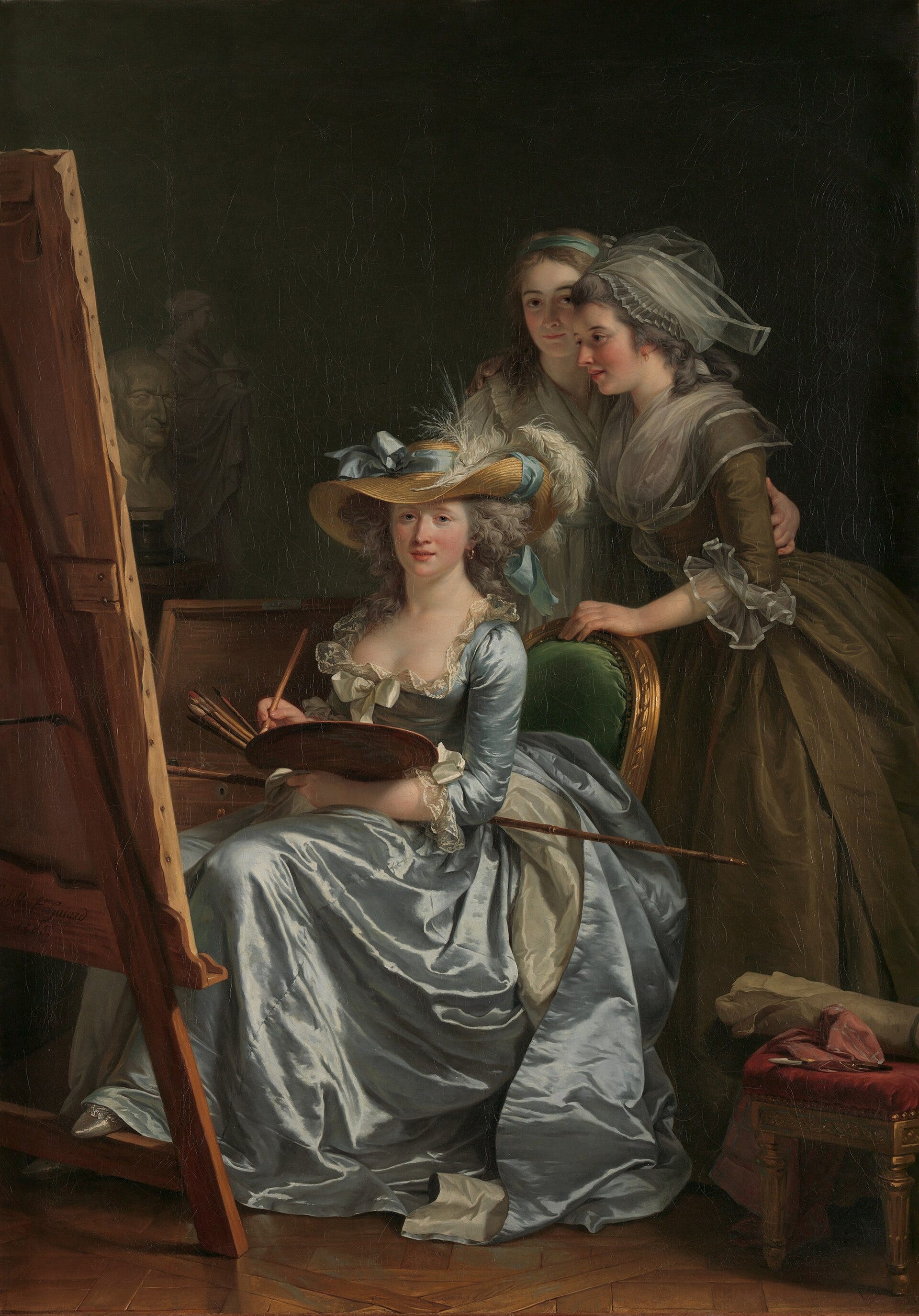
Adélaïde Labille-Guiard (1749 to 1803) was a French portrait painter who worked for the family of King Louis XVI, then for the deputies of the French Revolution. Her best-known painting, Self-Portrait with Two Pupils, hangs at the Metropolitan Museum of Art in New York.
Cool Stories About Art is a newsletter to learn art the fun way.
Join 200,000+ readers and get:
10 new art stories / month
The entire archive of content (140+ articles)
Comment, ask questions, and chat with other readers
In the France of the last kings, the Royal Academy of Painting and Sculpture, the king's society of artists, admitted no more than four women at a time. Labille-Guiard fought to win one of those seats, then fought to open the doors to the women who came after her.
Adélaïde Labille was born in Paris on April 11, 1749, the youngest of eight children. Her father, Claude-Edmé Labille, ran a fashion shop called À la Toilette.
The shop trained the girl's eye for fabrics, but a shopkeeper's daughter had no way into the art schools of Paris. As a teenager, Adélaïde learned to paint miniatures, tiny portraits that fit in the palm of a hand, from a friend of the family, the portrait painter François-Élie Vincent.
In 1769, at twenty, she married a clerk, Louis-Nicolas Guiard, and kept his name for her career. That same year, the Academy of Saint Luke, the guild of the painters of Paris, which accepted women, admitted her with a miniature.
In 1776, to learn oil painting, Adélaïde Labille-Guiard entered the studio of her first teacher's son, François-André Vincent, a young painter just back from Rome.
That year, a royal edict abolished the guilds, and in 1777 the Academy of Saint Luke closed. From then on, only the Royal Academy could give Labille-Guiard an official rank and a place at its Salon, the great public exhibition held at the Louvre.
In 1779, she separated her property from her husband's and lived on what her portraits earned.
By 1783, two women already sat in the Royal Academy. On May 31 of that year, the Academy received Labille-Guiard and Élisabeth Vigée Le Brun, the portraitist of Queen Marie Antoinette, on the same day. With them, all four places were taken.
When the French Revolution came in 1789, would it break the rule of four women?
In the rest of the story
What an anonymous pamphlet said about her, months after her election.
The case her most famous painting made to the Academy.
What the men of the Academy called her when she asked for more women.
What the Revolution ordered her to do with her biggest royal commission.