
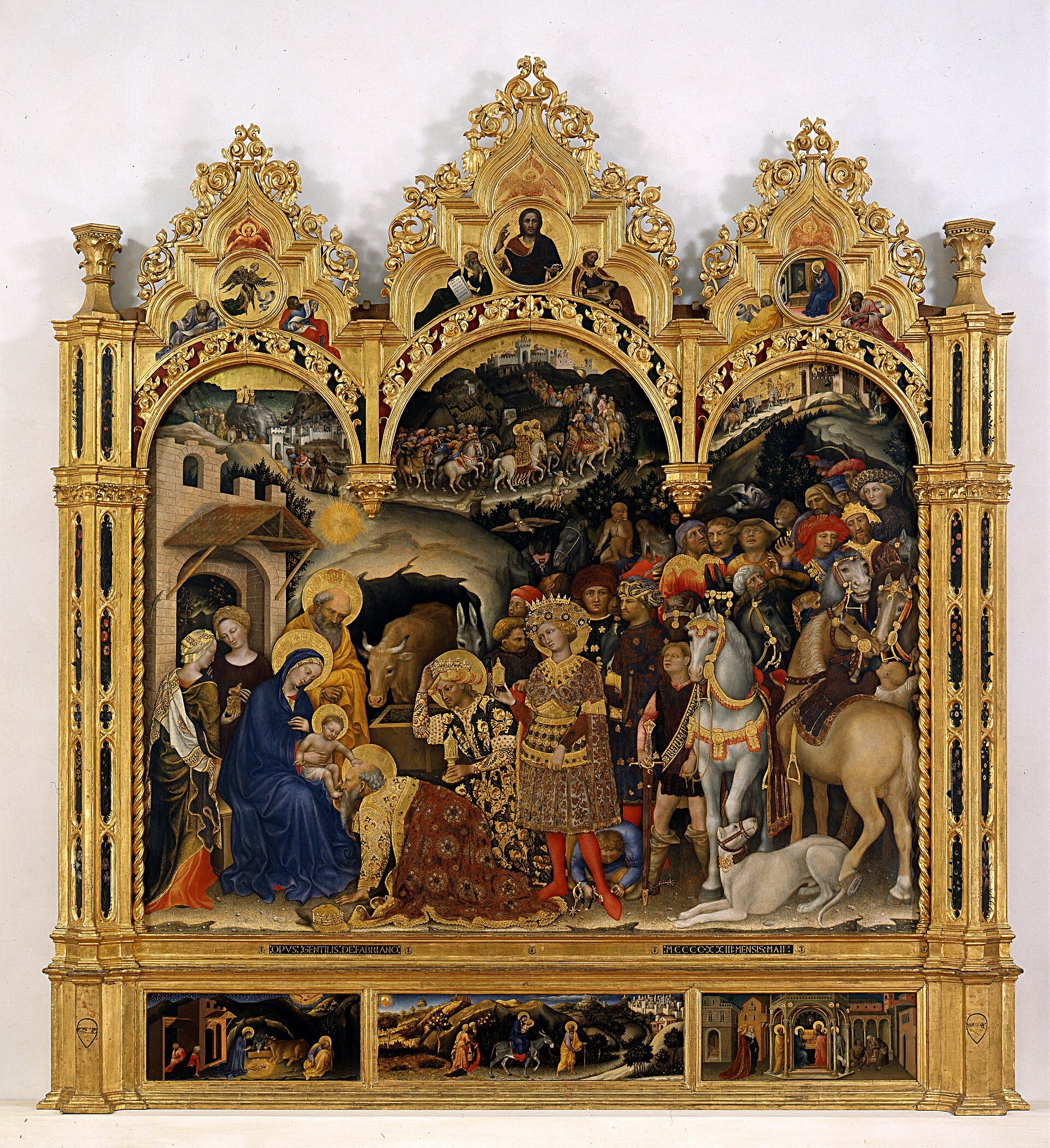
The Gospel of Matthew gives the wise men twelve verses, with no names, no crowns and no number. Painters supplied all three, then kept adding horses, servants, soldiers and, more than once, the man who paid. Here, the richest man in Florence follows the kings with a falcon on his fist, and a painter steps into his own canvas nearly twenty years after finishing it.
Cool Stories About Art is a newsletter to learn art the fun way.
Join 200,000+ readers and get:
10 new art stories / month
The entire archive of content (140+ articles)
Comment, ask questions, and chat with other readers
How Twelve Verses Became a Procession
In Matthew, learned travelers from the East follow a star to Bethlehem, kneel before the child and open their treasures: gold, frankincense and myrrh. Three gifts suggested three visitors, and tradition turned them into kings called Caspar, Melchior and Balthazar.
Medieval writers then had the three stand for the known continents, Europe, Asia and Africa. For painters, that meant a procession dressed from three corners of the world. For the people who paid them, it meant a crowd they could quietly join.
The twelve below include the versions most people look for and a few that lists rarely show, each kept for the story it carries. Together they follow the newcomers who slipped in among the kings: bankers, rulers, a painter's family and the painters themselves.
12. Peter Paul Rubens, The Adoration of the Magi (1609 and 1628 to 1629)
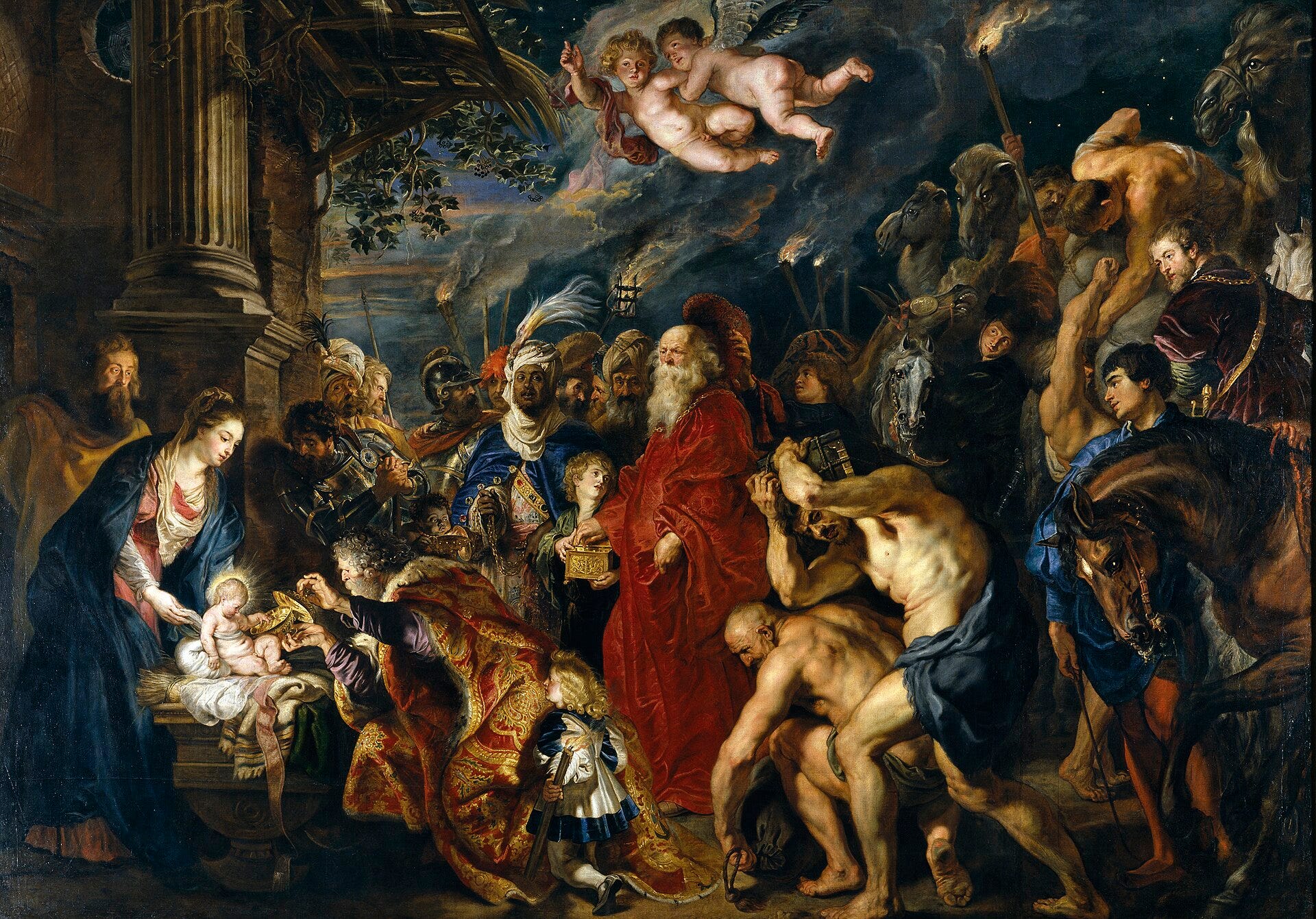
At the far right of this enormous canvas, half hidden behind the head of a horse, a man in a purple cloak turns toward the procession. He was not there when the picture first left the studio. He stepped into it nearly twenty years later, and he was the painter himself.
The story begins in Antwerp around 1608. The city council ordered the canvas from Peter Paul Rubens for the States Room of its town hall, at a precise moment. Spain and the Dutch Republic were about to sign the Twelve Years' Truce, and the picture was meant to celebrate it. The kings and their retinue stood for dignitaries coming to pay homage, and the child stood for peace.
That picture of peace did not stay in Antwerp for long. It may have been given to Rodrigo Calderón, a favorite of the Duke of Lerma at the Spanish court, and by about 1613 it was in Spain. Favor at that court proved fragile. Calderón was arrested in 1618 and executed in Madrid in 1621.
His goods were sold, and the painting passed to King Philip IV. So when Rubens came to Madrid in 1628, he found his own Adoration hanging in the royal palace.
He took up his brushes again. He enlarged the canvas on the right and at the top, repainted several passages with a looser, quicker hand, and in the new space he added the man in the purple cloak. To me, no gesture on this page is more personal: a painter returning to a picture of peace he had made two decades earlier, and joining the procession as one more traveler.
At a Glance
Artist: Peter Paul Rubens (1577 to 1640)
Painted: 1609, enlarged by the artist in 1628 to 1629
Medium: Oil on canvas
Size: 349 × 488 cm (137 3/8 × 192 1/8 in)
Where to see it: Museo del Prado, Madrid
11. Domingos Sequeira, The Adoration of the Magi (1828)
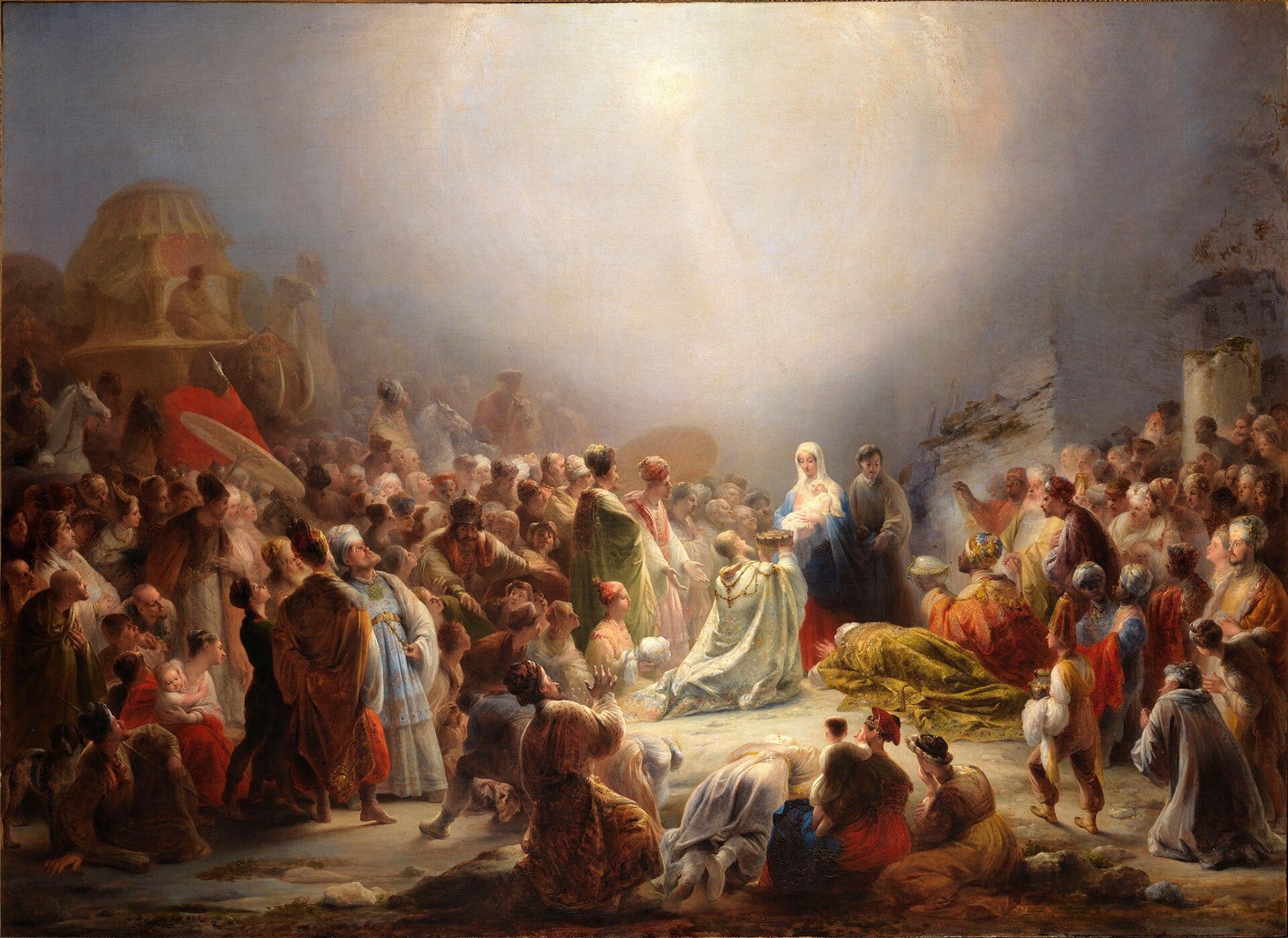
Most of this picture is darkness. A white light falls from the sky onto the mother and child, and the kings with their long train of followers fade into mist on either side. In 2015, a museum in Lisbon wanted this painting badly enough to ask every person in Portugal for a few cents.