
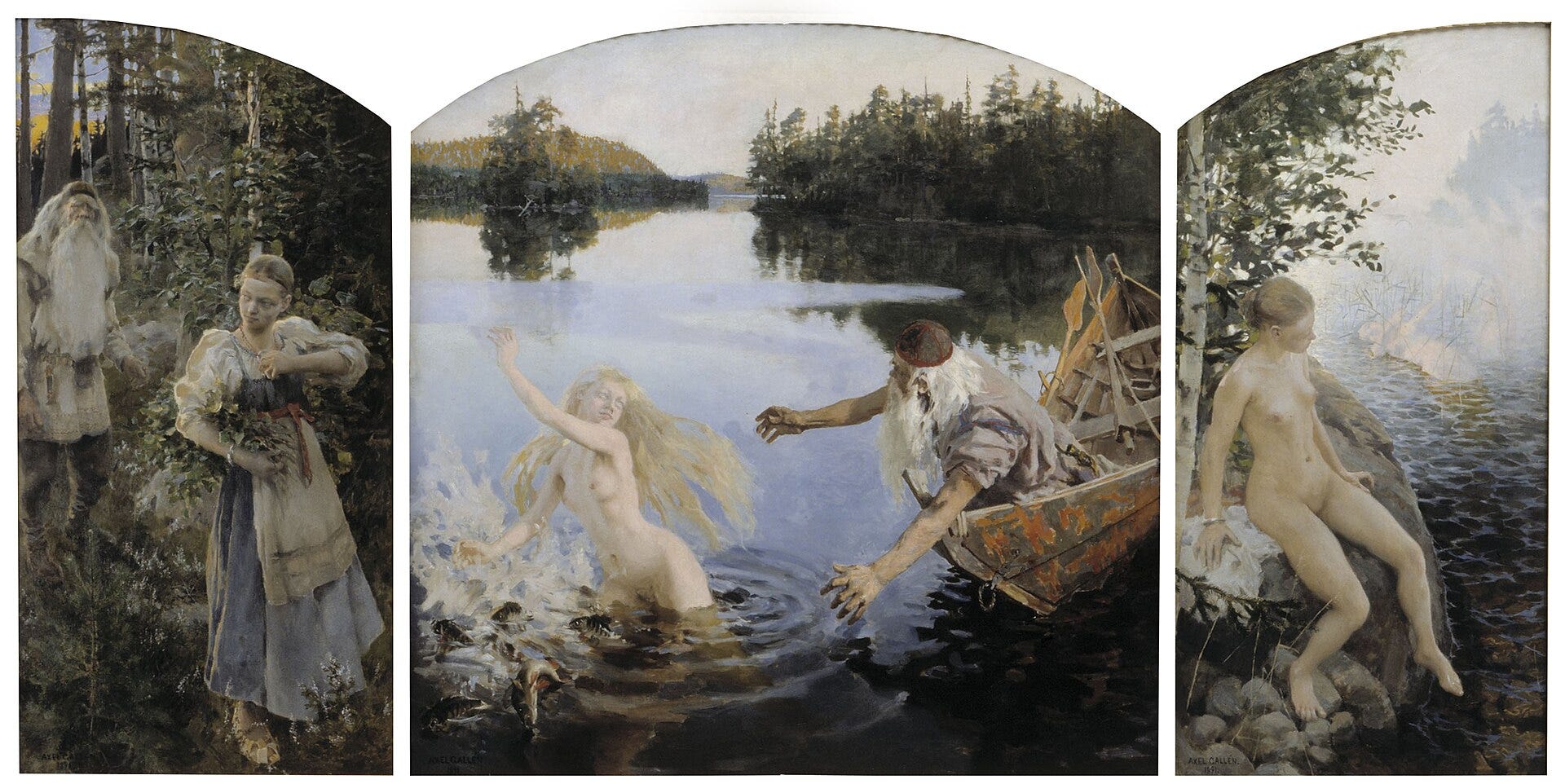
Akseli Gallen-Kallela (1865 to 1931) was a Finnish painter. He became famous for his scenes from the Kalevala, the national epic of Finland, like the Aino Myth, a painting in three panels at the Ateneum museum in Helsinki.
Cool Stories About Art is a newsletter to learn art the fun way.
Join 200,000+ readers and get:
10 new art stories / month
The entire archive of content (140+ articles)
Comment, ask questions, and chat with other readers
Akseli Gallen-Kallela was born Axel Gallén, in a Finland where educated families like his spoke Swedish, while most villagers spoke Finnish. He spent his life painting the heroes of old poems sung in Finnish, and he died under a Finnish name he had chosen himself.
Pori, the town where Axel Gallén was born on April 26, 1865, is a port on the west coast of Finland. Finland was then a grand duchy, a country with its own government and laws, but it belonged to the Russian Empire and was ruled by the Russian tsar. Before 1809, it had been part of Sweden for centuries.
As a teenager, Axel Gallén took evening drawing classes in Helsinki, the capital. At nineteen, he painted a peasant boy he knew, with a crow. To keep the boy still, Gallén told him that a little salt sprinkled on the crow's tail would tame the bird. The boy believed him and posed with the crow.
Gallén had never been to France, yet Boy with a Crow already looked like the work of the Realists of Paris, painters who showed peasants and workers as they really were. That same year, 1884, he left for Paris and the Académie Julian, a private school where many foreigners learned to paint.
In Paris, Gallén admired Jules Bastien-Lepage, a French painter who painted peasants outdoors, in the fields where they worked. The subject that would make Gallén famous, though, came from home.
That subject was the Kalevala. For centuries, village singers, above all in Karelia, a region of forests shared between Finland and Russia, had passed on its long poems in Finnish by heart. A doctor, Elias Lönnrot, wrote the poems down from the singers and published them in 1835.
One of the stories of the Kalevala tells of Aino, a young girl who would rather drown than marry an old man.
Why would a boy born Axel Gallén, in a family that spoke Swedish, end up giving himself a Finnish name?
In the rest of the story
Who posed for the girl Aino in Gallén's most famous painting.
The telegram that reached Gallén in 1895 and changed his paintings.
What a general asked the painter to draw in the middle of a war.
Why the painter traveled to America to look for his own paintings.