
In September 1528, the council of Regensburg, Germany, elected a painter mayor, and he turned the office down to paint a battle for the duke of Bavaria. Albrecht Altdorfer (around 1480 to 1538) was that German painter and printmaker, and the painting, The Battle of Alexander at Issus, now hangs in Munich.
Cool Stories About Art is a newsletter to learn art the fun way.
Join 200,000+ readers and get:
10 new art stories / month
The entire archive of content (140+ articles)
Comment, ask questions, and chat with other readers
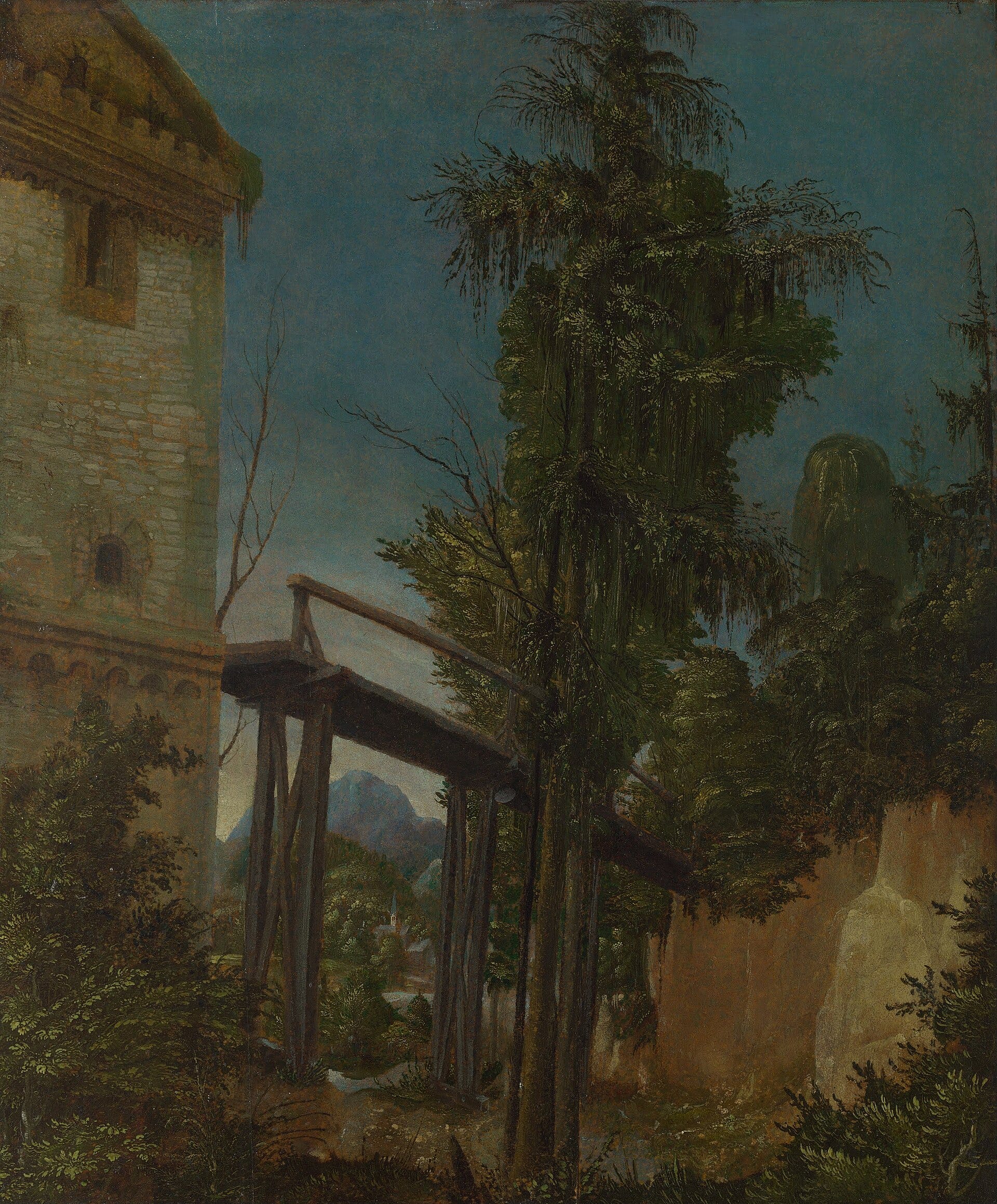
Albrecht Altdorfer painted some of the first landscapes in European art with no one in them, only trees, water and buildings. Yet the surviving piece of his tombstone names him by another title: paumeister, the old spelling of Baumeister, master builder. No building in Regensburg has ever been proved to be his design.
On March 13, 1505, Albrecht Altdorfer became a citizen of Regensburg. The city register entered him as "Maler von Amberg," the painter from Amberg, a town north of Regensburg.
Little is certain about the painter's beginnings. His father was probably Ulrich Altdorfer, a painter who colored prints sold as single sheets, and who worked in Regensburg in the 1480s.
Regensburg was a free imperial city. It obeyed no duke or prince, only the emperor, the ruler of the German lands, who was then Maximilian I. The city's own councils governed it.
In 1510, Altdorfer painted Saint George, the Christian knight of legend who saved a princess from a dragon. The panel is about 11 inches tall. A forest of leaves fills almost all of it. The knight and the dragon are small figures at its foot.
Within a few years, the painter could afford a house with its own tower and a courtyard, near the monastery of the Augustinian friars, a religious order that lived and preached in towns. He shared it with his wife. The couple never had children.
How did a painter of forests and empty landscapes end up, on his own tombstone, as the master builder of Regensburg?
In the rest of the story
What Altdorfer drew just before his city tore it down.
Why Altdorfer turned down the job of mayor of Regensburg in 1528.
What Regensburg sent its painter to carry to a king in Vienna.
What Altdorfer refused to pay for in his will.