American Gothic: Who the Two People Really Are
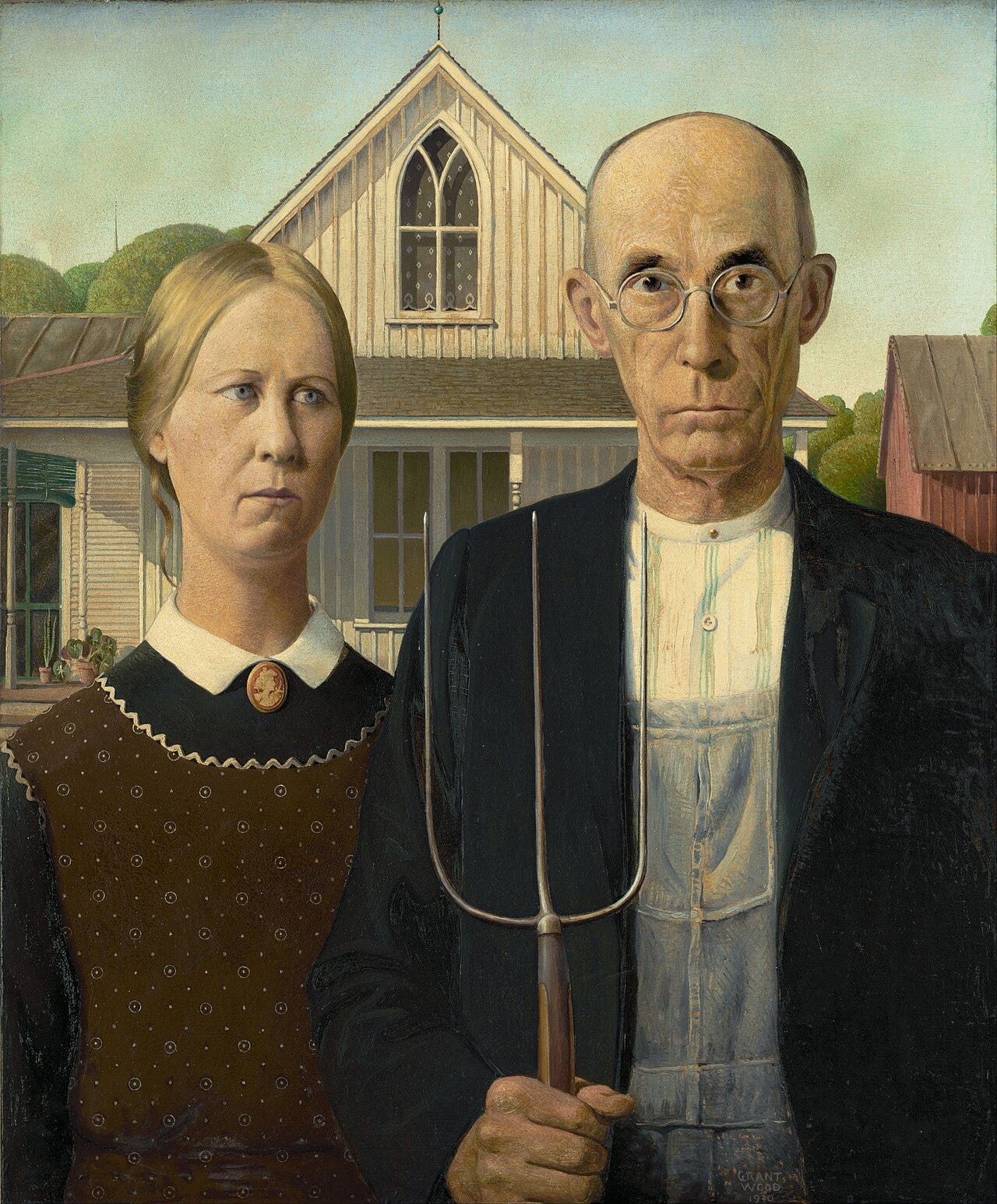
American Gothic is a 1930 painting by Grant Wood, in the Art Institute of Chicago. It shows a stern man with a pitchfork beside a woman in front of a white farmhouse.
Most people assume they are a married couple. They are not: Wood painted them as a father and his unmarried daughter, and the models were his own sister and his dentist.
It is the most parodied painting in America, and almost everything the public thinks about it is wrong. Here is who the two people really are, why it is called gothic, and whether Wood was mocking these people or honoring them.
The two people are not a couple
Grant Wood was clear about this: the pair are a farmer and his spinster daughter, standing guard over their home, not husband and wife. The gap in their ages is deliberate.
Neither model was a farmer. The woman is Wood's younger sister, Nan Wood Graham, and the sour faced man is his dentist, Dr Byron McKeeby, from Cedar Rapids, Iowa.
Wood posed them separately, in his studio, and never in front of the actual house. Nan was reportedly unhappy at being taken for the old man's wife, so her brother stressed for the rest of his life that she was meant to be the daughter.
Why it is called gothic
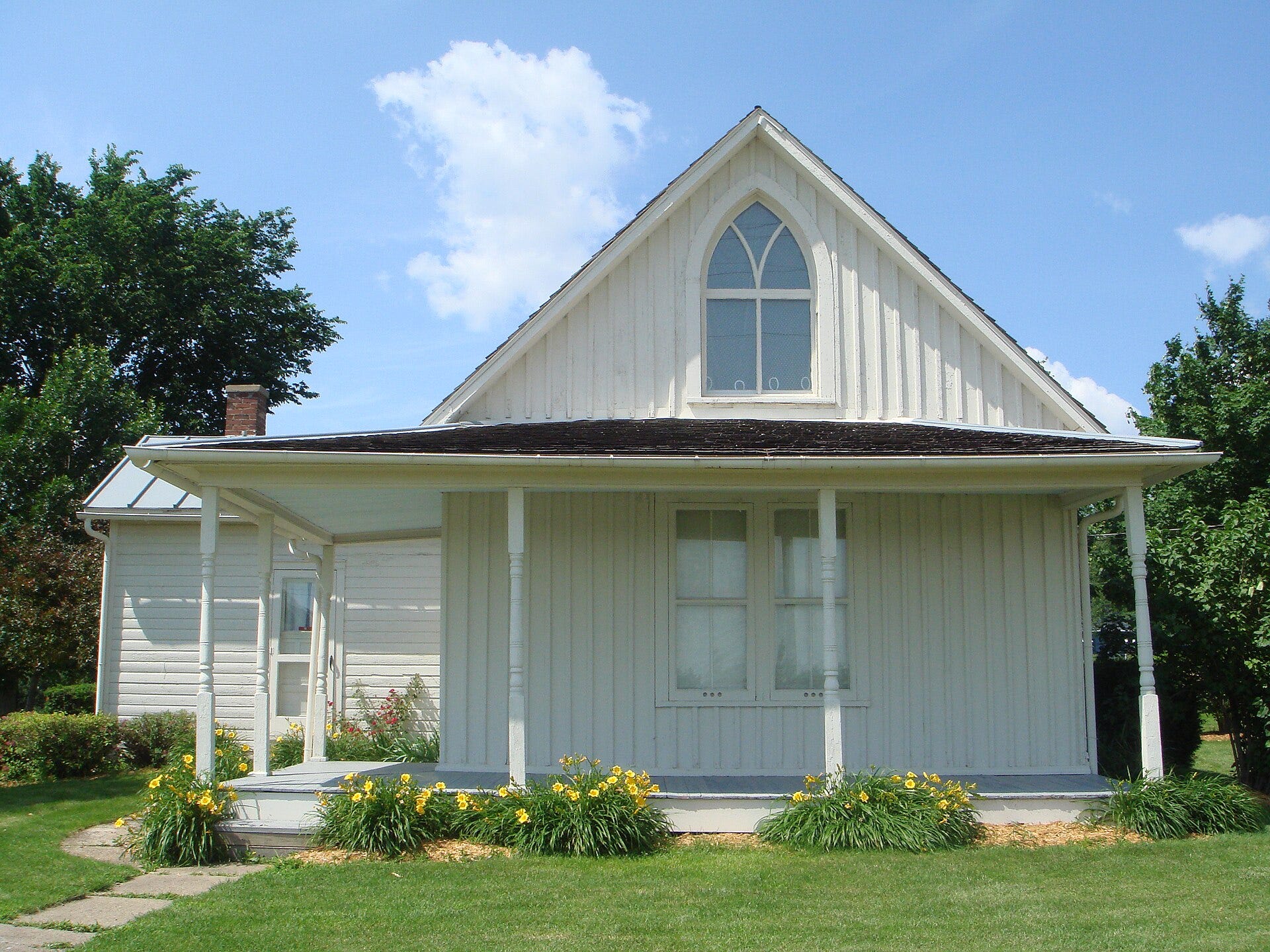
The title has nothing to do with the people and everything to do with the house. Look at the upstairs window: it is a pointed arch, a small piece of medieval Gothic architecture stuck onto a plain wooden farmhouse.
This American copy of a European style was called Carpenter Gothic.
Wood spotted a real house of this kind in the town of Eldon, Iowa, and was amused by the idea of such a pretentious window on such a humble building.
He decided to paint the sort of people he imagined would live behind it. The painting is named for the window, and the couple are almost an afterthought to it.
Satire, or a straight face
This is the argument that has never ended, and I lean toward both answers at once. Is American Gothic making fun of narrow, rigid, small town America, or is it a sincere tribute to plain, hardy, hard working people?
Wood, maddeningly, would never fully say.
The ambiguity is the reason it became famous. In 1930, a year into the Great Depression, some saw a proud image of the American backbone, others a cruel caricature of the joyless country cousin.
Wood, who had grown up on an Iowa farm himself, seems to have felt both at once, affection and mockery mixed. The picture is a mirror: people mostly see in it their own opinion of rural America.
Wood was not the country bumpkin he played
There is a myth that Grant Wood was a simple homespun farmer who painted what he knew. He worked hard to create that image, and it is not true.
Wood had trained in Paris and later spent time in Munich, painting in a loose, near Impressionist manner before American Gothic. The hard, sharp, enamelled style of this picture, every stitch of the apron and pore of the face crisply defined, did not come from Iowa.
It came from the Northern Renaissance painters he had studied in Europe, the precise, unforgiving realism of Flemish masters like Jan van Eyck and Hans Memling.
The most American painting ever made was built on old German and Flemish technique.
The Art Institute, the house, and the parodies
American Gothic is in the Art Institute of Chicago, which awarded it a three hundred dollar prize at its 1930 exhibition and acquired it that same year, and it rarely leaves.
It is not for sale and is treated as a national treasure. The real house still stands in Eldon, Iowa, now a small museum where visitors line up to pose in front of it with a pitchfork.
And the image has been parodied more than almost any other, its two figures replaced by every possible pair, from politicians to cartoon characters, on countless magazine covers and adverts, which is the surest sign of how deep into the culture it has sunk.
American Gothic, quick answers
Who are the people in American Gothic? A father and his unmarried daughter, not a couple. The models were Grant Wood's sister Nan and his dentist, Dr Byron McKeeby.
Why is it called American Gothic? For the pointed Gothic window on the farmhouse, a style called Carpenter Gothic. The title is about the house, not the people.
Is it satire or a tribute? Wood never fully said. It has been read both as a proud image of rural America and as a mockery of small town rigidity, and people tend to see their own view in it.
Who painted it and when? Grant Wood, in 1930, in Iowa.
Where is American Gothic? The Art Institute of Chicago.
If this painting pulled you in, you will love these too:
The secret behind Hopper Soir Bleu, the clown picture that went wrong
The Arnolfini Portrait, detail by detail, the mirror, the dog, and the question everyone asks
The darker truth about Gauguin, the part of the Tahiti story that never makes the wall label
The sister who guarded her own face
Nan Wood Graham spent decades as the woman in the picture, and she took it seriously. When the humorist and the advertiser turned her painted face into a joke, she sometimes fought back, once threatening legal action over an unflattering parody.
She outlived her brother by half a century and died in 1990, having been, for sixty years, the most recognized and most caricatured face in American art, a face that was never actually a farmer's wife.
You can see American Gothic in person at the Art Institute of Chicago. For more by the artist, browse the Metropolitan Museum collection.
Questions about the farm couple
Are the two figures a married couple? No. Grant Wood said they were a farmer and his unmarried daughter. His models were his own dentist and his sister.
Is the house real? Yes. It is a real house in Eldon, Iowa, with a distinctive pointed window that gave the painting its name.
What does the painting mean? People still argue about it. Some read it as gentle satire of narrow rural life, others as a tribute to hardy country values.
Where is American Gothic? It hangs in the Art Institute of Chicago.
Who painted it? Grant Wood, in 1930, a leader of American Regionalism.