
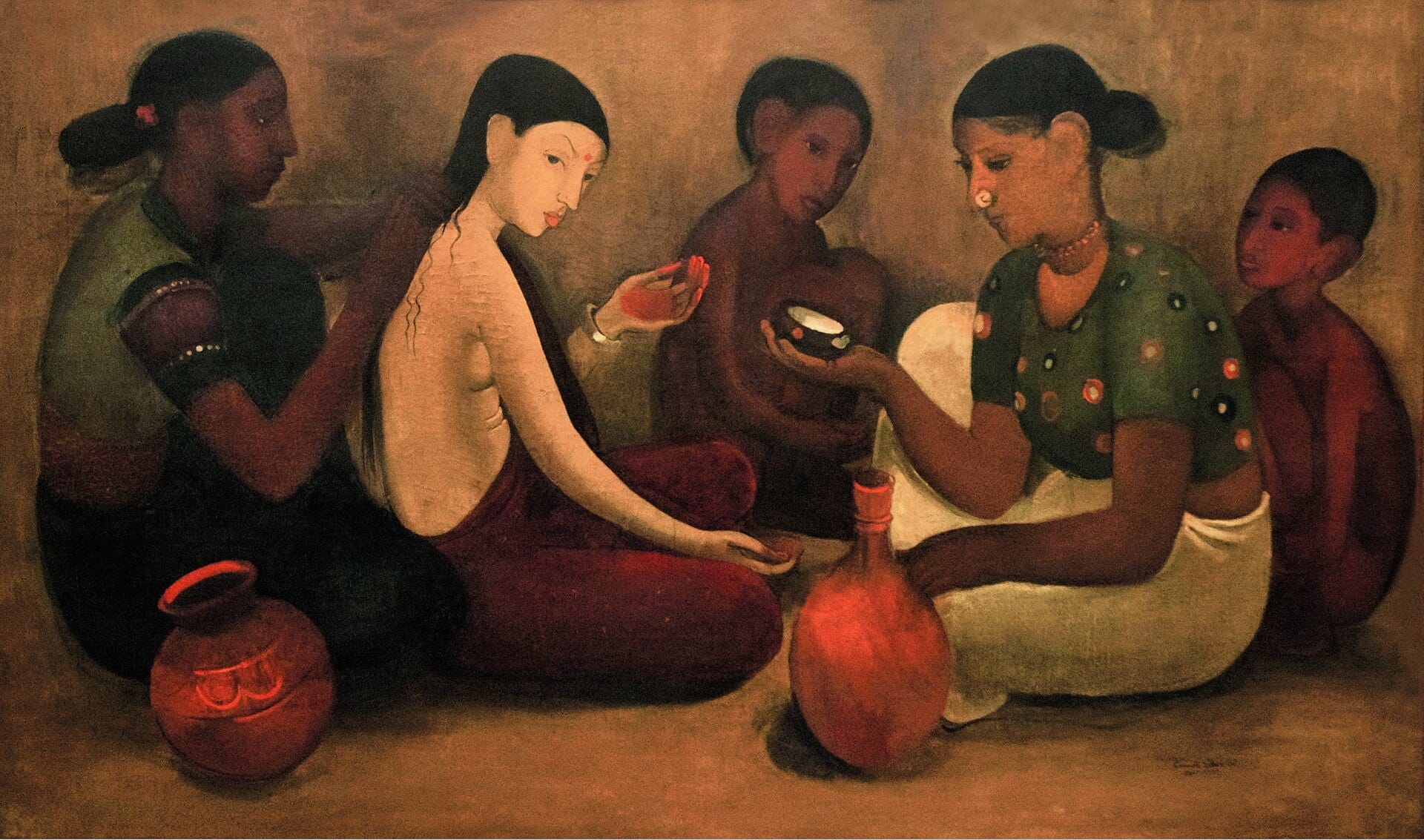
Amrita Sher-Gil (1913 to 1941) was a painter born in Budapest, Hungary, to a Sikh father from India and a Hungarian mother. She trained in Paris, then painted in India, and her best-known works, like Young Girls and Bride's Toilet, hang in New Delhi.
Cool Stories About Art is a newsletter to learn art the fun way.
Join 200,000+ readers and get:
10 new art stories / month
The entire archive of content (140+ articles)
Comment, ask questions, and chat with other readers
In 1933, at the age of twenty, Amrita Sher-Gil won a gold medal at the Grand Salon, the great yearly art exhibition of Paris. At the end of 1934, she left Paris and its prizes behind to paint India, the country of her father.
India was the country of her childhood too. In 1921, short of money in Hungary, her parents settled with Amrita, then eight, and her younger sister, Indira, at Summer Hill, a house on the edge of Shimla.
Shimla was a town in the hills of northern India, where the British, who then ruled the country, moved their government every summer.
Amrita's father, Umrao Singh Sher-Gil, was a Sikh nobleman from the Punjab, the region of northern India where the Sikh religion began in the late 1400s. He read Sanskrit and Persian, two classical languages of Asia. Her mother, Marie Antoinette, was an opera singer from Budapest.
Amrita had been drawing and painting since the age of about five. In Shimla, she and Indira also gave concerts and acted in plays.
In 1926, when Amrita was thirteen, her mother's brother came from Budapest to stay at Summer Hill. Ervin Baktay was a Hungarian expert on the culture of India.
Baktay looked at his niece's drawings and saw a real talent. He gave her a first training in academic art, the method of the fine arts schools of Europe, where students learn to draw from plaster casts and live models.
In 1929, at sixteen, Amrita Sher-Gil sailed to Europe with her mother, to study painting in Paris.
At the École des Beaux-Arts, the national school of fine arts of France, Amrita won first prize in the yearly portrait and still life competition three years in a row.
By twenty, she had the training, the prizes and the medal that young painters came to Paris to win. Her teachers had all been European.
Why did a painter honored in Paris at twenty leave Europe to paint India?
In the rest of the story
What Amrita Sher-Gil learned from paintings more than fifteen hundred years old.
Which journey across India gave her three famous paintings in one year.
The sentence in which she explained her choice herself.
What she was preparing in the last days of her life.