
Pliny the Elder, a Roman writer, told of a Greek artist, Zeuxis, whose grapes looked so real that birds flew down to the stage where they hung, and of his rival Parrhasius, who answered with a curtain made of paint and just as deceptive. None of those pictures survives. What remains of Greek painting is what chance spared: scenes fired onto clay vases, a few walls, some wooden boards, gravestones still in color and a floor of colored stone.
Cool Stories About Art is a newsletter to learn art the fun way.
Join 200,000+ readers and get:
10 new art stories / month
The entire archive of content (140+ articles)
Comment, ask questions, and chat with other readers
What Survived of Greek Painting
Greek painters told the stories of gods, heroes and the dead on any surface that would hold color, and nearly all of their work on wood and plaster has vanished. Where some of it remains, it took a sealed grave, a dark cave, a layer of volcanic ash or a copy made in another material to save it.
Clay held up far better, and it is where most Greek painting survives. On a vase, the picture went on in slip, a fine clay thinned with water. The pot was then fired in a kiln starved of air, which turned everything black. When air was let back in, the bare clay turned red again, and only the slip stayed black.
That firing gave two ways of working. In black-figure, the older one, the figures are black silhouettes on the red clay, with their details scratched in with a point. In red-figure, which came later, it is the other way around: the background is black and the figures keep the color of the clay.
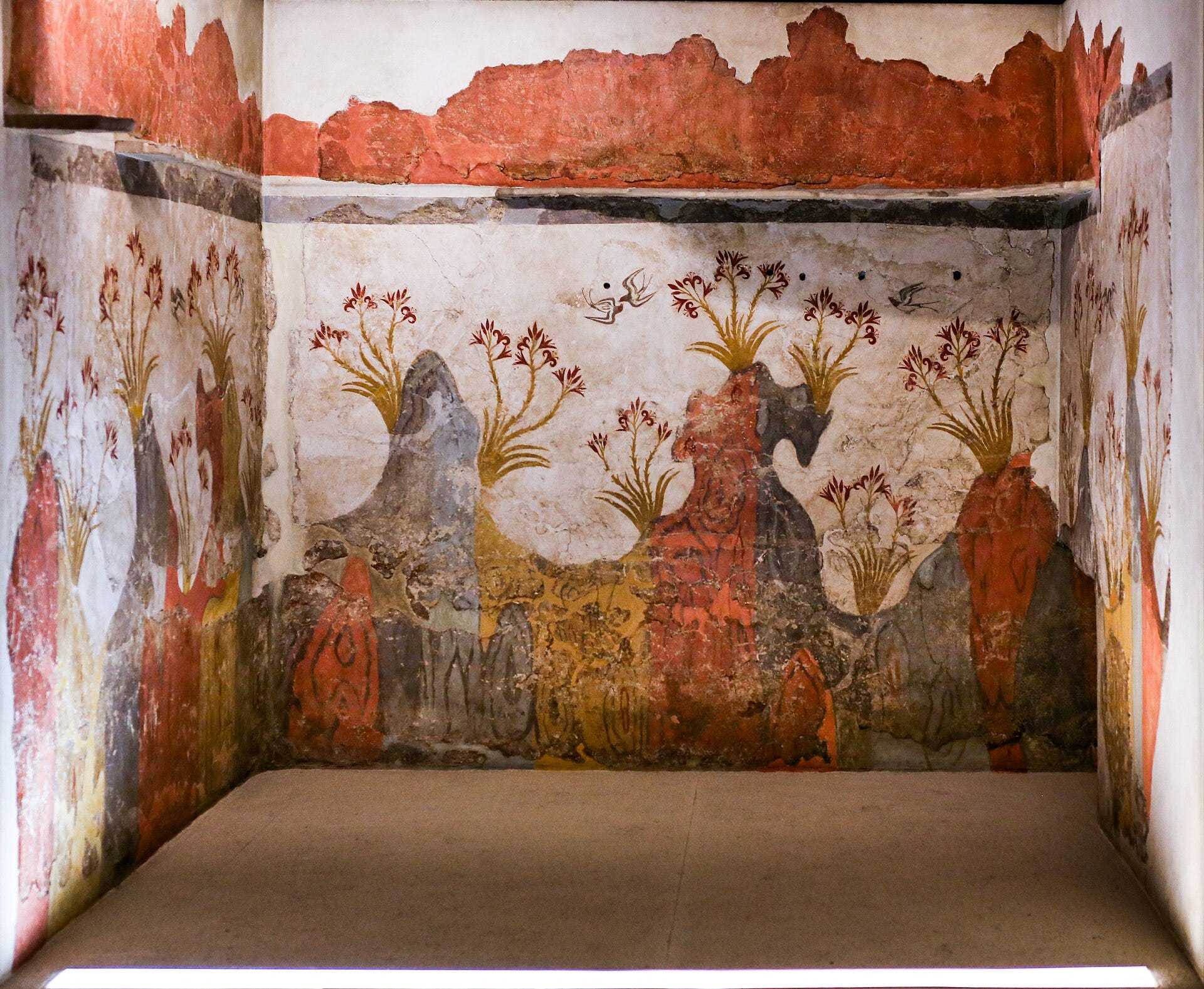
Eleven of the twelve are Greek paintings that still exist or, in one case, a copy that may preserve a lost one. The twelfth is older: a Bronze Age wall painting, made centuries before classical Greece by the people of a volcanic island that is Greek today. None is a modern picture of a Greek myth.
12. Kleitias and Ergotimos, The François Vase (about 570 BC)
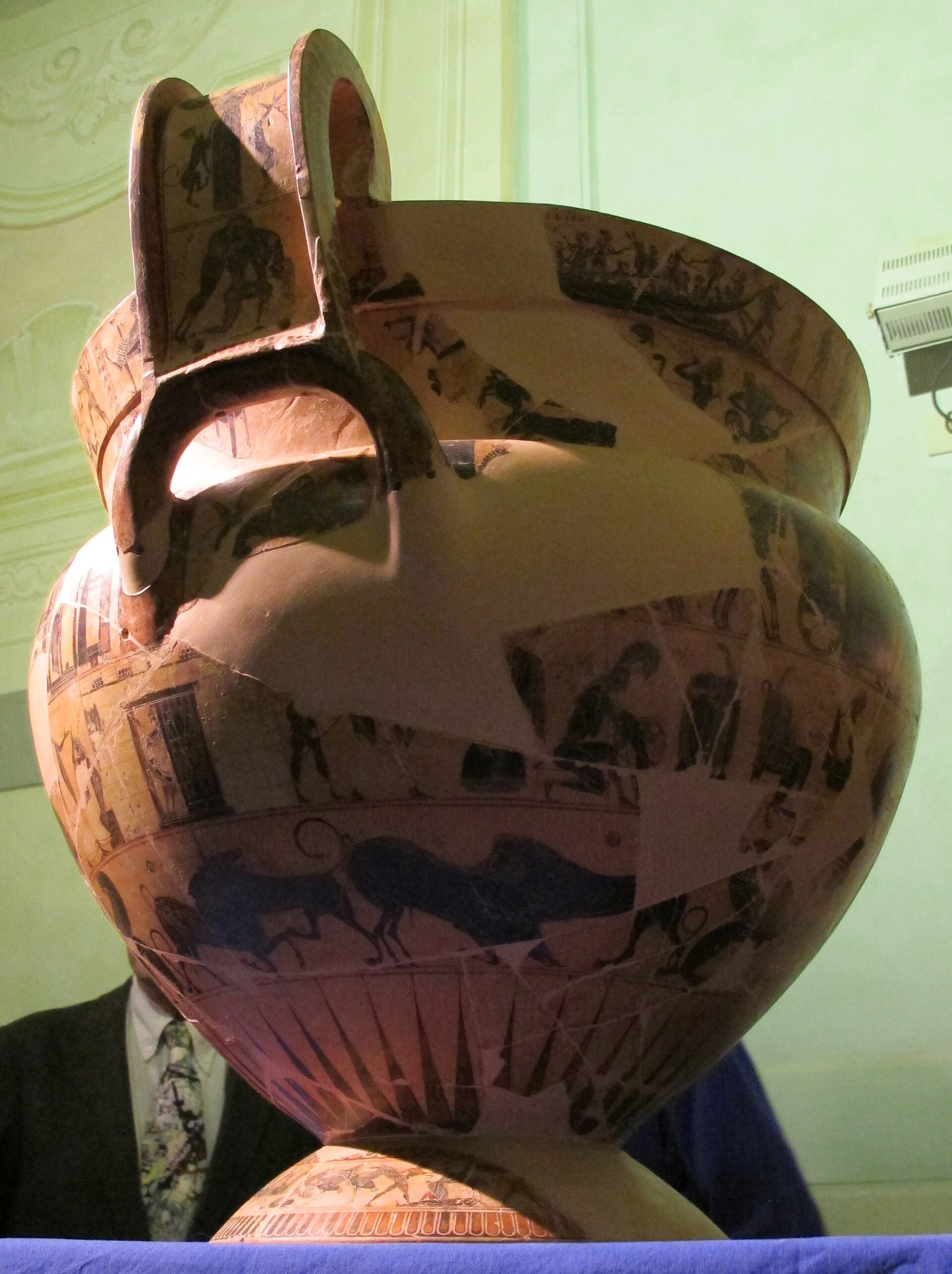
Bands of small figures, horses and chariots run around the body of this large vase, 270 figures in all. It is a volute krater, a jar in which the Greeks mixed their wine with water, 66 centimeters high. It was fired in Athens around 570 BC and signed by Kleitias, who painted it, and by Ergotimos, the potter who shaped it.
It reached the modern world in pieces. In 1844 and 1845, Alessandro François, an Italian who dug for antiquities, took its fragments out of an Etruscan tomb at Chiusi, in Tuscany. Once they had been joined again, the vase took his name, and it has kept it ever since.
On September 9, 1900, it broke a second time. In the museum in Florence where it was kept, a guard who was quarreling with a colleague hurled a wooden stool at its glass case. The vase burst into 638 pieces.
The museum's director handed the pieces to a restorer, Pietro Zei, and it took Zei two years to put the vase back together.
The stool is said to have been kept, and to be shown today in the museum, beside the vase it smashed.
At a Glance
Artist: Kleitias (painter) and Ergotimos (potter), Athenian, active about 570 BC
Made: About 570 BC
Medium: Black-figure painting on terracotta (volute krater)
Size: 66 cm high (26 in)
Where to see it: Museo Archeologico Nazionale, Florence
11. The Painted Stele of Hediste, Demetrias (late 3rd or early 2nd century BC)
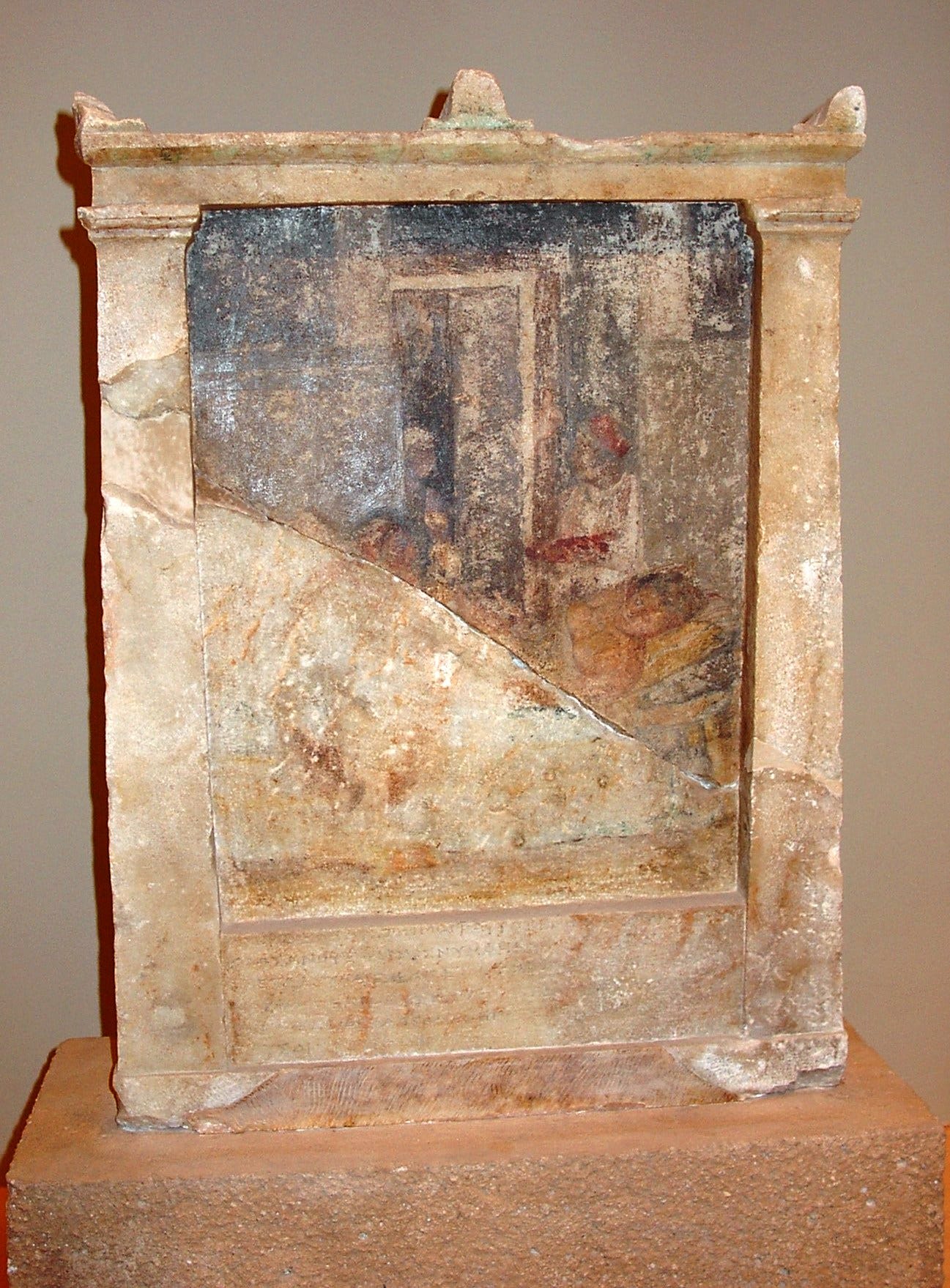
The newborn in this picture, tightly swaddled, is held by people of the household, not by its mother. She lies slumped on a bed behind them, and a man sits facing her. Early in the twentieth century, a Greek archaeologist pulled this gravestone, and many others with their colors intact, out of the towers of an ancient city wall. Under the picture, a few lines of verse said what had happened in that room.