
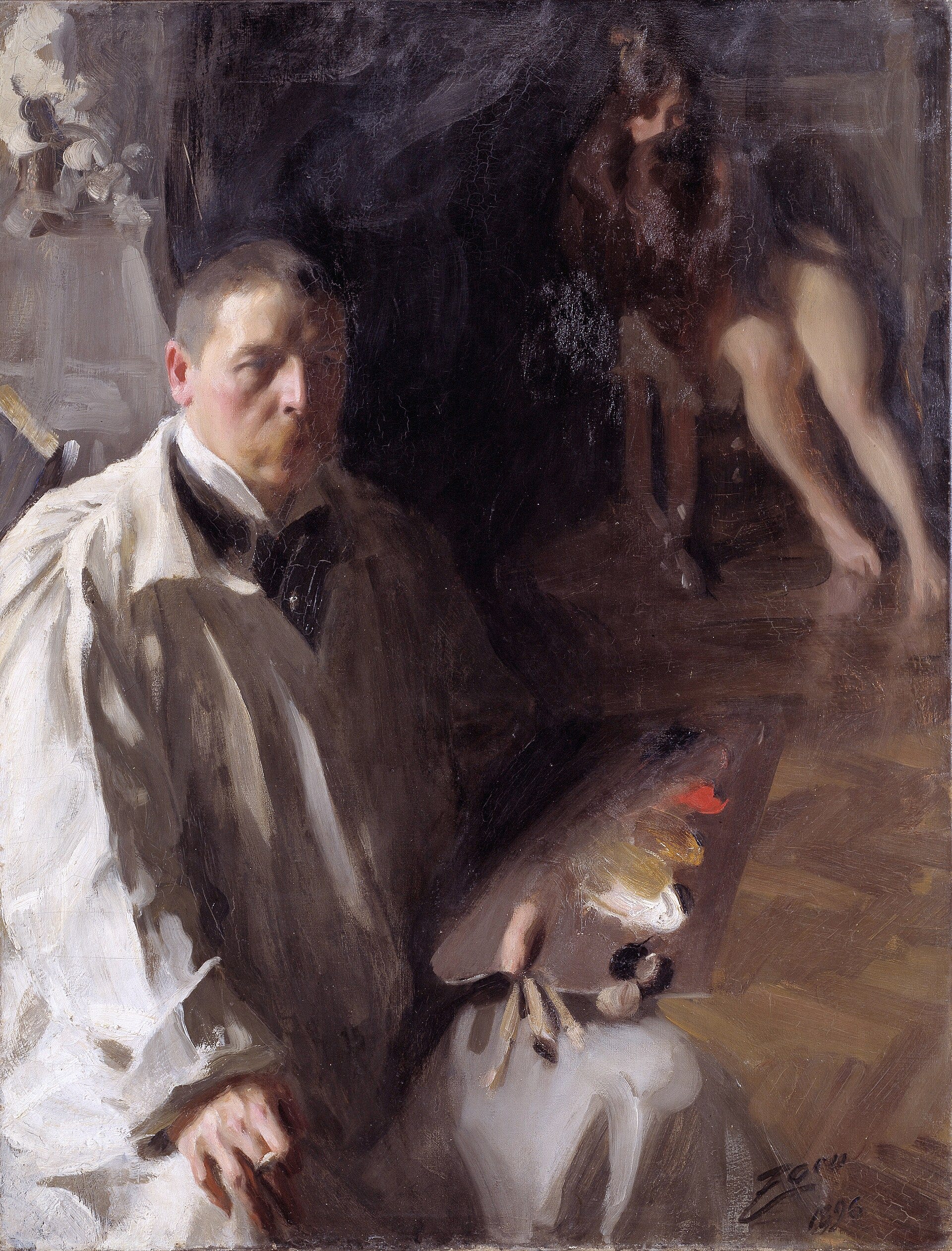
Anders Zorn was a Swedish painter, born in Mora in 1860 and dead in 1920, who became a portraitist everyone wanted. He painted the American presidents Grover Cleveland and William Howard Taft, etched Theodore Roosevelt, and is remembered by painters for the Zorn palette, four colors said to be enough for a whole portrait. The pictures most people know are his naked Swedish women bathing outdoors.
He was the son of a Dalarna woman and a German brewer who never married her, and he ended up in the White House. The four colors are what most people come looking for, and the legend is only partly true.
Cool Stories About Art is a newsletter to learn art the fun way.
Join 200,000+ readers and get:
10 new art stories / month
The entire archive of content (1,000+ articles)
Comment, ask questions, and chat with other readers
The recipe is short enough to learn in an afternoon: lead white, yellow ochre, vermilion and ivory black. With nothing else on the palette, a painter can mix a surprising range of natural skin tones, and art students still run Zorn palette exercises to learn restraint.
Zorn did not stop at four. Critics who compare the legend with his paintings, and with the paint box kept at the Nationalmuseum in Stockholm, say he used more. His contemporaries could not agree on the count either: the painter Birge Harrison wrote that he worked with only two colors, vermilion and yellow ochre, counting black and white as no colors at all.
So the fact that made Zorn famous among painters is a simplification. What is certain is how little he needed. A boy raised on his grandparents' farm in a village in Dalarna ended up charging $4,000 for a portrait in New York.
What You'll Discover
Where a village boy learned to paint.
What the four colors really were.
Who bought his picture on the spot.
Which presidents sat for him.
What he painted in the reeds.
Who stood behind the whole career.