
Andrew Wyeth was an American painter, born in Chadds Ford, Pennsylvania, in 1917, who died there in 2009 at the age of 91. He painted in egg tempera and spent seventy years on two places, Chadds Ford and Cushing, Maine.
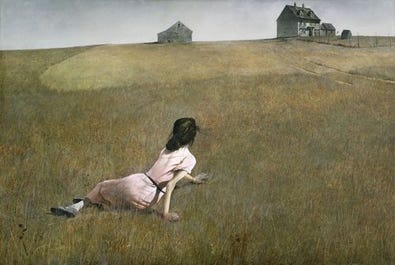
He is remembered for Christina's World, the 1948 picture of a woman in a pink dress crawling toward a farmhouse, and for the Helga pictures, about 240 works he kept secret for fifteen years.
Critics dismissed him as an illustrator for half a century while crowds kept lining up for one small picture. The woman in it is not who people think.
Cool Stories About Art is a newsletter to learn art the fun way.
Join 200,000+ readers and get:
10 new art stories / month
The entire archive of content (1,000+ articles)
Comment, ask questions, and chat with other readers
In the summer of 1948, at the Olson farm in Cushing, Maine, Wyeth began a picture of his neighbor Christina Olson. As a young girl she had developed a muscle condition that left her unable to walk. She refused a wheelchair and crossed the fields by dragging herself with her arms. Wyeth said he wanted "to do justice to her extraordinary conquest of a life which most people would consider hopeless."
The woman in the pink dress is not Christina. She lent Wyeth her hands and arms and nothing else. The young body in the field belongs to his wife, Betsy. The hair came from one of his aunts, and the shoe from an abandoned house. The figure that visitors take for Christina was assembled from three people and an old shoe.
Wyeth himself did not trust the result. In October 1948 he wrote to Betsy that it was "a complete flat tire." The Museum of Modern Art bought it anyway, for 1,800 dollars, and it became one of the most popular pictures in the museum. The critics have been fighting about it ever since.
What You'll Discover
What the train took from him.
Who Christina really was.
Why critics called him a minor painter.
What he hid for fifteen years.
Where the painter lies now.