
Angelica Kauffman (1741 to 1807) was a Swiss painter who worked in London and then in Rome, where she died. She painted portraits and scenes from ancient history and myth, such as Cornelia, Mother of the Gracchi, in which a Roman widow points to her two young sons as her only treasures.
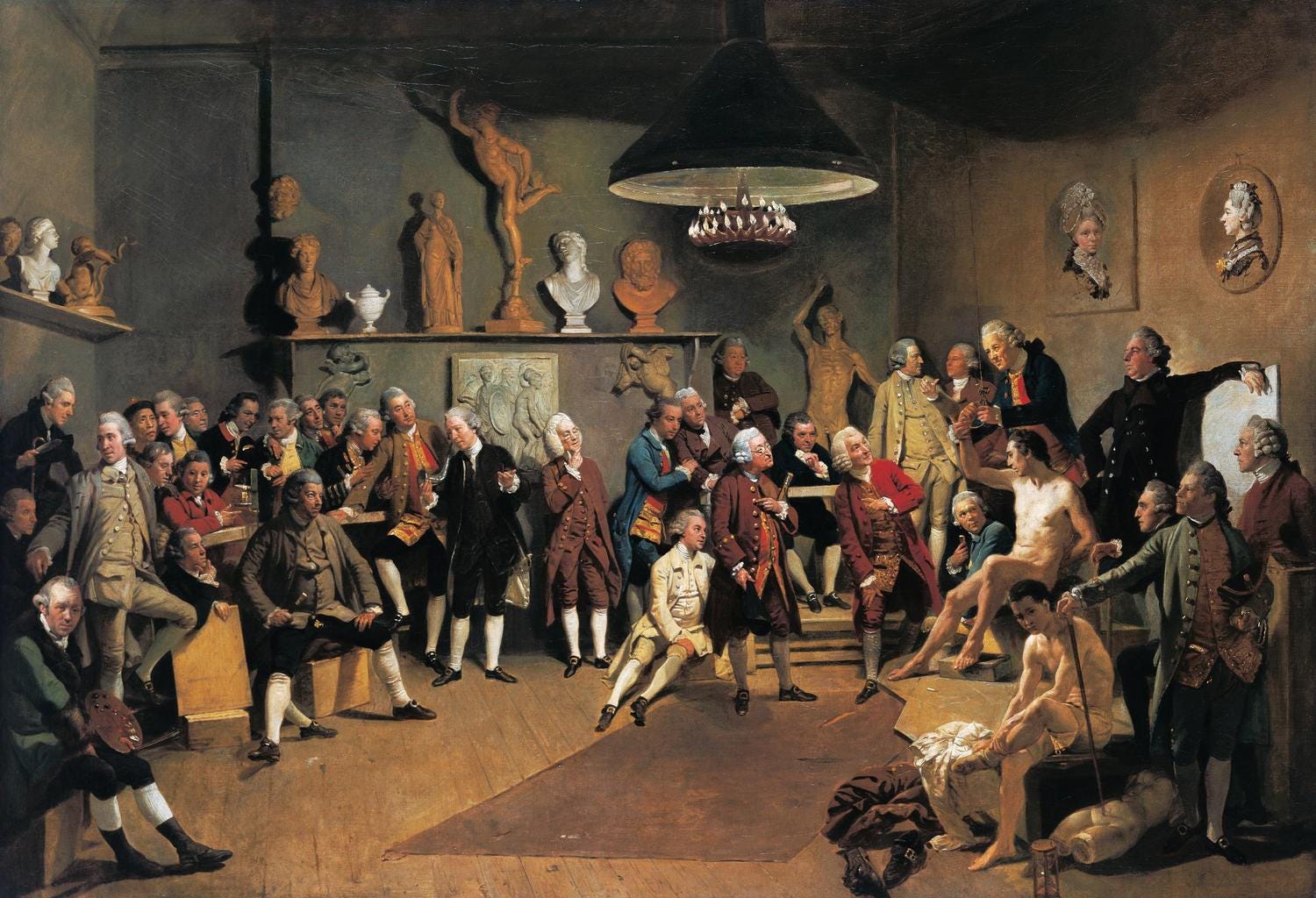
In 1768, Kauffman was one of only two women among the founders of the Royal Academy, the official society of British artists. Yet in a group portrait of its members by the painter Johan Zoffany, she appears only as a picture hanging on the wall.
By her forties, she was one of the most famous painters in Europe, rich enough to buy a painting by Titian, the great Venetian master.
Cool Stories About Art is a newsletter to learn art the fun way.
Join 200,000+ readers and get:
10 new art stories / month
The entire archive of content (140+ articles)
Comment, ask questions, and chat with other readers
Angelica Kauffman was born in 1741 in Chur, a small town in the Swiss Alps. Her father, Johann Joseph, was a poor painter of portraits and church walls from Schwarzenberg, a mountain village in what is now western Austria.
Johann Joseph traveled wherever he found work, and he trained his daughter as his assistant.
In 1742 the family moved over the Alps to Morbegno, in what is now northern Italy, and ten years later to Como. In 1754 they moved on to Milan, where Angelica, barely a teenager, painted portraits for the court of its governor, the Duke of Modena.
Angelica also sang and played the harpsichord, the keyboard instrument that came before the piano. Her father thought that a singer could earn more on the opera stage than a painter at the easel.
A priest, a friend of the family, warned that the opera was no place for a virtuous young woman. In 1757, after her mother died in Milan, Angelica, then fifteen, chose painting.
In the 1700s, the most admired kind of picture was history painting: scenes from the Bible, myth and the past, full of heroes.
To paint heroes, a painter had to know the human body. Academies, schools run by artists, taught it in the life class, where students drew a man who posed nude.
No written rule kept women out, but it was considered improper for a woman to attend, and Angelica never sat in one.
So how would a young woman who never sat in a life class learn to paint the bodies of heroes, and become, at twenty-seven, a founder of the Royal Academy?
In the rest of the story, you'll find out:
who the Swedish count she married in secret really was
how a woman kept out of the life class ended up on the Academy's ceiling
what Goethe, Germany's greatest writer, complained about in her portrait of him
what the artists of Rome carried behind her coffin