
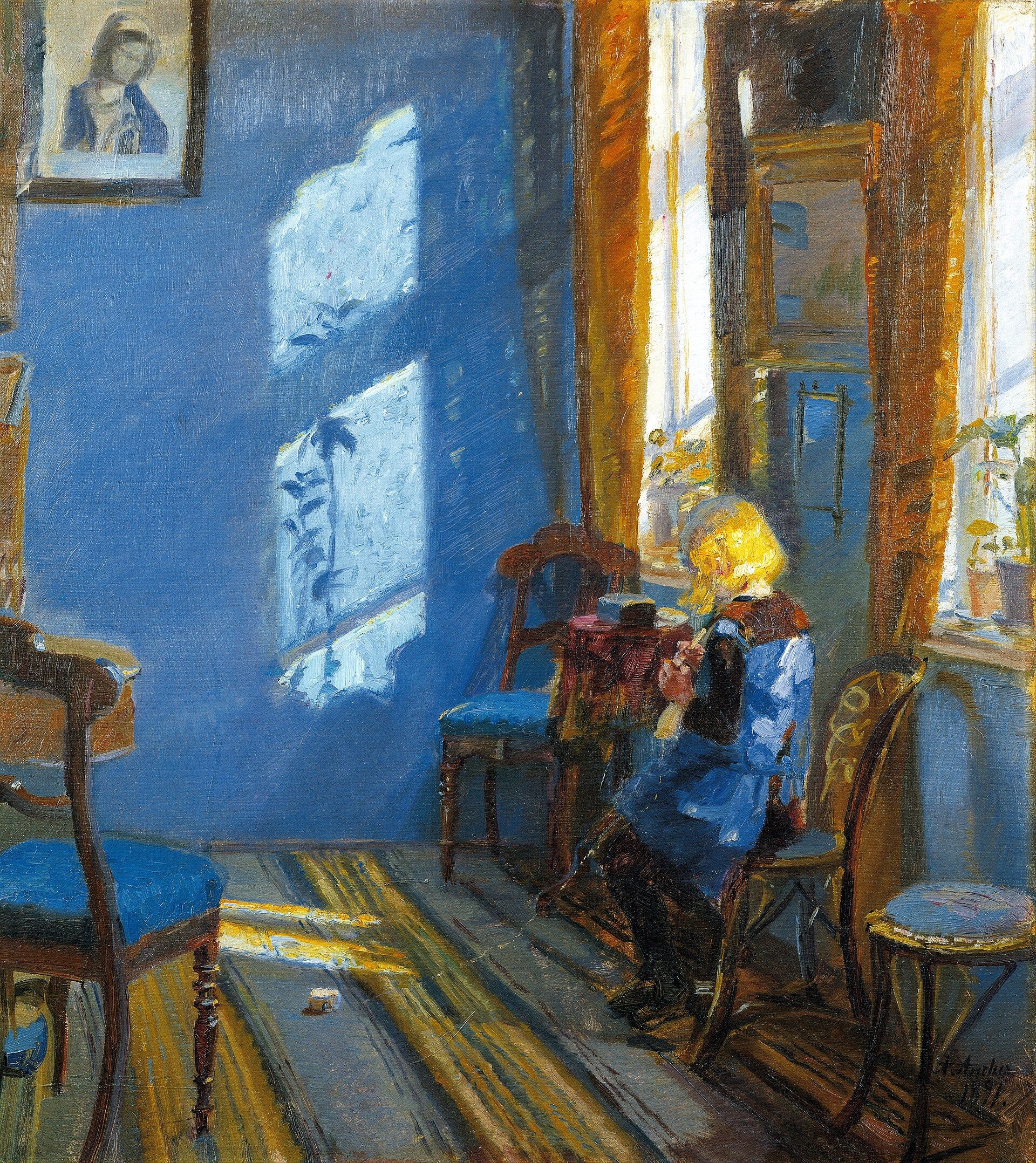
Anna Ancher (1859 to 1935) was a Danish painter from Skagen, a fishing town at the northern tip of Denmark. She became famous for painting sunlight in quiet rooms, as in Sunlight in the Blue Room, now at the Skagens Museum.
Cool Stories About Art is a newsletter to learn art the fun way.
Join 200,000+ readers and get:
10 new art stories / month
The entire archive of content (140+ articles)
Comment, ask questions, and chat with other readers
When Anna Ancher was young, the Royal Academy of Fine Arts in Copenhagen, the school that trained the painters of Denmark, would not take her as a student because she was a woman. Even the teacher she found elsewhere believed that a married woman should give up painting, and he told her so.
Anna Brøndum was born on August 18, 1859, in the only inn of Skagen, which her parents ran. Later in the century, artists from all over Scandinavia came to paint the fishermen of the town and its light, and they became known as the Skagen Painters. Anna was the only one of them born there.
In 1874, Michael Ancher, a young painter from Bornholm, a Danish island in the Baltic Sea, took a room at the inn. The lodger, then about 25, saw that the innkeeper's daughter, a girl of fifteen, had a gift for painting, and he encouraged her.
Since the Academy was closed to her, Anna spent the winters of 1875 to 1878 in Copenhagen, the capital, at a painting school for women run by Vilhelm Kyhn, a landscape painter. Kyhn taught her the basics and gave her little encouragement.
Between those winters, Anna came home to Skagen. By 1878, when Michael Ancher painted her portrait, she was not yet twenty and had agreed to marry him.
In 1880, she showed a picture for the first time at the spring exhibition the Academy held each year in Copenhagen: An Old Man Whittling Sticks, a fisherman of Skagen at work with his knife.
On August 18, 1880, the day she turned 21, Anna Brøndum married Michael Ancher in Skagen and took his name. She was now Anna Ancher.
After the wedding, her old teacher Vilhelm Kyhn sent her a set of china with a note: she could take her paint box to the sea and sail away with it. A married woman, he wrote, would want to be a housewife, no longer an artist.
How did the woman told to sail away with her paint box join the Academy that had been closed to her?
In the rest of the story
What she saw the first time she left Denmark.
Whose funeral she painted, and who bought it.
Where she painted while her husband had a studio of his own.
Where her face appeared, 63 years after her death.