
In the Gospel story, an angel comes to a young woman in Nazareth and tells her she is to be the mother of a son, and almost nothing that matters can be seen: a voice, a promise, a conception. Painters have spent five centuries showing it anyway, down to a carrier pigeon on a bridge and an angel riding a drum.
Cool Stories About Art is a newsletter to learn art the fun way.
Join 200,000+ readers and get:
10 new art stories / month
The entire archive of content (140+ articles)
Comment, ask questions, and chat with other readers
One Room in Nazareth, Painted for Five Centuries
The account belongs to Luke's Gospel. An angel greets Mary and announces that Jesus will be born to her, and she replies that she is the servant of the Lord. For Christians, that exchange marks the moment God became human, which is why the feast is kept on March 25, exactly nine months before Christmas.
That leaves a painter with a practical problem. A conversation and a conception have to fit into a single image that does not move. Over the centuries a set of signs grew up to help, the closed room, the open book, the lily, the dove or a ray of light, and each artist was free to arrange them in his own way.
The paintings were picked for the way they settle two questions every painter of the scene had to face: where the angel stands, and how his arrival becomes something the eye can see.
12. Carlo Crivelli, The Annunciation, with Saint Emidius (1486)
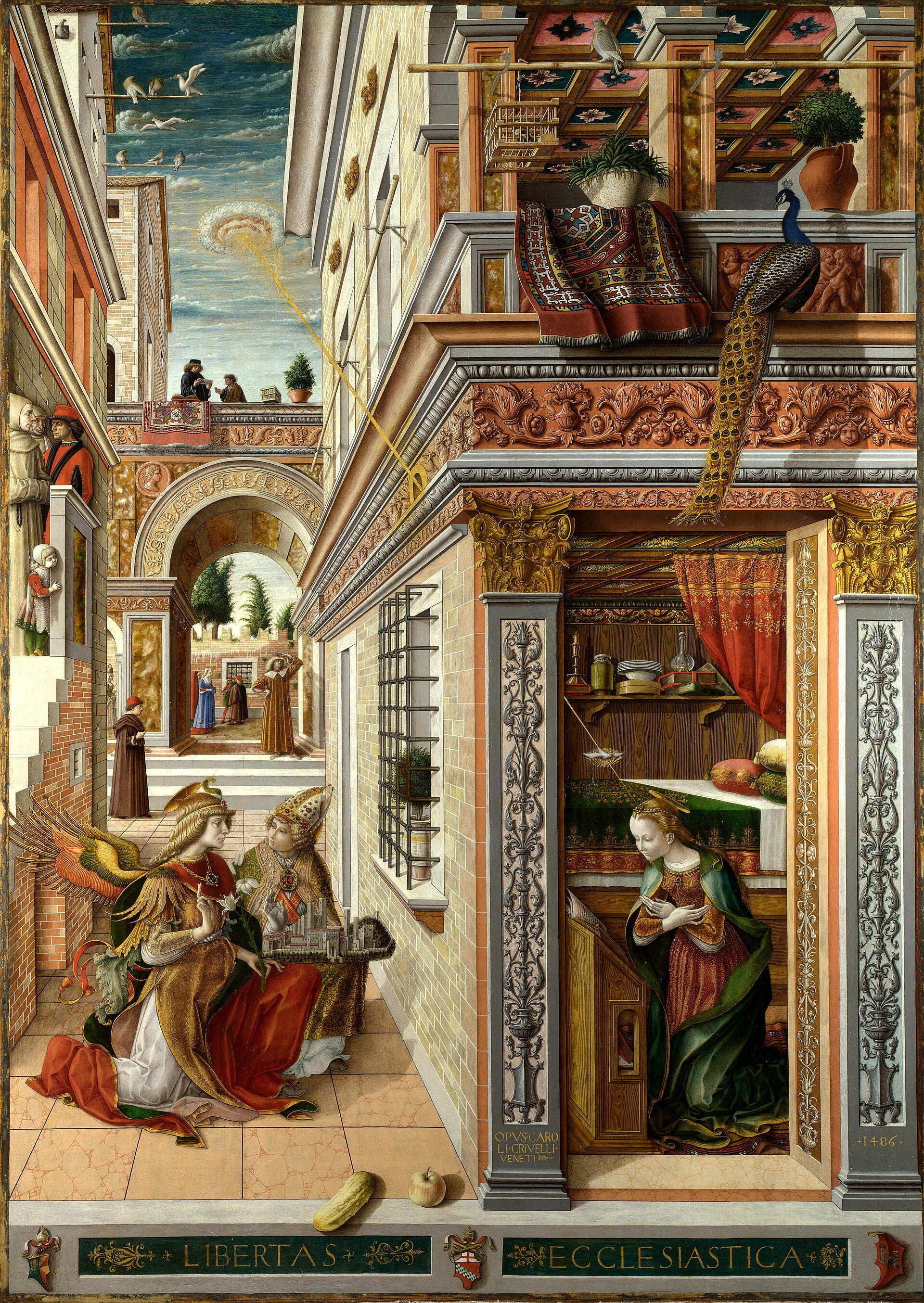
On a bridge at the back of the picture, a man is reading a sheet of paper that another man has just handed him. Beside them sits a small cage. It held the carrier pigeon that brought the message, and that message is the reason Carlo Crivelli painted this Annunciation at all.
The news was about Ascoli Piceno, a hill town in the Marche, on the Adriatic side of Italy. In 1482, Pope Sixtus IV granted the town a measure of self-government, which meant it could run its own affairs without answering directly to Rome. Word of it reached Ascoli on March 25, the very day the Church celebrates the Annunciation.
Four years later, the coincidence became a commission. The Franciscan friars of the town's Annunziata convent ordered an altarpiece to mark it, and Crivelli delivered it that same year, with both announcements in a single picture.
The civic half of the story kneels in the street. Next to the angel is Saint Emidius, the patron saint of Ascoli, holding a model of the town on his knee, its towers still recognizable today. Across the foot of the canvas runs the name of the privilege the pope had granted, LIBERTAS ECCLESIASTICA.
The sacred half takes another route. The Holy Spirit, in the form of a dove, does not fly in through a window. It slips through a small gilded hole cut in the wall of the house and travels down a thin ray of gold to Mary, who kneels inside a richly furnished room.
Around these two messages, Crivelli fills the street with the life of the town. A child peers around the corner of a staircase at the visitors, and a peacock, a symbol of the Resurrection, perches on the cornice. Up on the bridge, the two men are still reading the pigeon's news, while in the house below, the other announcement has already arrived.
At a Glance
Artist: Carlo Crivelli (about 1430/35 to about 1494)
Painted: 1486
Medium: Egg and oil on canvas
Size: 207 × 146.7 cm (81.5 × 57.8 in)
Where to see it: The National Gallery, London
11. Lorenzo Lotto, The Annunciation (about 1534)
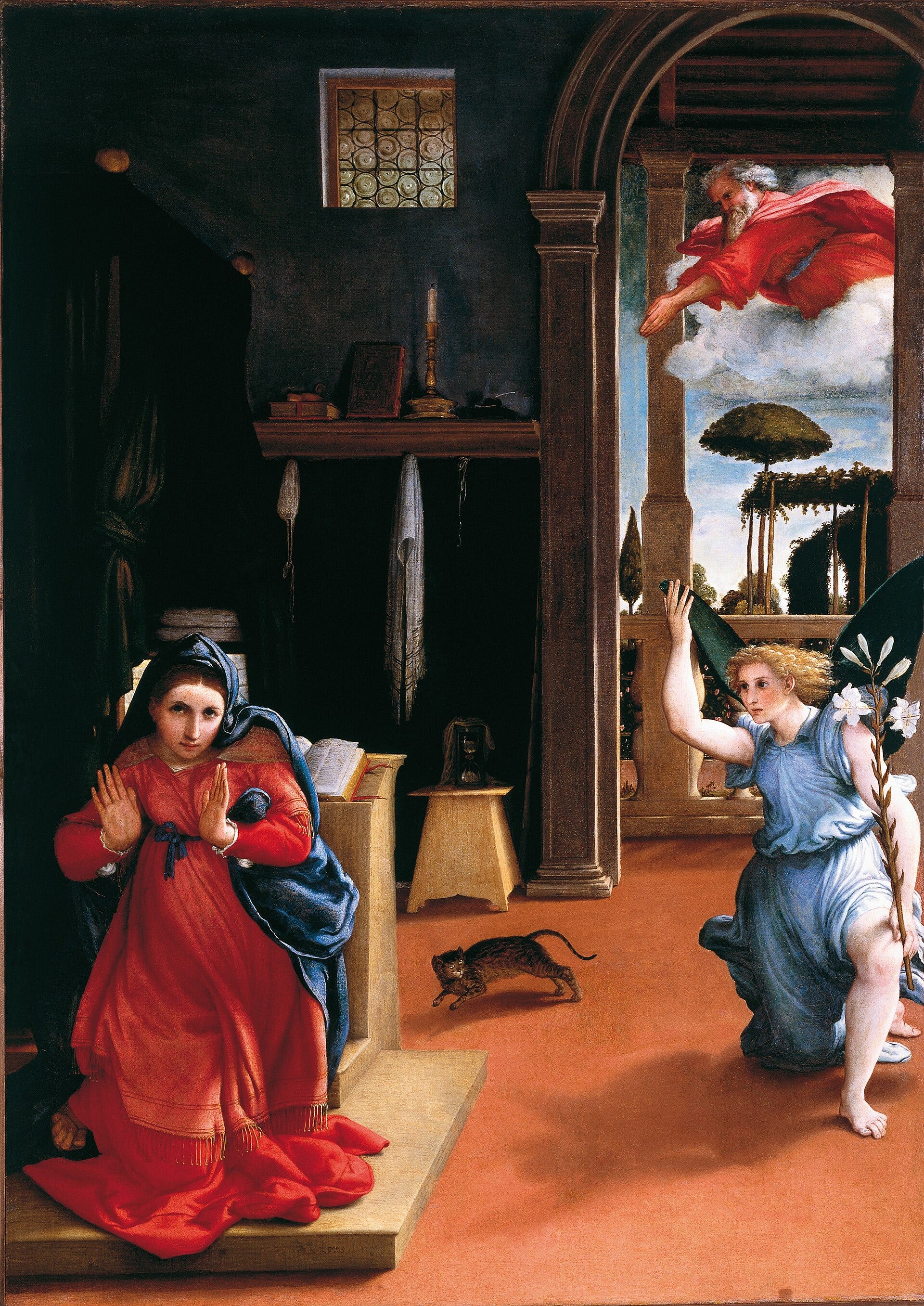
Mary has turned her back on the angel. Kneeling at her prayer stool, she faces outward, both hands raised, while behind her the visitor lands and a tabby cat arches its back and bolts across the floor. Lorenzo Lotto made the picture around 1534 for a church in Recanati, a small town in the Marche whose neighbor, Loreto, has a shrine that claims to hold the actual house where the angel came to her.