
Anthony van Dyck was a Flemish painter, born in Antwerp in 1599 and dead in London in 1641 at the age of 42. He started as an assistant to Rubens, spent six years in Italy, and from 1632 was the principal painter of Charles I of England, who knighted him.
He is remembered as the man who gave the Stuart court its look: elegant lords in silk, painted as if the viewer stood a little below them. The pointed beard called a Van Dyke carries his name.
He painted the king who would lose a civil war and then his head. He died in December 1641, before any of it began.
Cool Stories About Art is a newsletter to learn art the fun way.
Join 200,000+ readers and get:
10 new art stories / month
The entire archive of content (1,000+ articles)
Comment, ask questions, and chat with other readers
In the summer of 1624 he was twenty-five and stuck in Palermo. He had come to Sicily to paint the Spanish viceroy, a plague broke out, and he stayed about eighteen months. On 12 July he went to see the painter Sofonisba Anguissola. In his sketchbook he gave her age as ninety-six.
She could no longer see well enough to paint, and she told him it was her worst torment. He noted that her hand was still steady, without any trembling, and that her memory and mind were very sharp. Then she gave him a lesson. Do not raise the light too high, she said, or the shadows in the wrinkles of old age grow too large.
The sketchbook is now in the British Museum, 121 leaves of drawings. On 19 May 1624 he filled one with a sketch made from life: a woman led to execution through the streets of Palermo, in penitential dress and a tall pointed cap painted with a devil. The painter of silk and lace had also stood in the street and drawn what was in front of him.
What You'll Discover
Whose pupil he really was.
What the nobles of Genoa wanted.
What the king promised him.
Why the king looks so tall.
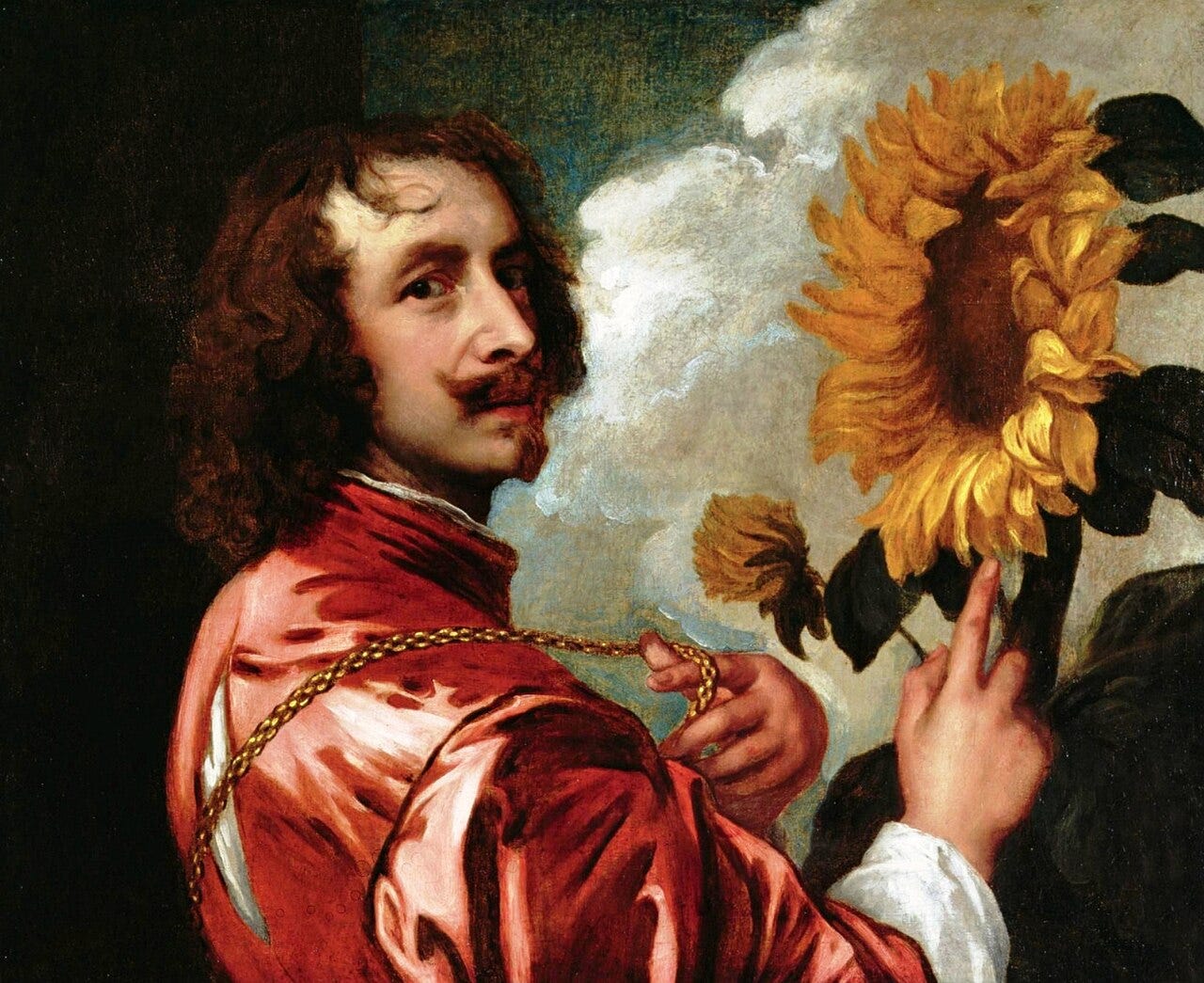
What the sunflower is doing there.
Why painters sit beside princes.