
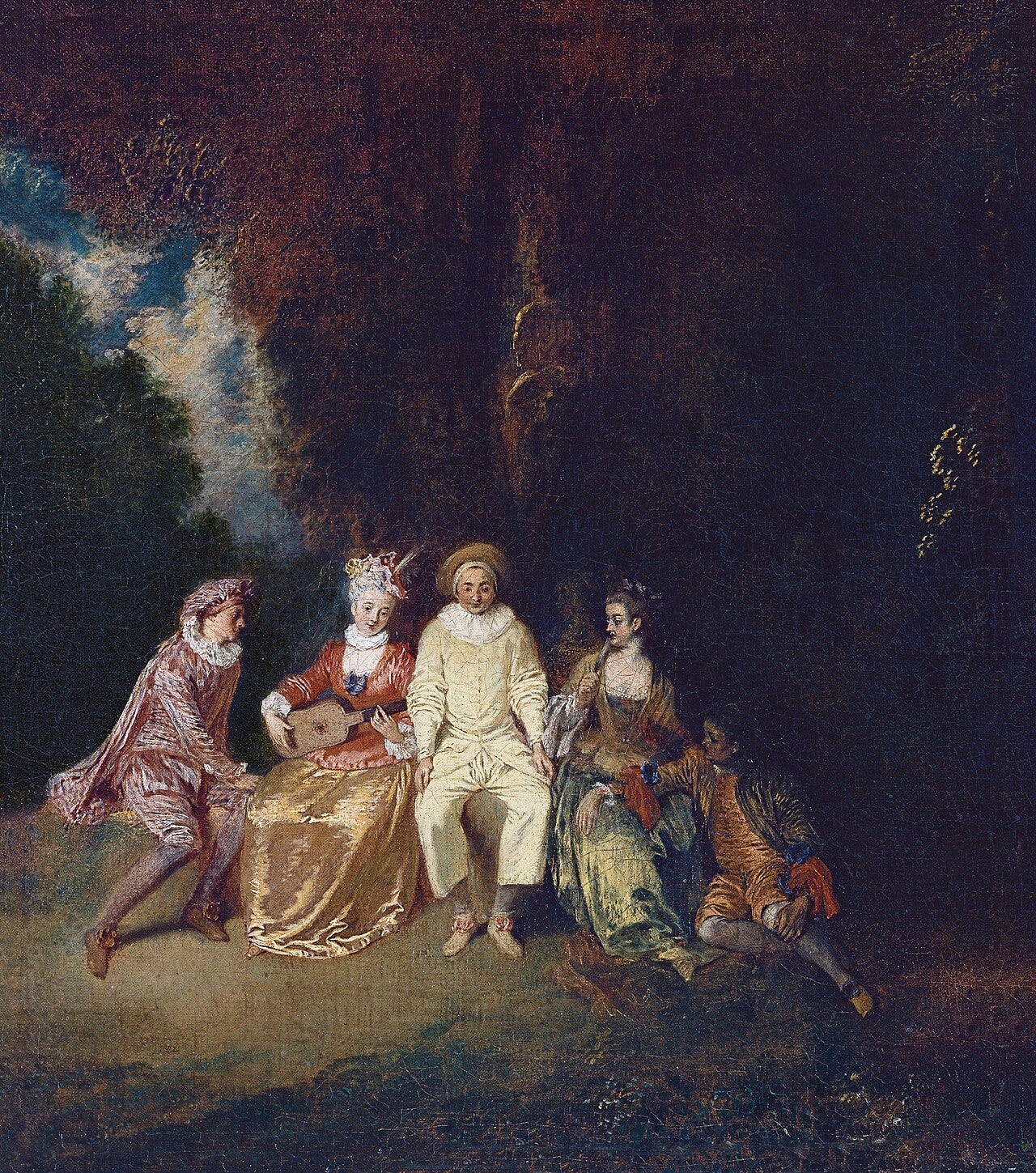
Antoine Watteau was a French painter, baptized in Valenciennes in 1684, who died in 1721 at 36. He invented the fête galante, the dreamlike garden party that became the signature of French Rococo, and the Royal Academy had to create a new category of painting just to admit him. Most people who type his name are looking for one picture: Pierrot, the life-size clown in white satin who stares out of the Louvre.
That clown has no known past. Nobody can say who he is, who ordered him, or why he looks past us.
Cool Stories About Art is a newsletter to learn art the fun way.
Join 200,000+ readers and get:
10 new art stories / month
The entire archive of content (1,000+ articles)
Comment, ask questions, and chat with other readers
Nobody wrote about it while Watteau lived. The painting is missing from the great set of engravings after Watteau's work that his friend Jean de Jullienne published after his death, and no written record mentions it before 1826, more than a hundred years later.
When it finally surfaced, it was a problem for the dealers. One of them, unable to sell it, chalked a line on the canvas: how happy Pierrot would be, if he had the gift of pleasing you. Dominique Vivant Denon, who ran Napoleon's museums, bought it anyway, and a collector later left it to the Louvre.
So who is the man in white? The Louvre calls him a character of the theater, the most famous comic figure of his day, and says plainly that the origins of the picture remain unknown. Some scholars think it began as a shop sign. Others see Watteau himself inside the costume. A third camp answers that the sad clown is a nineteenth century invention.
What You'll Discover
Who taught him the theater.
What the Academy had to invent.
Whether Pierrot is Watteau himself.
Whose drawings he studied at night.
Why he crossed the Channel ill.
What he painted for a friend.