
A painter from Sicily, in southern Italy, painted the moment the angel Gabriel tells Mary she will be the mother of Jesus, and left the angel out. Antonello da Messina (about 1430 to 1479), one of the first Italians to master oil paint, shows Mary alone, looking toward an angel no one sees. That picture, the Virgin Annunciate, hangs in Palermo, Sicily.
Cool Stories About Art is a newsletter to learn art the fun way.
Join 200,000+ readers and get:
10 new art stories / month
The entire archive of content (140+ articles)
Comment, ask questions, and chat with other readers
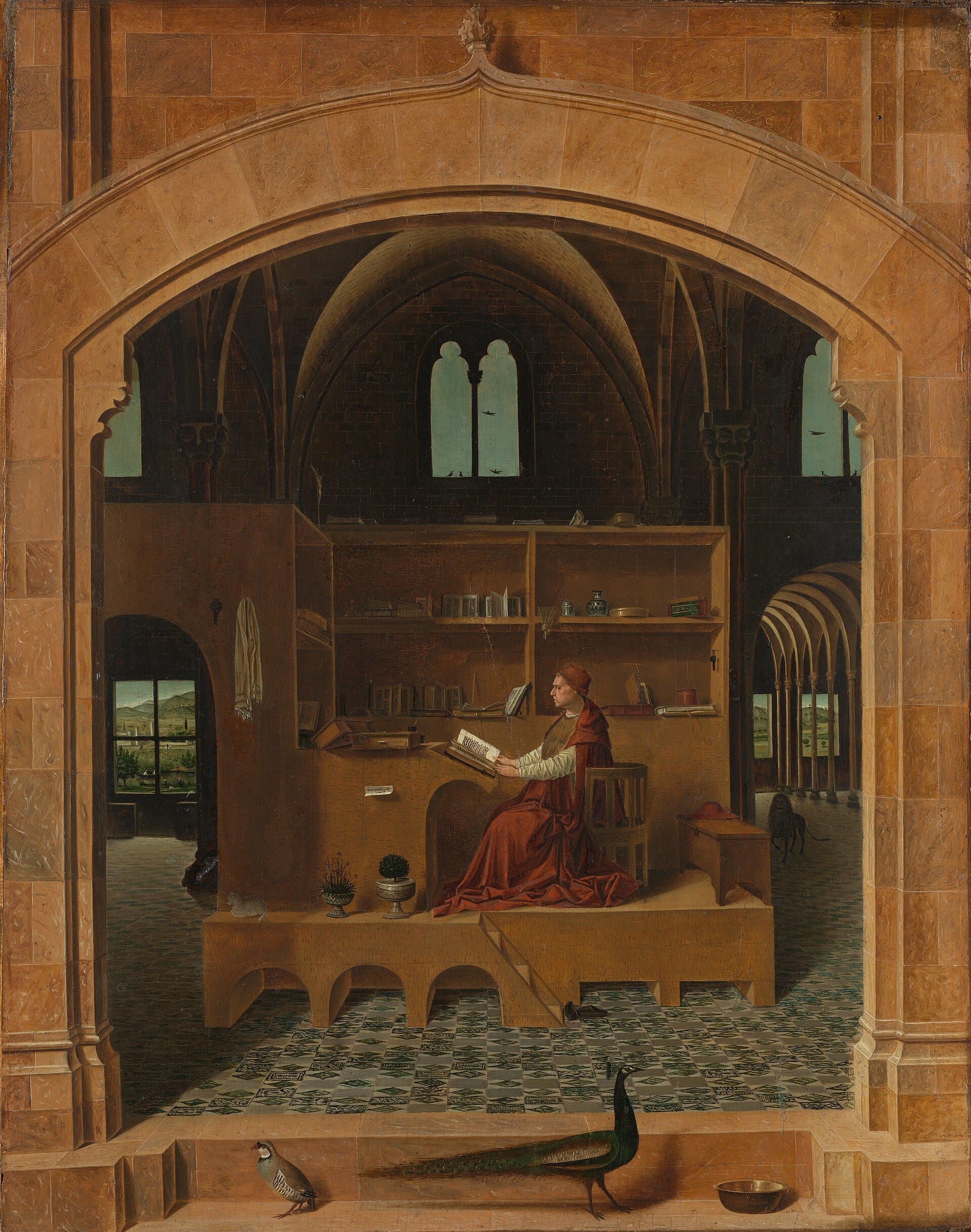
Half a century after Antonello's death, some people in Venice took Saint Jerome in His Study for the work of Jan van Eyck, the most famous painter of Flanders, a region of rich trading cities in today's Belgium. Yet Antonello was an Italian, and his home city lay more than a thousand miles from Flanders.
Antonello was born around 1430 in Messina, a port on the northeastern tip of Sicily. Only a narrow arm of the sea, the Strait of Messina, separates the city from the Italian mainland.
His father, Giovanni de Antonio, cut and carved stone for a living. The boy was named Antonello di Giovanni, Antonello son of Giovanni. As a painter, he would sign his pictures with the name of his city instead: Antonello of Messina.
In Antonello's youth, rulers and rich collectors in Italy sought out paintings from Flanders. Flemish painters mixed their colors with oil, which dried slowly and could be laid on in thin layers, almost transparent, one over another.
With oil, the Flemish painters could render the shine of a pearl or the single hairs of a fur collar. Most Italian painters still used tempera, colors mixed with egg yolk, which dried within minutes and could not be blended as smoothly.
Jan van Eyck died in Bruges in 1441, still in the service of the Duke of Burgundy, who ruled Flanders. Antonello was then about eleven years old, a boy in Messina.
By 1457, Antonello was a master painter with his own workshop in Messina. That year, a religious brotherhood of Reggio Calabria, a town just across the strait, ordered from him a painted banner to carry through the streets on feast days. It is the earliest of his orders that the records mention.
How did a stonecutter's son from Messina, who was a boy when Van Eyck died, learn to paint like the Flemish master?
In the rest of the story
The writer who first sent Antonello to Flanders, and what he claimed happened there.
The change of mind Antonello left visible in a painting of Christ.
What happened to the large painting Antonello made for a church in Venice.
What Antonello left out of his most famous painting of the Virgin Mary.