
Antonio Canova was an Italian sculptor, born in 1757 in a village of stonecutters near Venice, who died in Venice in 1822. He became the most famous sculptor in Europe, carving gods and heroes in white marble in the Neoclassical style, which imitated the art of ancient Greece and Rome.
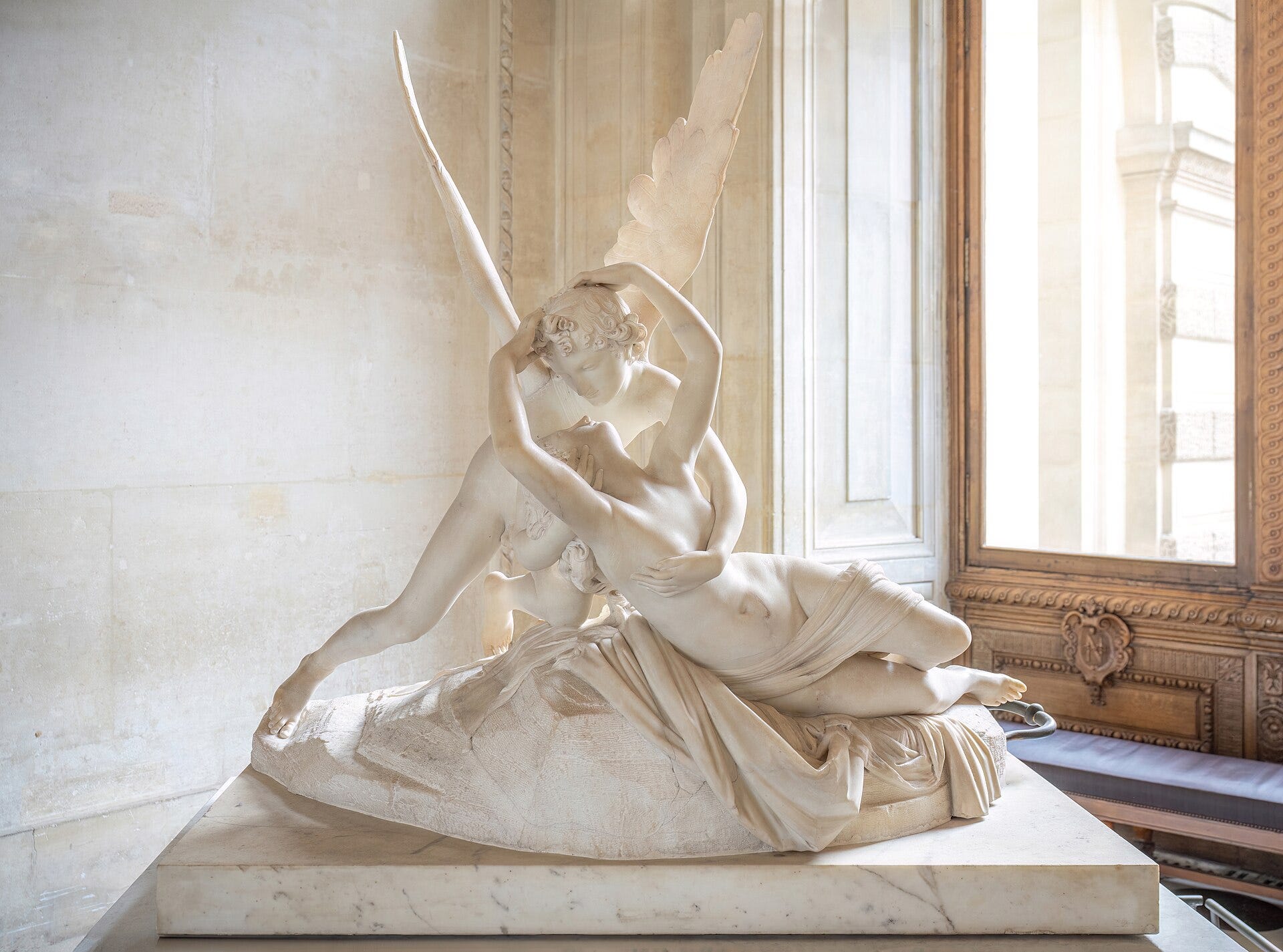
*Canova's best-known works are Psyche Revived by Cupid's Kiss, at the Louvre in Paris, and The Three Graces. Popes and kings ordered statues from him, and so did the family of Napoleon Bonaparte.*
In 1802, Napoleon Bonaparte, then the ruler of France, brought Canova to Paris to carve his portrait. Thirteen years later, after Napoleon's fall, the pope sent Canova back to Paris to reclaim the statues that Napoleon's armies had taken from Rome.
Cool Stories About Art is a newsletter to learn art the fun way.
Join 200,000+ readers and get:
10 new art stories / month
The entire archive of content (140+ articles)
Comment, ask questions, and chat with other readers
Antonio Canova was born in Possagno, a village at the foot of Mount Grappa, north of Venice. Possagno then belonged to the Republic of Venice, an independent state.
The Canova men were stonecutters. Antonio's father died before the boy turned four, and his mother remarried. Antonio grew up with his grandfather, Pasino, who taught him to carve stone.
A rich senator of Venice noticed the boy and placed him with a sculptor known as Torretti. In 1768, at about eleven, Antonio followed his master to Venice.
By about twenty, Canova had his own studio in Venice. One of the highest officials of Venice ordered from him a marble group, several figures carved from one block: Daedalus, the inventor of Greek myth, fastening wings of wax and feathers on his son Icarus.
The young sculptor was paid 100 sequins, gold coins of Venice, and spent the money on a journey to Rome, the pope's city and the capital of European art.
In 1779, at the Vatican, the pope's palace, Canova studied the most famous ancient statues in the world. Two of them were the Apollo Belvedere, a marble Greek god who has just shot an arrow, and the Laocoön, a Trojan priest and his two sons strangled by snakes.
Less than twenty years later, the Apollo Belvedere and the Laocoön were on their way to Paris, taken by the armies of Napoleon Bonaparte, the French general who would make himself emperor. By 1803, Canova was carving a giant statue of Napoleon himself.
Why would the pope trust Napoleon's own sculptor to bring the Apollo Belvedere and the Laocoön home?
In the rest of the story
What Napoleon did with the giant nude statue Canova carved of him.
Why British soldiers stood guard inside the Louvre in the fall of 1815.
What Canova asked his half-brother to do, the day before he died.
What survived of the only statue Canova made for the United States.