
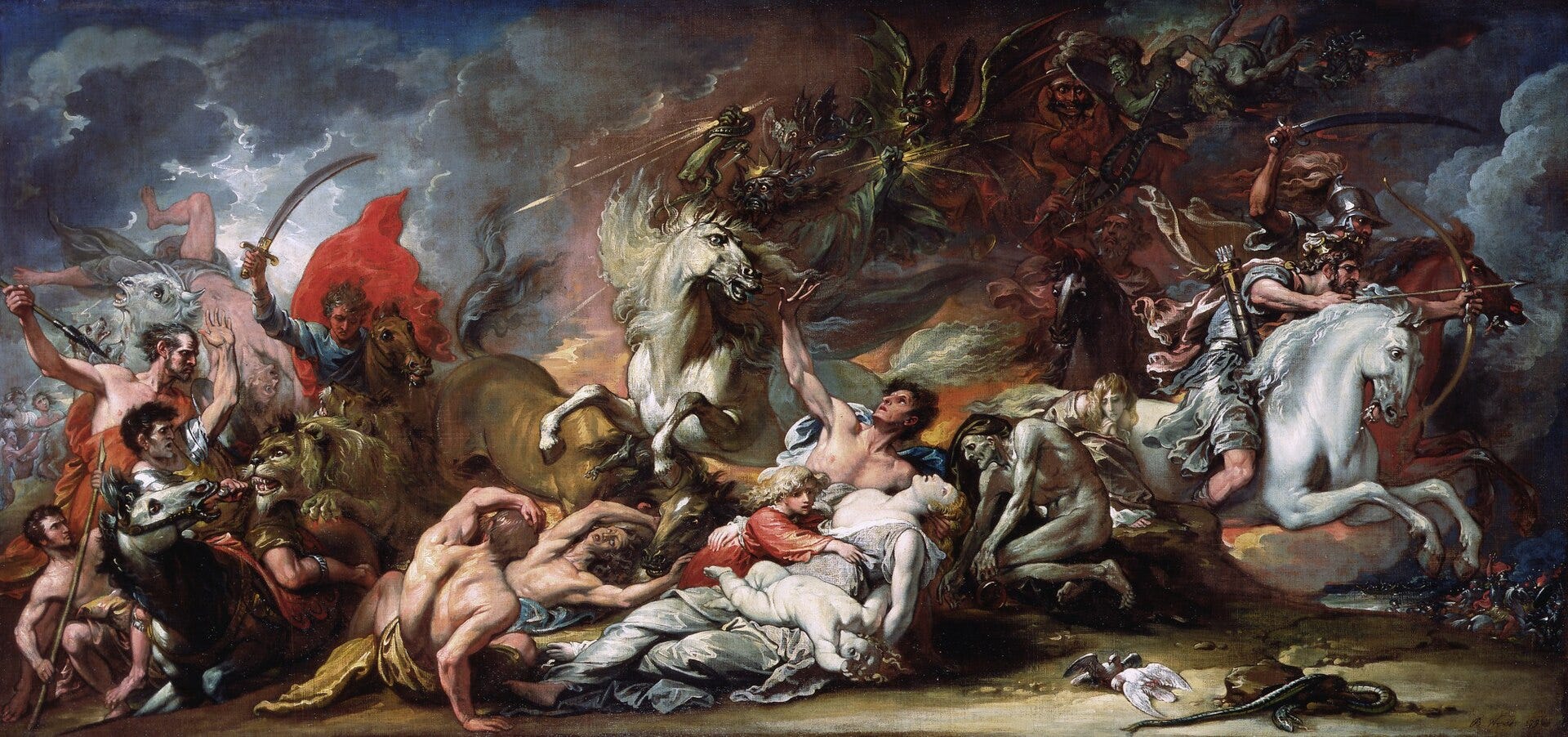
The last book of the Bible describes the end of the world as a string of visions, each one arriving before the last has settled: broken seals, riders, beasts, a falling star. For more than a thousand years, artists tried to hold those visions still long enough to show them. Along the way, some of their pictures were scattered, cut down or slashed.
Cool Stories About Art is a newsletter to learn art the fun way.
Join 200,000+ readers and get:
10 new art stories / month
The entire archive of content (140+ articles)
Comment, ask questions, and chat with other readers
Picturing a Book of Visions
Apocalypse is a Greek word for an unveiling. It names the last book of the Bible, also called Revelation, which tradition says a man named John wrote in exile on Patmos, a small island in the Aegean.
That book gives painters almost nothing to copy. John speaks of seals broken one after another, four riders sent out over the earth, a beast with seven heads and a city coming down from heaven, but he never says what any of it looks like. Every artist who took it on had to decide.
That choice sets the subject apart from the Last Judgment or hell, which draw on other passages of the Bible. A picture of the Apocalypse starts from one precise moment of John's book, a seal, a rider, a beast, a woman in the sky. Artists faced that choice from about 945 to 1899, in a monk's manuscript, in woven wool, in woodcuts, oil paint, watercolor and lithography.
12. Jean Bondol, The Apocalypse Tapestry (about 1377 to 1382)
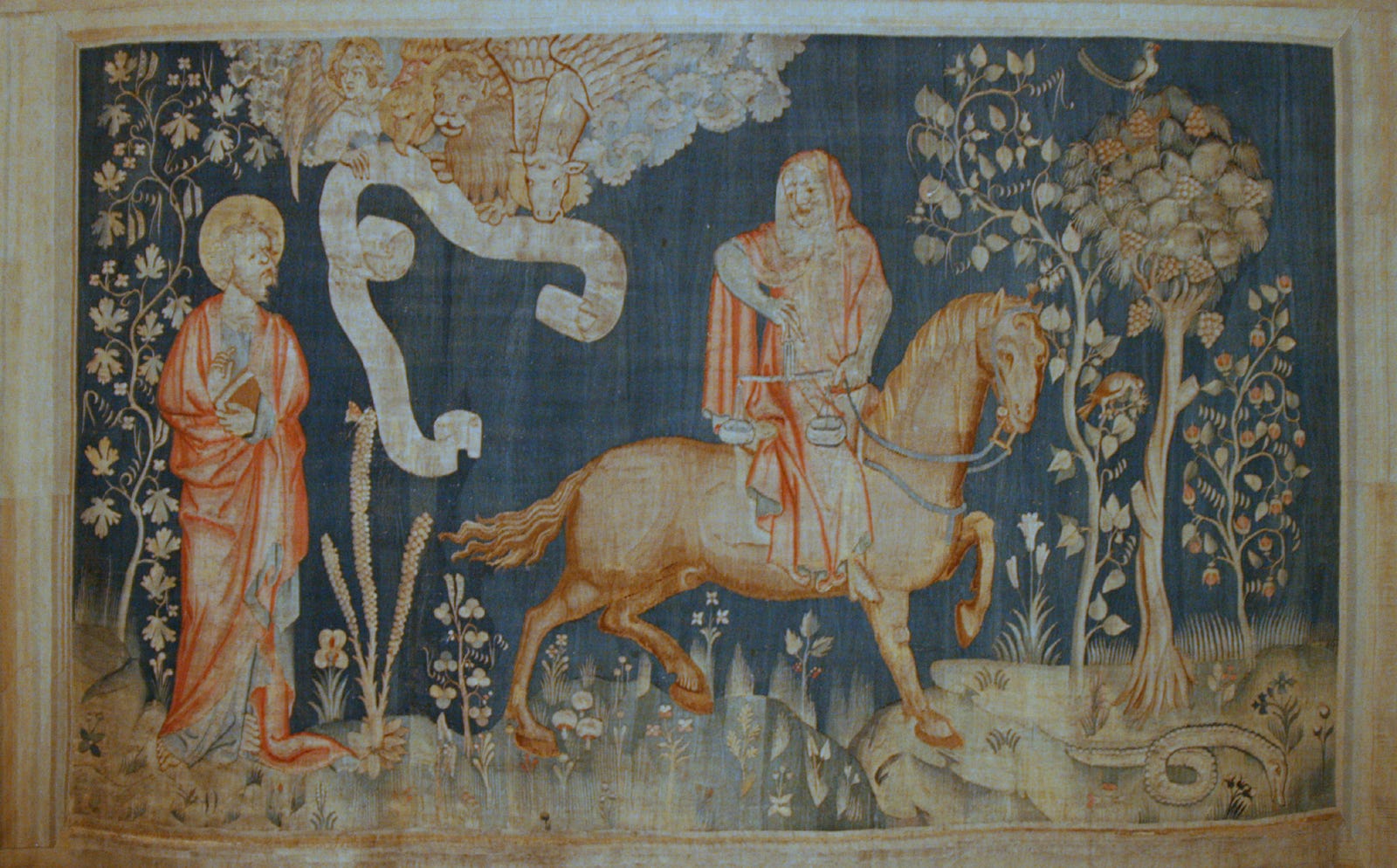
Inside a woven border, on a ground of deep blue and red, a horseman from the Book of Revelation rides across the wool. He belongs to the Angers Apocalypse, a set of hangings that once stretched about 140 meters, some 460 feet, and told the whole book in roughly ninety scenes.
Such a length was a prince's commission. Louis, Duke of Anjou, whose older brother reigned as Charles V of France, paid for it, and the painter Jean Bondol drew the designs. Weavers in Paris worked on the set from 1377 to 1382, and they followed the order of the book, so that the hangings could be read from the first vision to the last.
Four centuries later, nobody wanted to read them. In 1782 the canons of Angers Cathedral could not even find a buyer for the set, and after the Revolution the state sold it off as surplus property. The pieces scattered.
Their new owners treated them as plain cloth. Some pieces were laid on floors. Others lined stables or kept the frost off fruit trees.
A later bishop of Angers gathered back what could be found and left it to the cathedral in 1848, where the pieces were mended and joined again.
About seventy scenes survive. Since the 1950s they have hung in the castle of Angers, in a long gallery built for them, and visitors follow the Book of Revelation on foot, from one scene to the next, in the order the weavers gave it.
At a Glance
Artist: Jean Bondol, also called Hennequin of Bruges (active 1368 to 1381), designer, woven in the Paris workshop of Robert Poinçon
Made: About 1377 to 1382
Medium: Wool, woven
Size: About 104 m long and 450 cm high today (341 ft by 177 in)
Where to see it: Château d'Angers, Angers, France
11. Francis Danby, The Opening of the Sixth Seal (1828)
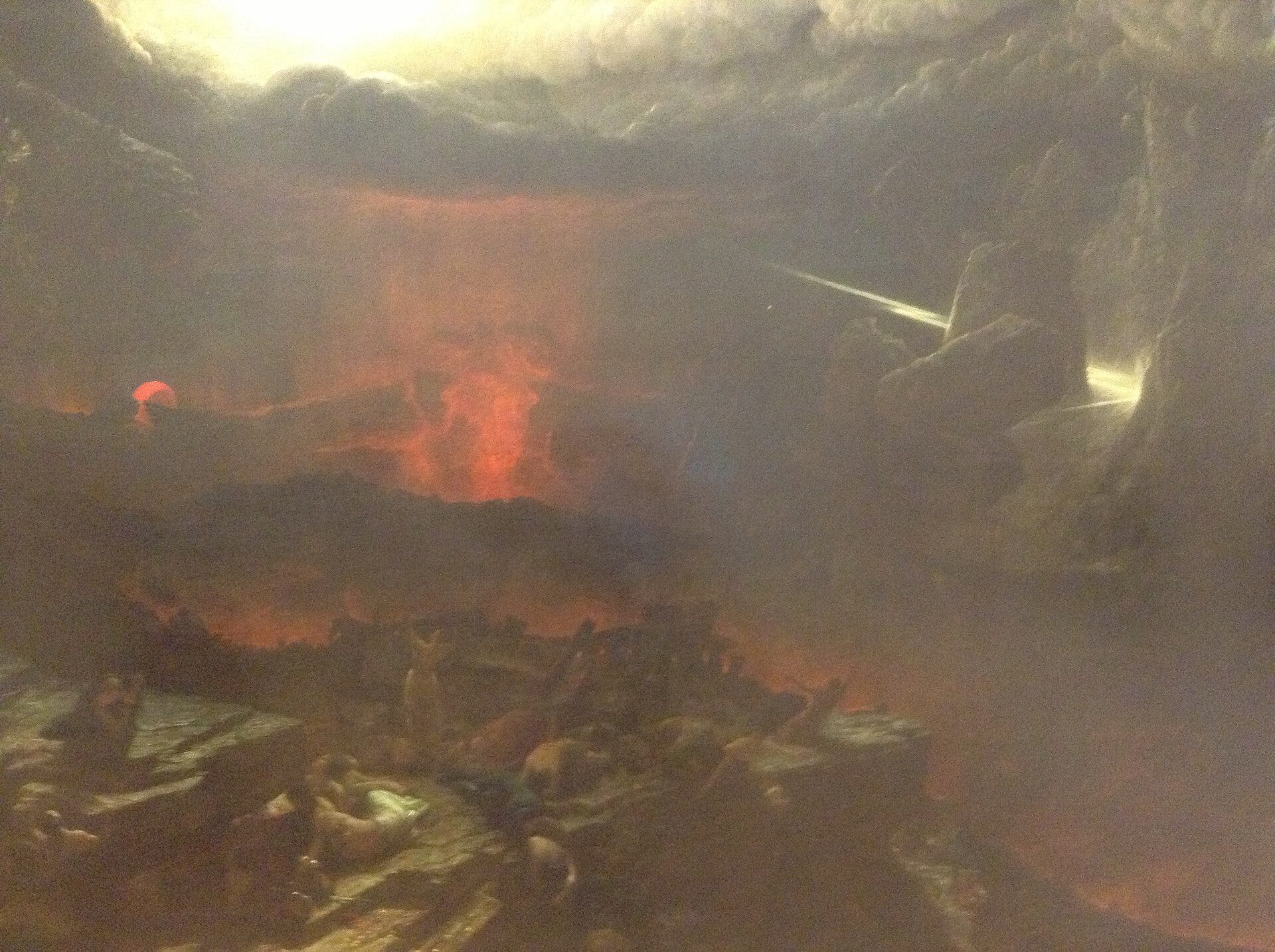
Broken chains hang from the wrists of the man at the front of this picture, while behind him a black sky splits open over a ruined town. In 1843, while the canvas was on show, someone cut a piece out of its center. The painter, Francis Danby, took the damaged picture back, and he did not simply mend it.