
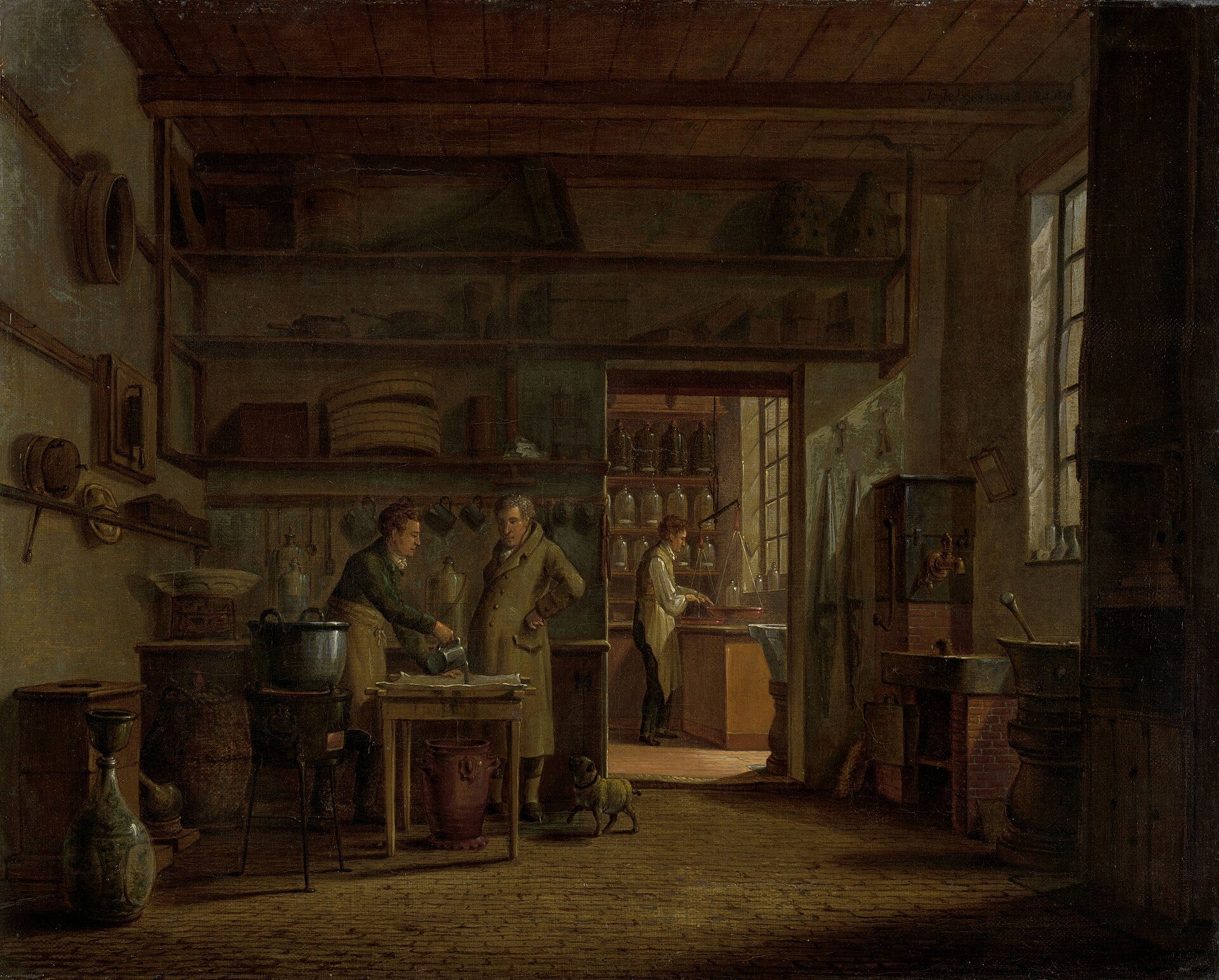
A pharmacy used to be a workshop with a counter at the front. Remedies were weighed, pounded, boiled and recorded in the same room where they were sold. Painters who stepped inside found the same scale, the same mortar and the same labeled jars there, whether the man behind the counter was a village healer or Christ himself.
Cool Stories About Art is a newsletter to learn art the fun way.
Join 200,000+ readers and get:
10 new art stories / month
The entire archive of content (140+ articles)
Comment, ask questions, and chat with other readers
What Happened Behind the Pharmacy Counter
An apothecary prepared and sold medicines. For most of the trade's history, though, he worked on someone else's orders: a physician examined the patient, often by studying a flask of urine, and the apothecary made up whatever the physician prescribed.
That division of labor gave artists a ready-made stage. There was a counter, a scale for measuring doses, a mortar, rows of jars marked with their contents and, later, colored bottles in the window.
Each work chosen here is set in a pharmacy, or in a room doing the job of one, and keeps at least one detail of the trade that a pharmacist would spot. Over the centuries the counter travels from a castle and a hospital to a street corner, while the jars on the shelves hardly change.
12. Unknown painter, Christ as Apothecary (first half of the 18th century)
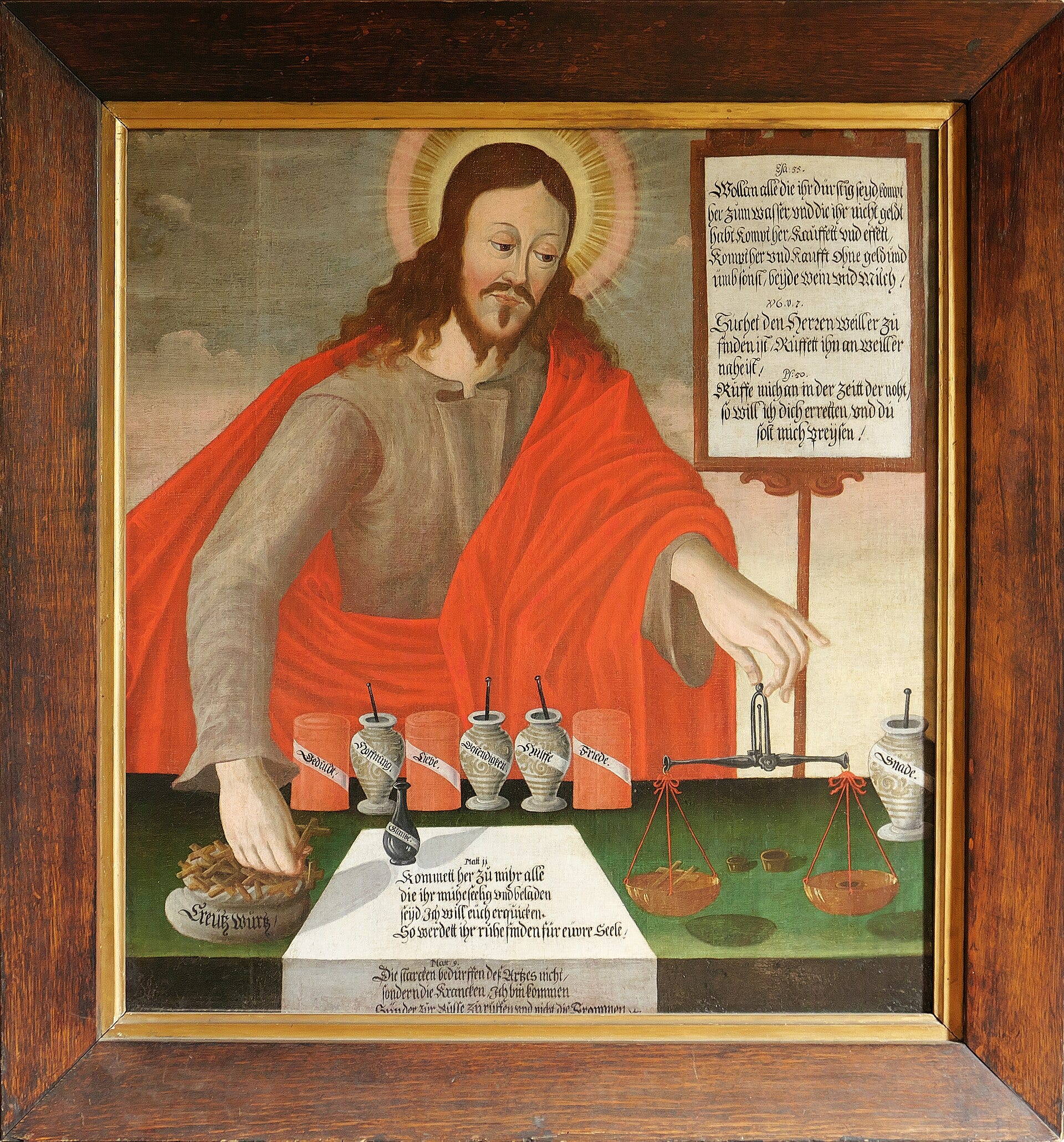
The labels on the eight jars behind this counter name remedies no pharmacy ever stocked: grace, help, love, patience, peace, constancy, hope and faith. In front of the shelves, Christ in a purple cloak holds an apothecary's scale, and a ribbon carries his words from the Gospel of Matthew: it is not the healthy who need a physician, but the sick.
The scale carries two meanings. In a pharmacy it measures out a dose, and at the Last Judgment it weighs souls.
A pharmacist would also notice the open sack in front of Christ, marked Kreuzwurz. That is the German name of groundsel, a real plant of the old pharmacopoeia, and the word happens to contain Kreuz, the cross, which may be a deliberate pun.
This canvas, known as Christ as Apothecary, belongs to the Church of the Holy Spirit in Werder, a small town on an island in the Havel river, in Brandenburg. The novelist Theodor Fontane, who spent years describing the towns and villages of the region, came across it there in a side room, stored among what he called historical junk.
Fontane did not like the picture. He dismissed it as a piece of bad taste from the early eighteenth century, yet he described it all the same, because it was, in his words, "so abnormal, so unique of its kind." Its date is still argued over, somewhere between about 1620 and the middle of the 1700s.
Fontane was wrong about one thing: the picture was not unique. More than 120 images of Christ as an apothecary are known, in paintings, engravings, stained glass and prayer books, from the 1600s to the late 1800s, and most come from southern Germany, Switzerland and Austria. A better preserved version hangs in the church of Plötzin, the next village.
Nobody recorded who gave the Werder canvas to its church. One historian, noting that the town received its first pharmacy license in 1734, has suggested that an apothecary made the gift, though it remains a guess. The image itself traveled further than any single gift could take it: it crossed the line between Catholics and Protestants, and pharmacists hung copies of it in their own shops.
At a Glance
Artist: Unknown, possibly a traveling painter
Painted: Probably first half of the 18th century (the dating is debated)
Medium: Oil painting
Size: Not published
Where to see it: Church of the Holy Spirit (Heilig-Geist-Kirche), Werder (Havel), Germany
11. Gottfried Locher and Bartholomäus Hübner, The Rustic Pharmacy (1775)
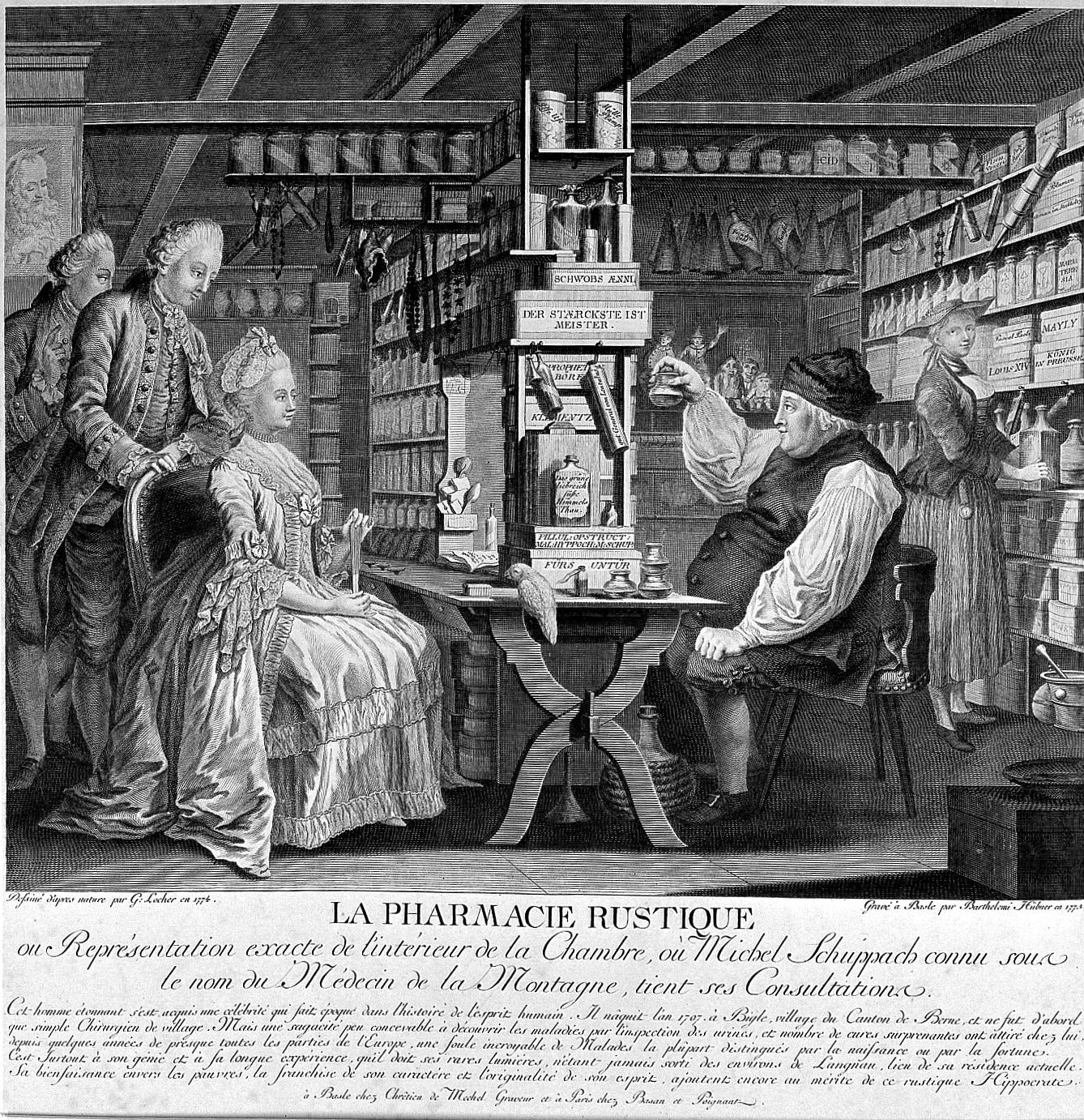
In a room lined with jars and bottles, a heavy man in a cap raises a flask of urine to the light, and a young woman seated across from him waits to hear what he reads in it. When his fame peaked, eighty to ninety patients came to see him every day. He had left school at sixteen to learn the trade of a village barber.