
For most of the 1800s, Europeans and Americans knew the Arctic only from pictures, and those pictures came home on ships. Navies sent expedition after expedition to find a sea route over the top of America, and officers sketched the ice from decks it held fast for months. Yet one image of the frozen sea that artists keep remaking came from a man who never went north.
Cool Stories About Art is a newsletter to learn art the fun way.
Join 200,000+ readers and get:
10 new art stories / month
The entire archive of content (140+ articles)
Comment, ask questions, and chat with other readers
What the Ice Asked of Painters
The Arctic set painters a problem no studio had prepared them for. Nothing stood beside an iceberg to give its size, no tree and no house, and in winter the sun never rose. White ice under a pale sky left them shapes and a few blues to work with.
What kept them at it was the Northwest Passage, a sea route from the Atlantic to the Pacific through the islands north of Canada. When the British explorer Franklin vanished there in 1845 with two ships and 129 men, the search lasted more than ten years and filled the newspapers.
Most of these pictures were made by people who saw the ice for themselves, often from a ship in danger, two of them by artists born in the Arctic. Three come from painters who never went north and stay for what they made others imagine.
12. Julius Payer, Never Back! (1892)
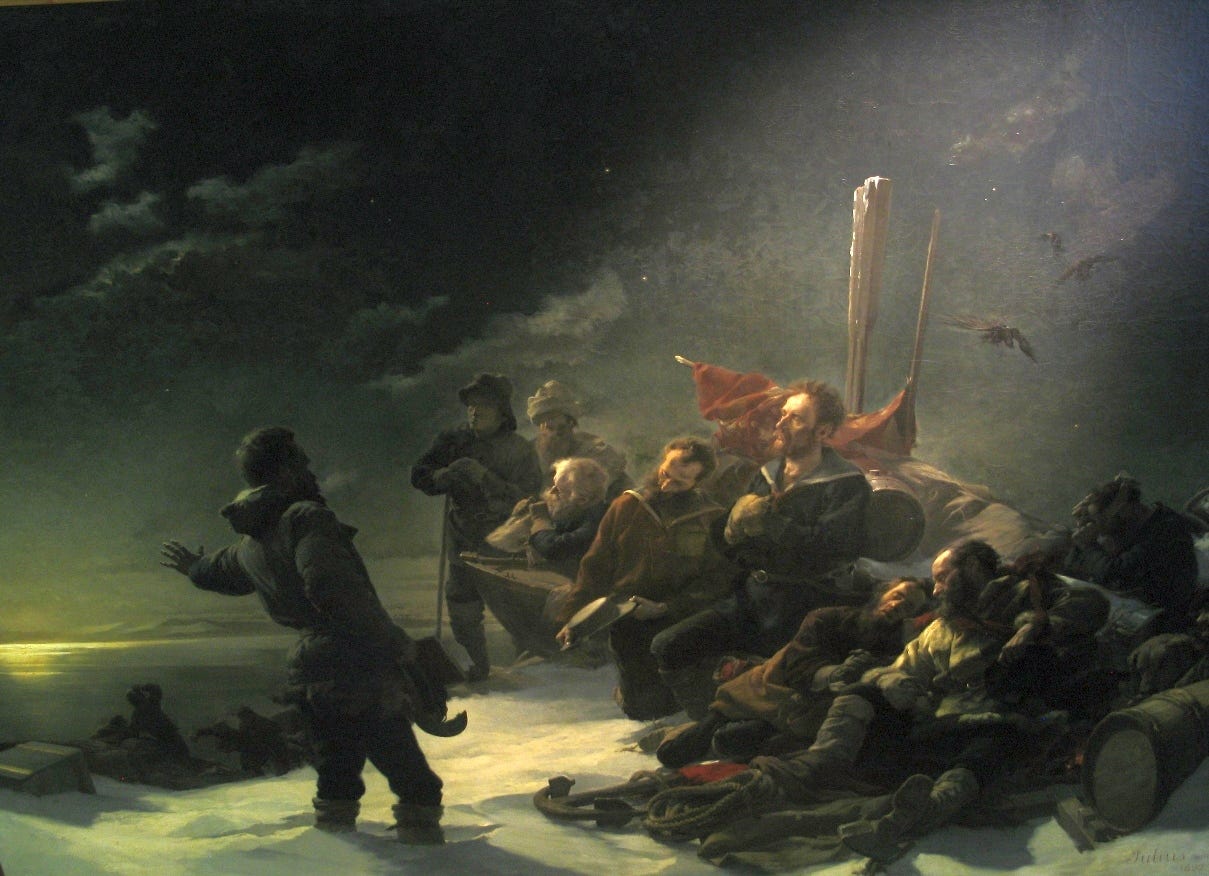
Men in heavy coats strain at ropes, dragging boats and sledges across broken pack ice under a gray sky, and several of them have turned to look back the way they came. Julius Payer called the picture Never Back!, and he knew what those men were looking at, because he had been one of them.
In 1872 Payer, an officer in the Austrian army, shared command of the Austro-Hungarian North Pole Expedition with the naval officer Karl Weyprecht. By the end of August their ship, the Tegetthoff, was locked in the ice north of Novaya Zemlya, the long Russian islands in the Arctic Ocean.
For a year the ship drifted with the pack. On August 30, 1873, the crew sighted land that no map showed, an archipelago they named Franz Josef Land after their emperor. Another winter went by, and on May 20, 1874, the men abandoned the Tegetthoff and started south, hauling their boats and sledges over the ice.
The ice worked against them. As they walked south, the drift of the pack carried them back, and by mid-July, after two months of hauling, they were almost within sight of the ship again. Many of them wanted to return to it, which would have meant certain death. Weyprecht talked them into going on.
That refusal is the moment the title names. On August 14 the men reached open water, and after six days in the boats Russian fishermen picked them up near Novaya Zemlya. Only one man had died, of illness.
At home, people doubted that Payer had discovered anything at all. He left the army that same year and started over as a painter.
Never Back! followed in 1892, eighteen years after the retreat, as part of what is said to be the only group of paintings a polar explorer ever made of his own expedition. Payer passed over the sighting of new land, the moment that made his name, and painted the day his men almost turned around.
At a Glance
Artist: Julius Payer (1841 to 1915)
Painted: 1892
Medium: Oil on canvas
Size: Not published
Where to see it: Heeresgeschichtliches Museum (Museum of Military History), Vienna
11. William Smyth, Perilous Position of HMS Terror, Captain Back, in the Arctic Regions in the Summer of 1837 (about 1838)
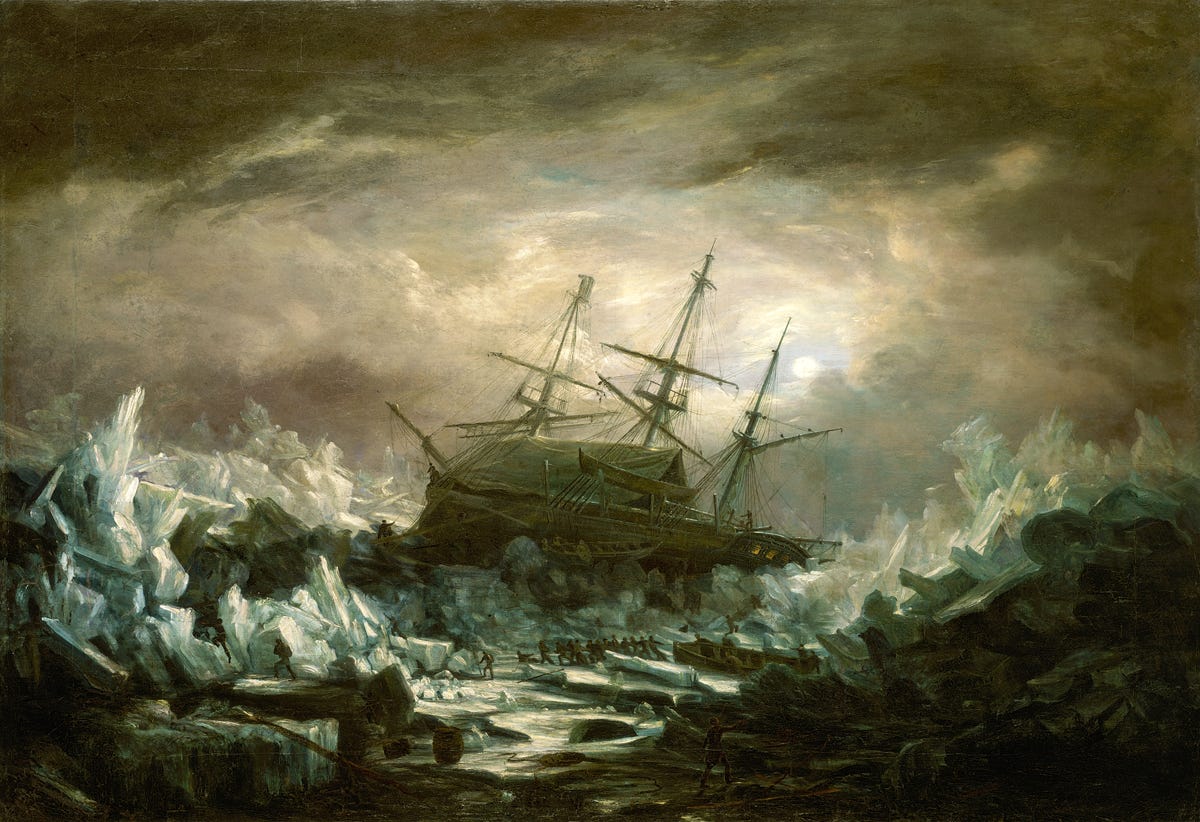
A three-masted ship lies tilted on a slab of ice, its hull lifted clear of the water, while in the foreground thirteen men haul a boat across the floe and five more hold it steady. Barrels, planks and coils of rope lie scattered around them. The ice has held the ship like this for months, and nobody on board can tell whether it will let go or crush the hull.