
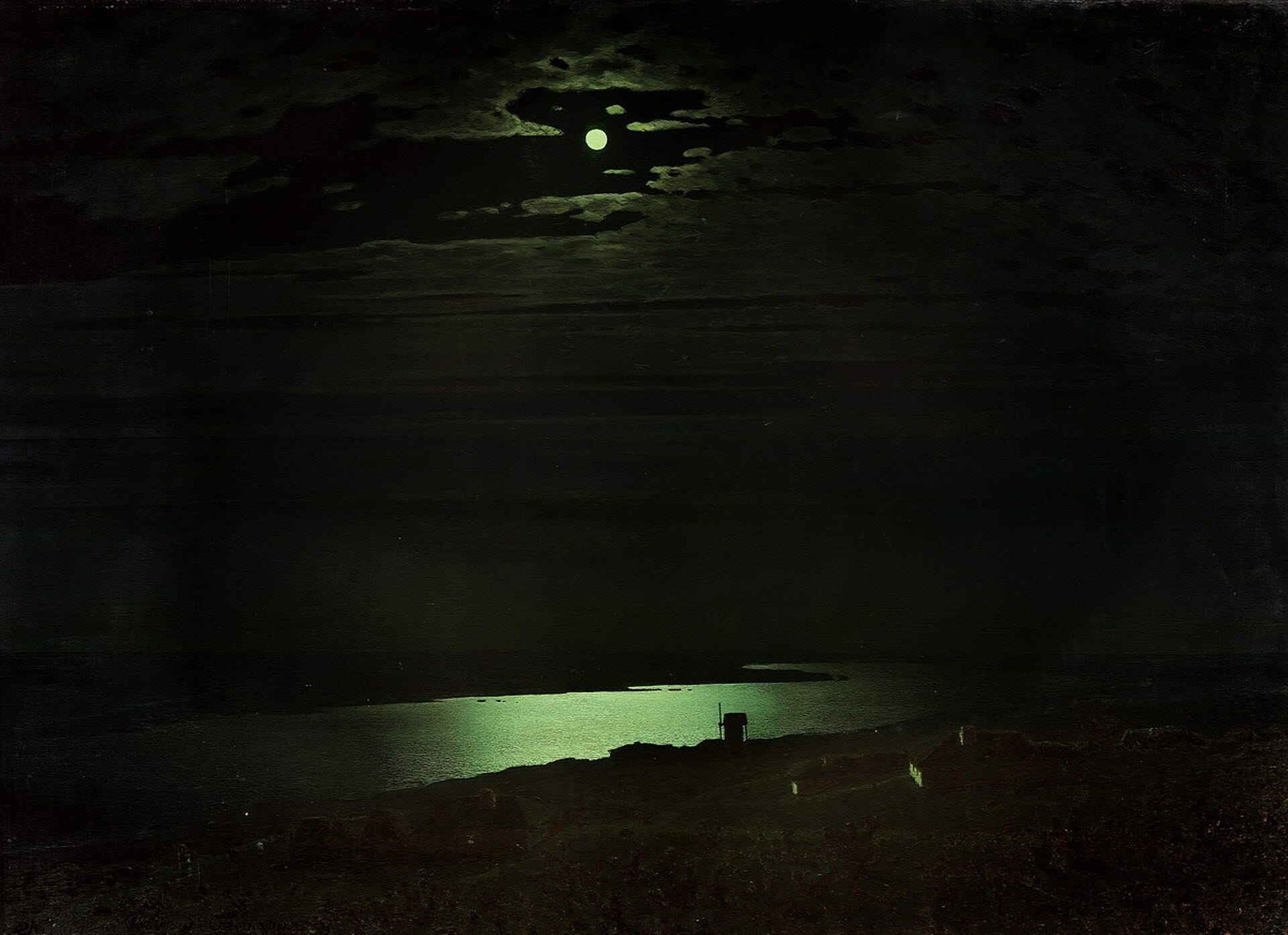
Arkhip Kuindzhi (1841 to 1910) was a landscape painter born in Mariupol, then in the Russian Empire, now in Ukraine. He became famous for his moonlit landscapes, above all Moonlit Night on the Dnieper, now at the State Russian Museum in Saint Petersburg.
Cool Stories About Art is a newsletter to learn art the fun way.
Join 200,000+ readers and get:
10 new art stories / month
The entire archive of content (140+ articles)
Comment, ask questions, and chat with other readers
In the fall of 1880, crowds lined up along a street in Saint Petersburg to see Moonlit Night on the Dnieper, hung alone in a darkened room. Two years later, at the height of his fame, Arkhip Kuindzhi stopped showing his new paintings to the public. He went on painting for twenty-eight more years, for himself alone.
Arkhip Kuindzhi grew up in Mariupol, a small port on the Sea of Azov, north of the Black Sea. Greeks from Crimea, the nearby peninsula, had founded the town, and Arkhip's father, Ivan, was a Greek shoemaker.
Arkhip lost both his parents at about six, and an older brother and an aunt raised him. After two years at a parish school, the orphan went to work. He herded animals, then counted bricks on a building site and worked as a clerk for a grain merchant.
A friend of the grain merchant advised the boy to visit Ivan Aivazovsky, the most famous painter of the sea in the Russian Empire, in Feodosia, a port in Crimea. Arkhip went, but what he learned there is not known for sure.
For several years, the young Kuindzhi earned his living retouching photographs in studios of Mariupol and other southern ports. By hand, with a brush or a pencil, he hid stains and flaws.
In the 1860s, Kuindzhi went to Saint Petersburg, then the capital of the Russian Empire, to enter the Imperial Academy of Arts, the official art school. He failed its entrance exam.
Yet in 1868, the Academy accepted his painting A Tatar Village in Crimea by Moonlight, a night view of a village of the Crimean Tatars, the Muslim people native to the peninsula. The Academy gave him the title of "free artist," which recognized him as a professional painter. He then followed its classes without being enrolled.
Twelve years later, the young man who had failed the entrance exam filled a hall in Saint Petersburg with a single painting.
What did Arkhip Kuindzhi do with his twenty-eight years out of public view?
In the rest of the story
Who ended up with the fortune of the former herd boy.
What the Academy that had failed Kuindzhi asked him to do, years later.
What Kuindzhi did every day at noon on the roof of his house.
What the public finally saw in 1913, three years after his death.