
A star cannot be carried indoors, so painters of astronomy showed everything the work required: brass arcs, clocks, globes, pages of figures. Two of those workplaces met a hard fate. An observatory was pulled down by the very state that had ordered it, and a fire took a couple's instruments, books and printing press in a single night.
Cool Stories About Art is a newsletter to learn art the fun way.
Join 200,000+ readers and get:
10 new art stories / month
The entire archive of content (140+ articles)
Comment, ask questions, and chat with other readers
A Science Done in the Dark
For most of its history, astronomy was a matter of measuring rather than gazing. An observer fixed the height of a star, timed its passage, wrote both numbers down, and then spent days on the calculations.
Every one of those steps called for an object a painter could put on canvas: a brass scale, a clock, a globe, a book of tables. The trade looks crowded in pictures for that reason, although what it studies is a point of light.
Each work chosen here shows an astronomer, or an astronomer's work, and keeps a detail that anyone who has used a telescope or read a star chart can still check. Pictures in which a globe or a telescope stood only for learning, with no work going on, were left out.
12. Anonymous Ottoman painter, The Astronomers of Taqi al-Din at the Istanbul Observatory (about 1581)
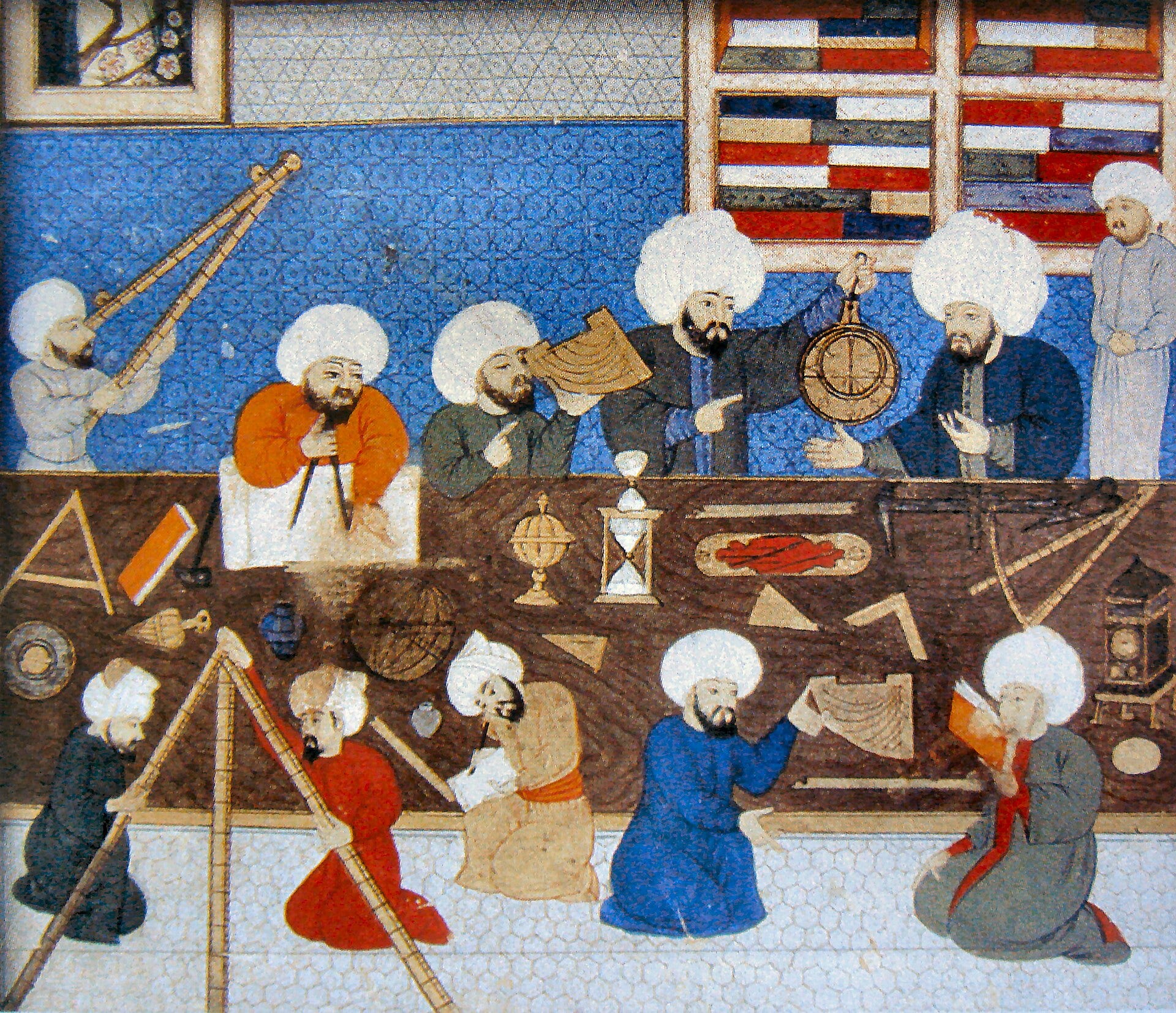
Among the turbaned scholars crowded under this dome stands a clock, and anyone who has timed a star looks at it first. The man who ran this observatory, Taqi al-Din, was one of the first astronomers to use a mechanical clock in his observations.
The observatory stood in Istanbul, on a height above the district of Tophane, and it was a state project. An edict of Sultan Murad III ordered it, and books and instruments were gathered there for its scholars.
The painter put every stage of their work into a single room. At low desks, some men read and copy. Others handle a globe, a sand glass and a quadrant, the quarter circle used to measure how high a star stands above the horizon.
That room did not last. On 22 January 1580, the state that had ordered the observatory had it demolished. Two reasons are given, politics at court and the astronomer's own forecasts, which had proved wrong.
An anonymous painter of the sultan's workshop made this miniature after the demolition, for the Şehinşahname, a verse chronicle of Murad III's reign by the poet Alaeddin Mansur. So little is known of the building's size or shape that pictures like this one are where its scholars still sit at their desks.
At a Glance
Artist: Anonymous painter of the Ottoman court workshop, for the Şehinşahname of Alaeddin Mansur
Made: About 1581
Medium: Ink, watercolor and gold on paper (manuscript page)
Size: Not published
Where to see it: Istanbul University Library, Istanbul
11. Andreas Stech and Isaak Saal, Johannes and Elisabeth Hevelius Observing with a Sextant (1673)
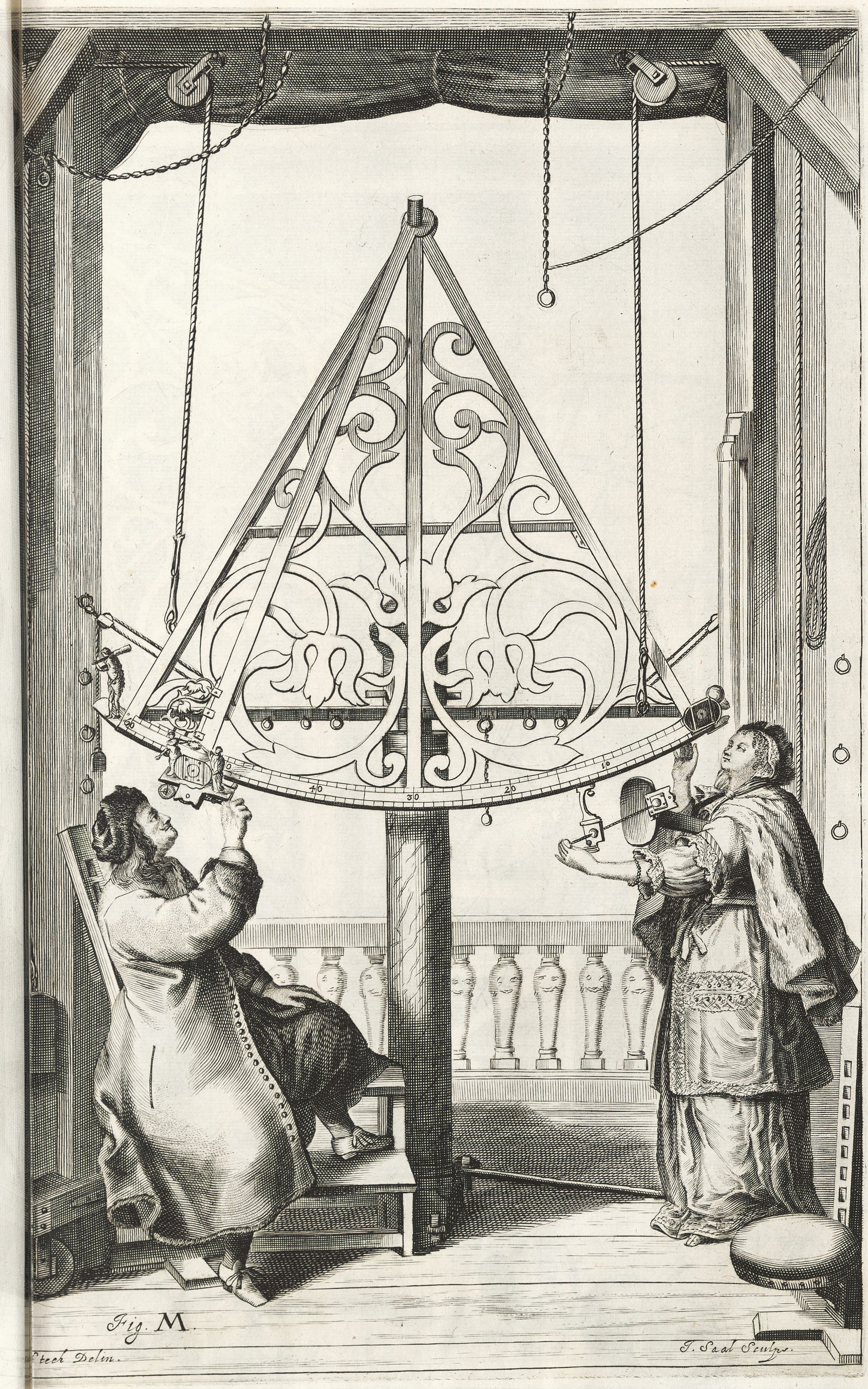
Two people stand at either end of a great brass arc set up on a rooftop, each with an eye to a sight. The plate was printed in 1673 to show how the instrument worked, and one of its two observers is a woman of twenty-six.