
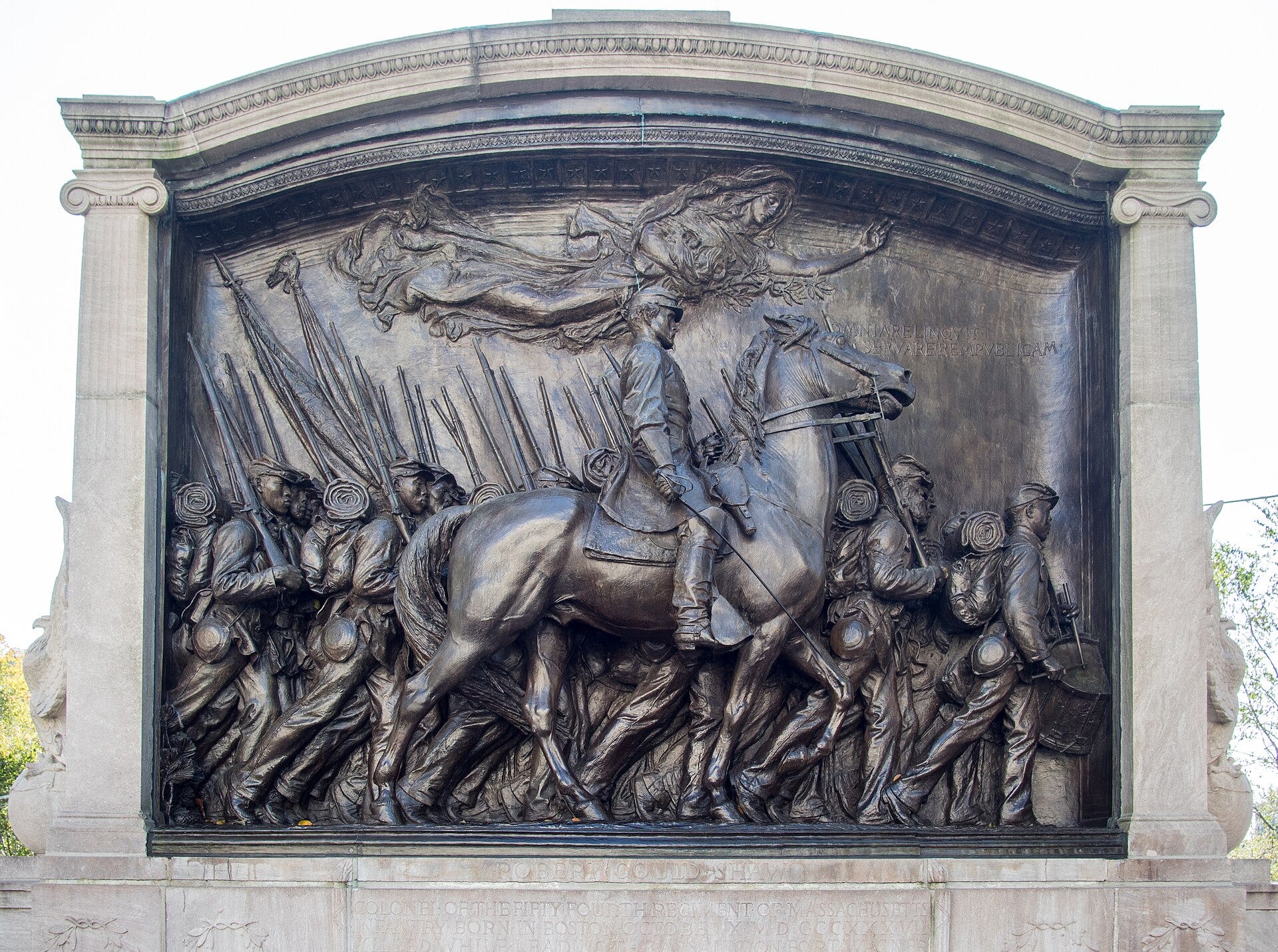
Augustus Saint-Gaudens (1848 to 1907), born in Ireland, was the leading American sculptor of the late 1800s. His bronze monuments include the Shaw Memorial in Boston, honoring a white colonel and the Black soldiers of his regiment, and General Sherman in New York.
Cool Stories About Art is a newsletter to learn art the fun way.
Join 200,000+ readers and get:
10 new art stories / month
The entire archive of content (140+ articles)
Comment, ask questions, and chat with other readers
Augustus Saint-Gaudens worked big. His first statue of Diana, the Roman goddess of the hunt, made to turn in the wind on top of a New York tower, stood eighteen feet tall.
Yet one of his last works fit in the palm of a hand: a twenty-dollar gold coin requested by President Theodore Roosevelt. The United States Mint, the government's coin factory, judged it too hard to strike, that is, to stamp out in its presses.
Augustus Saint-Gaudens was born in Dublin, Ireland, on March 1, 1848. His father, Bernard, was a French shoemaker from Aspet, a village in the Pyrenees, the mountains between France and Spain. His mother, Mary McGuinness, came from County Longford, in the middle of Ireland.
When Augustus was six months old, the family moved to New York.
In 1861, at thirteen, Augustus left school to work for Louis Avet, a Frenchman in New York who carved cameos. A cameo is a small portrait in relief: the face is carved so that it rises from the flat surface of a stone.
At night, the boy studied drawing at the Cooper Union and the National Academy of Design, two New York art schools.
In 1867, at nineteen, Augustus sailed for Paris, on a trip paid for by his father.
While he waited to enter the École des Beaux-Arts, the official art school of France, Augustus paid his way by carving cameos for an Italian cutter. In 1868, he joined the class of the sculptor François Jouffroy.
In 1870, when France went to war with Prussia, a German kingdom, Augustus left Paris for Rome.
There, he began Hiawatha, a statue of the Native American hero of The Song of Hiawatha, a long poem by Henry Wadsworth Longfellow.
How did a boy who carved tiny faces in stone end up in a fight between the president and the Mint?
In the rest of the story
Why a monument promised in two years took fourteen.
Why the model behind the gold coin vanished from his life story.
What an assistant saved from the fire that burned the sculptor's studio.
What Roosevelt told the Mint when it still refused the coin.