
Almost none of the Aztec sculptors, featherworkers and book painters left a name, and their work very nearly vanished with them. After Tenochtitlan fell in 1521, the great stones of its central square were buried under the new Spanish city, and the feathers, turquoise and painted books crossed the ocean to Europe. Almost everything seen today survived one way or the other.
Cool Stories About Art is a newsletter to learn art the fun way.
Join 200,000+ readers and get:
10 new art stories / month
The entire archive of content (140+ articles)
Comment, ask questions, and chat with other readers
Gods in Stone, Feathers and Turquoise
The Aztecs called themselves the Mexica. Their capital, Tenochtitlan, fell in 1521 to Hernán Cortés and his Indigenous allies, and Mexico City was built on its ruins. The art of Tenochtitlan came from workshops of specialists, and the names attached to it are mostly those of the rulers who ordered it.
Today the heavy stones are in Mexico City, and most of the light, precious pieces are in Vienna, London, Oxford and Paris.
These twelve works run from a basalt disc of more than twenty tons to an object nineteen centimeters high, through fired clay, feathers, turquoise and bark paper. They were chosen for two reasons. Together they cover the great crafts of the Aztec world, and each one comes with a road that can be told, from the ground where it was dug up, or the collection where it first surfaced, to the place where it is shown today.
12. Codex Mendoza (about 1541)
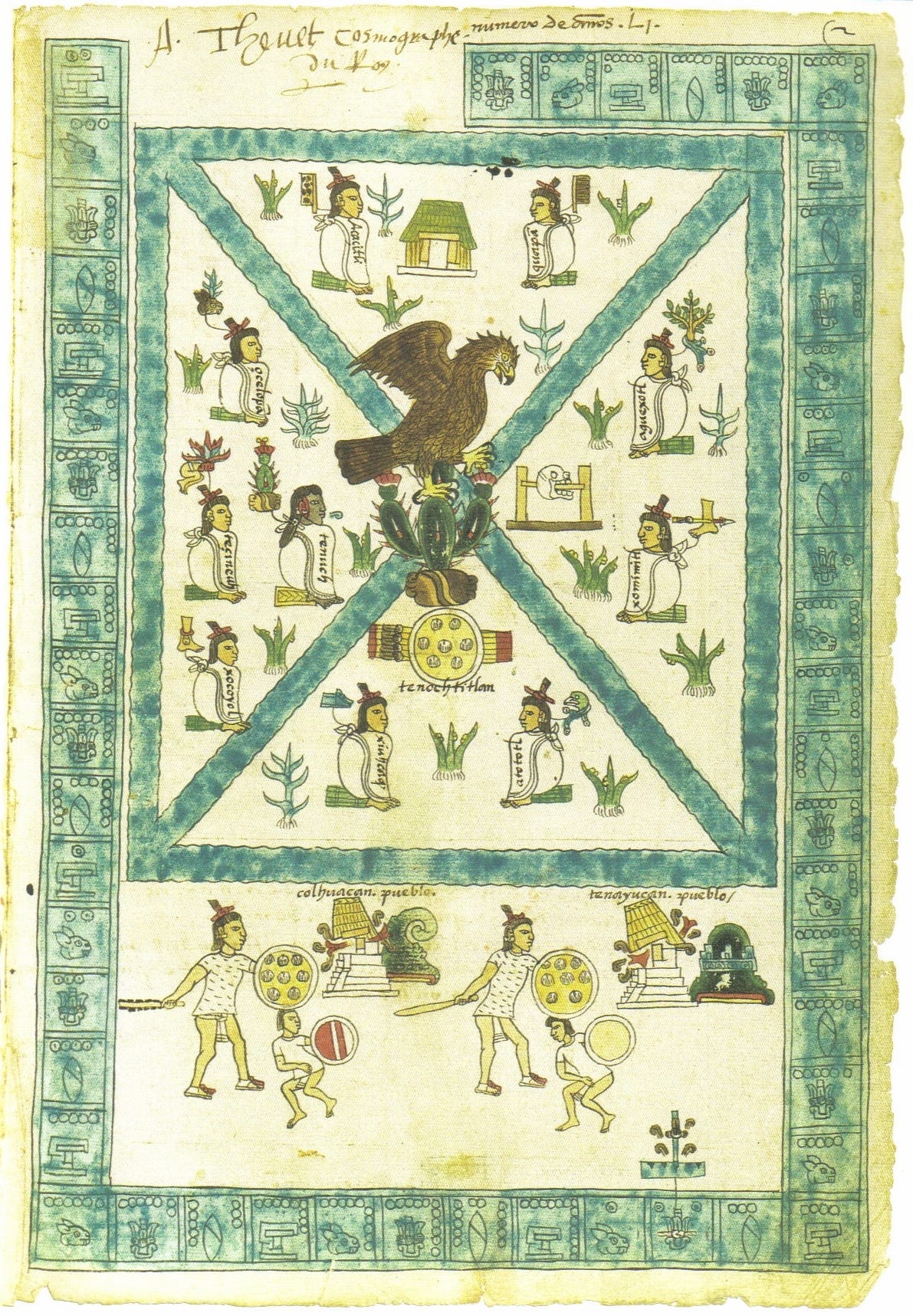
An eagle perches on a nopal cactus growing out of a stone, at the center of a square of blue water cut into four by two crossing channels. Seated men fill the quarters around it, and warriors line up below. The same eagle on its cactus is on the Mexican flag today.
The page opens the Codex Mendoza. Indigenous painters made the book in Mexico City about 1541, twenty years after the conquest, under the authority of the viceroy Antonio de Mendoza. Its decoration has been credited to a painter named Francisco Gualpuyogualcal, though the attribution is disputed.
In pictures, with notes in Spanish to explain them, the book tells three things: the rulers of Tenochtitlan from 1325 to 1521, the tribute the conquered towns owed them, and the life of a Mexica from birth to old age.
All of it was meant for the emperor Charles V, in Spain, and it never reached him. In the account the English writer Samuel Purchas gave in 1625, French privateers captured the ship that was carrying it across the Atlantic.
So the book surfaced in France, in the hands of André Thevet, cosmographer to King Henry II, who wrote his own name in five places in the manuscript, twice with the year 1553. The Englishman Richard Hakluyt bought it for twenty French écus, and by 1587 it was in England.
From Hakluyt it passed to Purchas himself, and after two more English owners it entered the Bodleian Library in Oxford between 1655 and 1659. The book still opens there on the eagle, because the history it tells begins with the founding of Tenochtitlan on an island in Lake Texcoco, in 1325 by tradition.
At a Glance
Artist: Unknown Indigenous painters, decoration possibly by Francisco Gualpuyogualcal
Made: About 1541, Mexico City
Medium: Ink and color on European paper, 71 leaves
Size: Each leaf about 21 × 31 cm (8 1/4 × 12 1/4 in)
Where to see it: Bodleian Library, Oxford
11. Tlaltecuhtli Monolith (late 15th century)
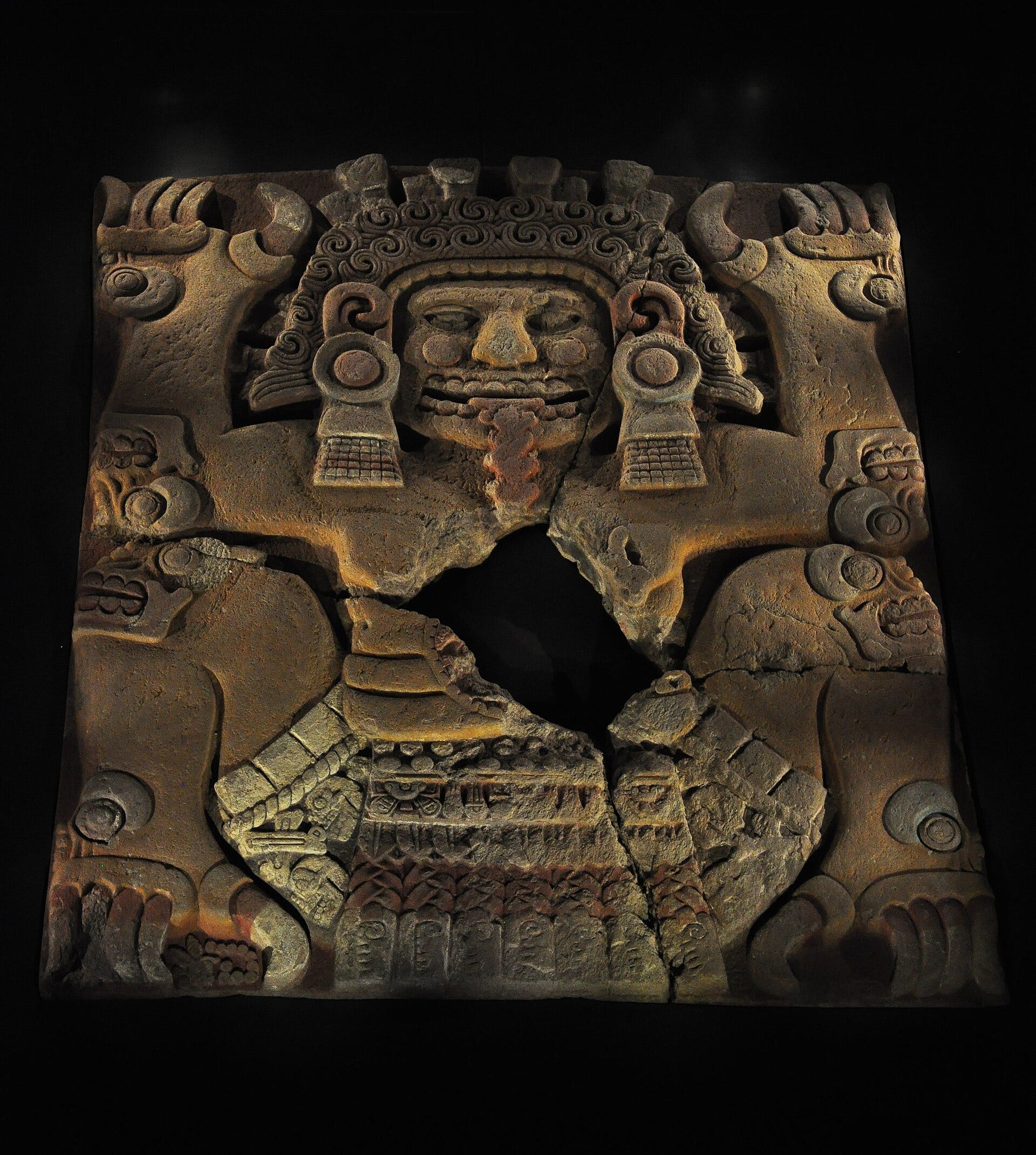
A worker was digging on a building site in the center of Mexico City, where an old house had just been torn down, when his pickaxe struck the side of a stone. The slab that came out of the ground was longer and wider than any Aztec sculpture ever found. It lay face up to the sky, broken into four pieces, and not one of the breaks carried the mark of a tool.