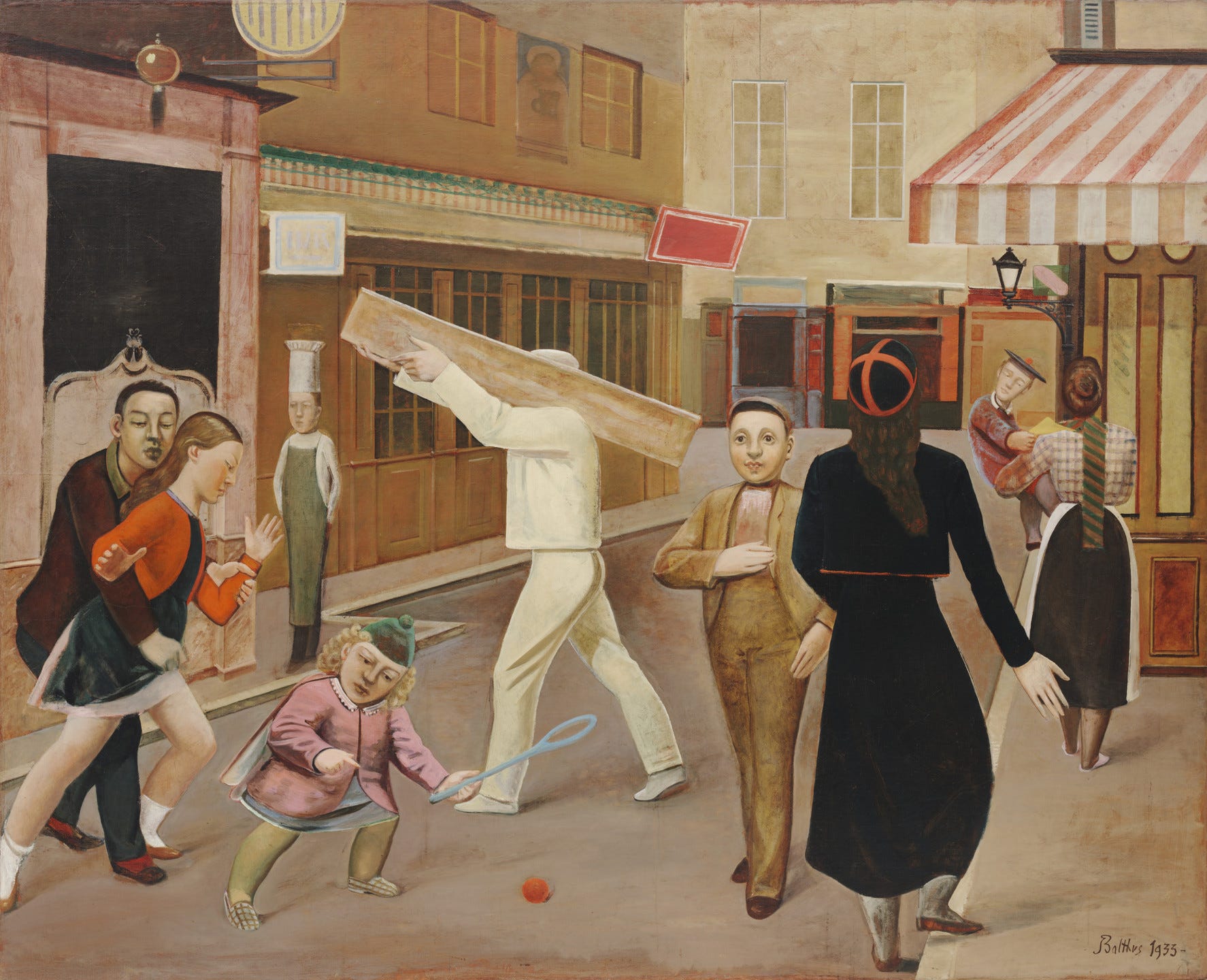
Balthus: The Complete Story
Balthus was the self taught count of figurative painting, the most argued over French artist of his century. Born Balthasar Klossowski in Paris in 1908, he was published by Rilke at 13, collected by Picasso, and directed the Villa Medici, all without a single day of art school.
His pictures of adolescence divide every room they hang in, and he refused to explain them for ninety years. Here are the facts on both sides of the argument.
Balthus at a glance:
1908: born Balthasar Klossowski in Paris to Polish émigré parents; the poet Rilke becomes his mother's companion and his first champion.
1921: Rilke prefaces Mitsou, the 13-year-old's picture book about a lost cat. The career starts there.
1935: designs sets and costumes for Antonin Artaud's Les Cenci; Artaud writes the first serious essay on his painting.
1961: André Malraux appoints him director of the French Academy at the Villa Medici in Rome, a post he holds 16 years.
2001: dies at 92 in his Swiss chalet; heads of state attend the funeral and Bono sings.
A childhood among the poets
His parents were Polish German artists in Paris, and after their separation his mother's companion was the poet Rainer Maria Rilke.
When the boy's cat vanished in 1919, he drew the story in forty ink drawings; Rilke had them published in 1921 as Mitsou, with his own preface, making Balthus a published artist at thirteen.
His training afterwards was the Louvre, and at eighteen, copying Piero della Francesca in Arezzo, he found the stillness that never left his work.
1934: the exhibition that set the terms
His first Paris show, at Galerie Pierre in 1934, contained The Street and The Guitar Lesson and caused the scandal that has framed him ever since. The Surrealists courted him; he declined.
Picasso later bought his large canvas The Children in 1941, a painting that now belongs to the French state, and Camus, Artaud and Giacometti counted him a friend. The art world argued; the artists collected.
More incredible painter stories
If Balthus pulled you in, you will love these too:
The myth: the provocateur
Balthus insisted, to the end, that his adolescent subjects were about the gravity of childhood, angels not scandals, and he refused all biography: his ideal catalogue note read, Balthus is a painter of whom nothing is known.
The counter reading has never gone away, and in 2017 a petition asked the Met to remove Therese Dreaming; the museum kept it on view, arguing that art exists to be debated, not hidden.
Both positions now hang beside the picture, permanently.
The count at the Villa Medici
In 1961 Andre Malraux appointed him director of the French Academy in Rome, and for sixteen years Balthus restored the Villa Medici room by room, receiving the world under a title, Count Klossowski de Rola, that no registry ever confirmed. In 1977 he retired with his wife, the painter Setsuko Ideta, to the Grand Chalet of Rossiniere in Switzerland, the vast wooden house where he painted slowly until his death in February 2001, at 92.
Where to see Balthus
The Met in New York holds Therese Dreaming and The Mountain; the Pompidou keeps The Street era works in Paris; and the Guitar Lesson, too contested to hang, has spent decades in private hands. The Grand Chalet remains in the family, occasionally opened for exhibitions.
Building rooms for Artaud
In 1935 Antonin Artaud, prophet of the Theater of Cruelty, hired Balthus to design his play Les Cenci. The production closed after 17 performances and became a legend anyway.
He kept designing for the stage: Camus' State of Siege in 1948, Ugo Betti, Mozart at Aix-en-Provence.
Painters rarely make good scenographers. Balthus was the exception, perhaps because his paintings were already staged rooms with the fourth wall removed.
The mountain paintings
The controversy talk skips the landscapes, though he painted them all his life: the cliffs at Larchant, farm terraces at Champrovent, and the huge alpine stage of The Mountain in 1937.
The Mountain restages Courbet in the Bernese Oberland, hikers frozen mid-gesture on sunlit rock, a picnic turned tableau.
During the war he painted the same Savoy valley in morning and afternoon light. Nothing happens in them, slowly, and that suspension is the effect he wanted everywhere.
Setsuko and the Japanese turn
In 1962 Malraux sent him to Japan to arrange an exhibition. There he met Setsuko Ideta, a student of 20 to his 54; she became his second wife in 1967, and a painter in her own right.
The marriage brought a Japanese register into the late work: flattened space, matte surfaces scraped like old plaster, kimonos in the studio light.
From 1977 they lived in the Grand Chalet at Rossinière, one of the largest wooden houses in Switzerland, where he painted at glacial pace while Setsuko managed the world outside the door.
The Balthus questions that keep coming up
What is he known for? Still, dreamlike figure paintings, above all of adolescents, argued over since 1934.
Was he really a count? He used the title Count Klossowski de Rola; no registry ever confirmed it, and he never minded.
Did he attend art school? Never. He trained by copying in the Louvre and Piero della Francesca in Arezzo.
When did he die? In February 2001, at 92, at Rossiniere in Switzerland.
How much does a Balthus cost? Thérèse, from 1938, sold for 19 million dollars in New York in 2019, his auction record. Most major canvases are already in museums.
What is the Grand Chalet? An 18th-century wooden former hotel of some forty rooms in Rossinière, his home for his last 24 years. Cartier-Bresson photographed him there; David Bowie came to talk.
More secrets to unlock
From Rilke's preface to Bono's eulogy
The career is bracketed by two unlikely documents: a cat picture book prefaced by Rilke in 1921, and a funeral in 2001 attended by heads of state where Bono sang. In between, the painter of whom nothing was known made sure the work, and only the work, did the talking.