
Bears are painted badly for a simple reason: almost no European painter had seen one alive. Medieval bestiary bears are dogs with long snouts, and the animal only starts looking like a bear once painters could visit a menagerie or a zoo.
Learn art the fun way
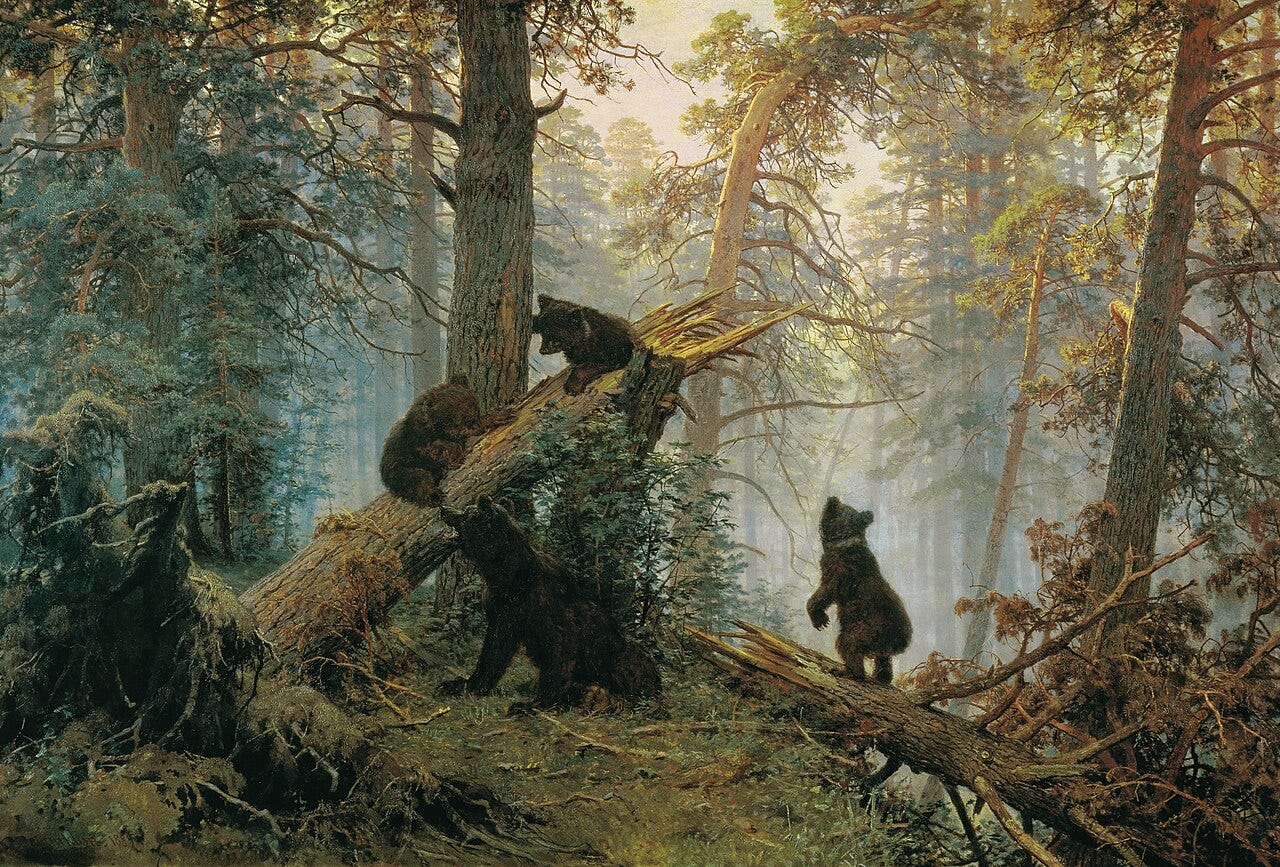
1 | Morning in a Pine Forest, Ivan Shishkin (1889)
Shishkin painted the forest and the mist. The four bear cubs were painted by his friend Konstantin Savitsky, whose signature the dealer Tretyakov had removed.
It became the most reproduced picture in Russia, on chocolate wrappers included.
Pavel Tretyakov bought it in 1889 and had Savitsky\u2019s signature removed because a single name sold better. Savitsky had already been paid a quarter of the fee.
2 | The bestiary bear
Medieval manuscripts show bears as long muzzled dogs, because the illuminator was copying an earlier copy. Nobody in the chain had seen the animal.
More on the format in what is an illuminated manuscript.
The main source is the Physiologus, a Greek text of the second century, copied and recopied for a thousand years. Each generation of illuminators worked from the last one\u2019s drawing rather than from an animal.
3 | Licked into shape
Ancient and medieval writers believed bear cubs were born formless and licked into shape by the mother. The idea appears in painting as a mother bear working on a shapeless lump.
The English phrase survives, the belief does not.
4 | Bear baiting in prints
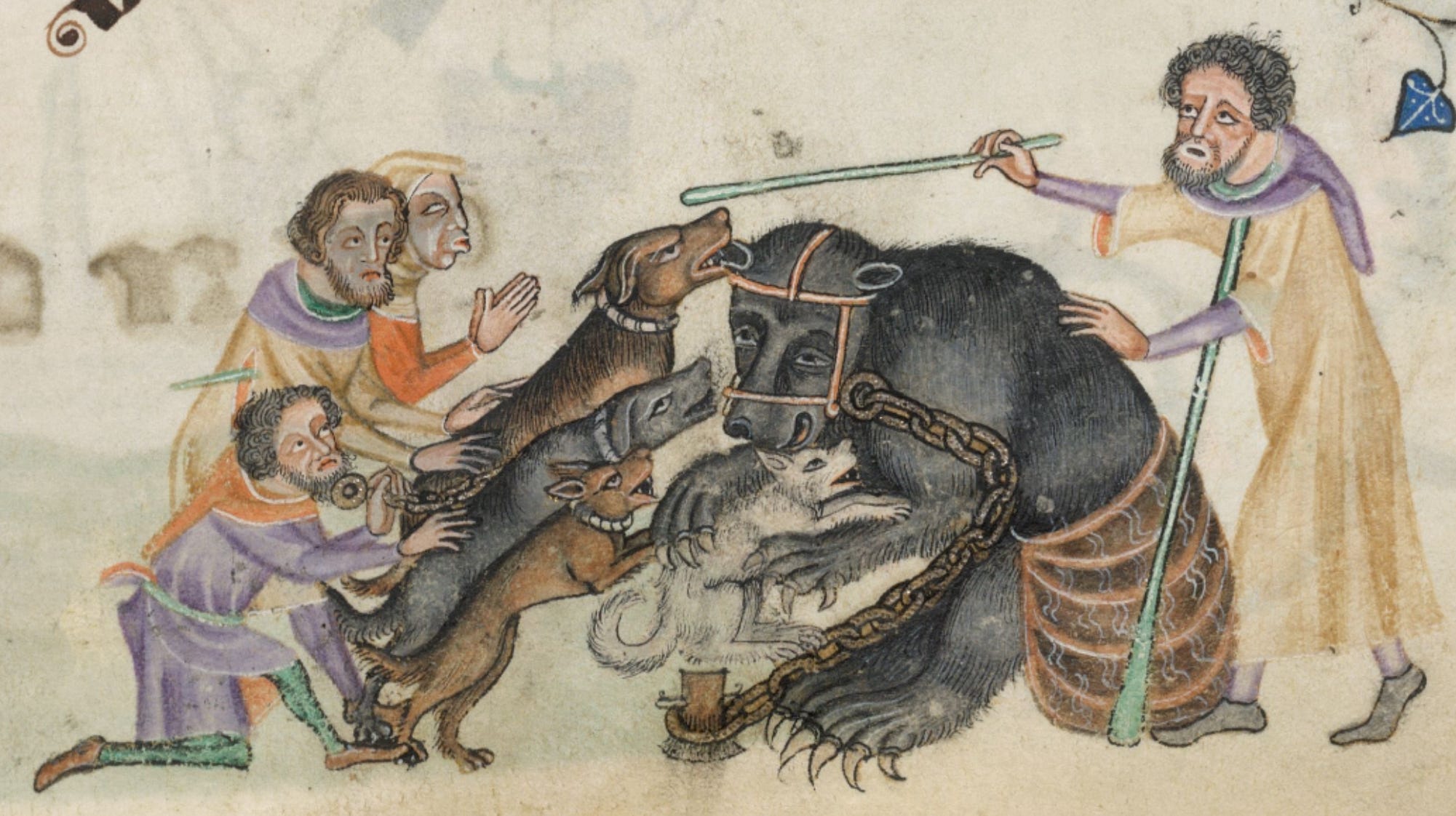
Bear gardens operated beside London theatres, and prints of the baiting sold to the same audience. It is a brutal subject treated as sport.
More on the medium in what is engraving.
The Bear Garden stood on Bankside beside the Globe, and the two venues competed for the same audience. Prints of the ring sold as souvenirs, which is most of what survives of it.
5 | Bears in Bruegel and the Netherlandish crowd
Northern painters put dancing bears with their handlers into village scenes, because a chained bear on a rope was a real thing you would see at a fair.
More on him in Pieter Bruegel the Elder.
6 | Callisto and the constellation
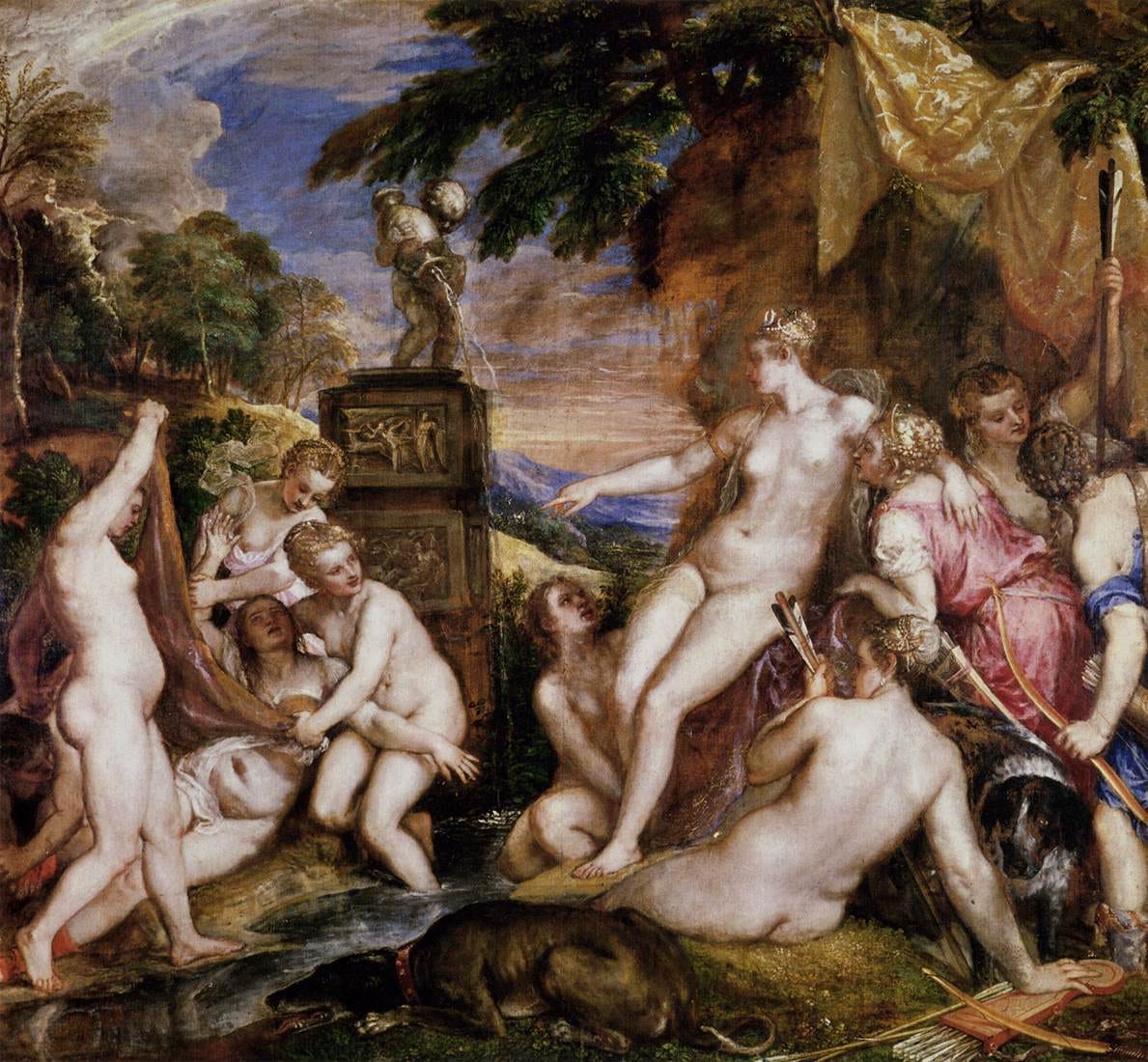
In myth Callisto is turned into a bear and placed in the sky as the Great Bear. Titian painted the moment of her disgrace, and it is one of the great mythological cycles.
More on him in Titian.
Titian painted that cycle for Philip II, and I rate the whole set in 7 secrets hidden in famous paintings.
Titian painted Diana and Callisto in 1559 for Philip II, as part of a set he called poesie. It was bought jointly by the National Gallery and the National Galleries of Scotland in 2012 for forty five million pounds.
7 | The heraldic bear
Bern is named for a bear and carries one on its arms, and Berlin has one too. Civic painting in those cities is full of bears standing upright and holding things.
A heraldic animal never has to look real.
The name Bern is traditionally derived from B\u00e4r, and the city kept live bears in a pit from the fifteenth century until the enclosure was replaced in 2009. The animal is on the arms, the flag and the coins.
8 | The polar bear enters painting
Arctic exploration in the nineteenth century brought polar bears into European pictures, usually on ice beside a wrecked ship, as a sign of a place that does not want you.
More in ice and frozen scenes in art.
9 | Landseer and the animal with feelings
Victorian animal painting gave bears human expressions, and audiences loved it. Accuracy of anatomy improved at exactly the moment sentiment took over.
More on the world it came from in what is romanticism art.
10 | The Russian bear as politics
British and French caricaturists drew Russia as a bear from the eighteenth century onward. Russian painters answered by making the bear noble and at home in the forest.
The same animal, two opposite arguments.
The image starts in English and French print satire in the eighteenth century and hardens during the Crimean War. Russian painters answered with the forest bear, at home and unbothered, which is exactly what Shishkin painted.
11 | Bears in Japanese art
The bear appears in Ainu culture in northern Japan with real ritual importance, and enters Japanese painting through that northern tradition rather than through European bestiaries.
More on him in Katsushika Hokusai.
12 | Why bears are painted so rarely
They were dangerous, hard to see, and carried no fixed Christian meaning, so a painter had little reason to include one. Lions had symbolism and dogs had loyalty. The bear had neither.
When you do find one, it is usually a fair, a myth or a coat of arms.
Bears on canvas, questions readers ask
Who painted Morning in a Pine Forest? Ivan Shishkin painted the landscape in 1889 and Konstantin Savitsky painted the bear cubs. Savitsky\u2019s signature was removed by the dealer.
Why do medieval bears look wrong? Illuminators copied earlier drawings rather than live animals, so the bear drifts towards a long muzzled dog.
What does licked into shape mean? An old belief that bear cubs were born formless and shaped by the mother\u2019s tongue. The phrase outlived the belief.
Why is Russia drawn as a bear? European caricaturists used the bear for Russia from the eighteenth century, and Russian painters answered with a noble forest version.
Where is Morning in a Pine Forest today? The Tretyakov Gallery in Moscow for Shishkin, the National Gallery for Titian\u2019s Diana and Callisto.
The most reproduced painting in Russian history has a co author whose name was scrubbed off the canvas by the man who bought it, because one signature sold better than two.
Two collections worth an hour of your time: the Met and the Rijksmuseum.