
The Benin Bronzes are works in brass and ivory, made over several centuries for the kings of Benin, a kingdom in the south of present-day Nigeria. In 1897, British troops took its capital, Benin City, looted the royal palace and shipped thousands of these works to Britain, which is why most of them are now in Western museums. Each one was made to be used: rung, struck, worn or set on a shrine.
Cool Stories About Art is a newsletter to learn art the fun way.
Join 200,000+ readers and get:
10 new art stories / month
The entire archive of content (140+ articles)
Comment, ask questions, and chat with other readers
Made for the King of Benin
The kingdom of Benin is unrelated to the modern Republic of Benin, which lies farther west. Its ruler, the Oba, was served by nearly fifty guilds of craftsmen, and the brass casters, the Igun Eronmwon, ranked highest among them. Their skills passed from father to son, and the guild still works today in Igun Street, in Benin City.
Despite the name, most of the Benin Bronzes are cast in brass, which mixes copper with zinc. The casters worked by the lost-wax method: they shaped a model in wax, coated it in clay, heated the mold until the wax ran out, and poured molten brass into the space it left.
The British capture of the city in 1897 followed an attack. In January, a British mission heading for Benin City was attacked on the road, and British members of the party were killed. The city fell to a British force in February, the palace burned, and the Oba was sent into exile.
In July 2022, Germany agreed to transfer to Nigeria the ownership of the 1,130 Benin objects held in its museums, and the first twenty went back that December. The same year, the Smithsonian's National Museum of African Art returned 29.
All but one of these objects were made to do a job at the court of Benin, on a shrine, on a palace pillar, at a festival or on the Oba himself. The exception was carved in Benin for buyers in Europe.
12. Altar to the Hand of the Ezomo Ehenua (19th century)
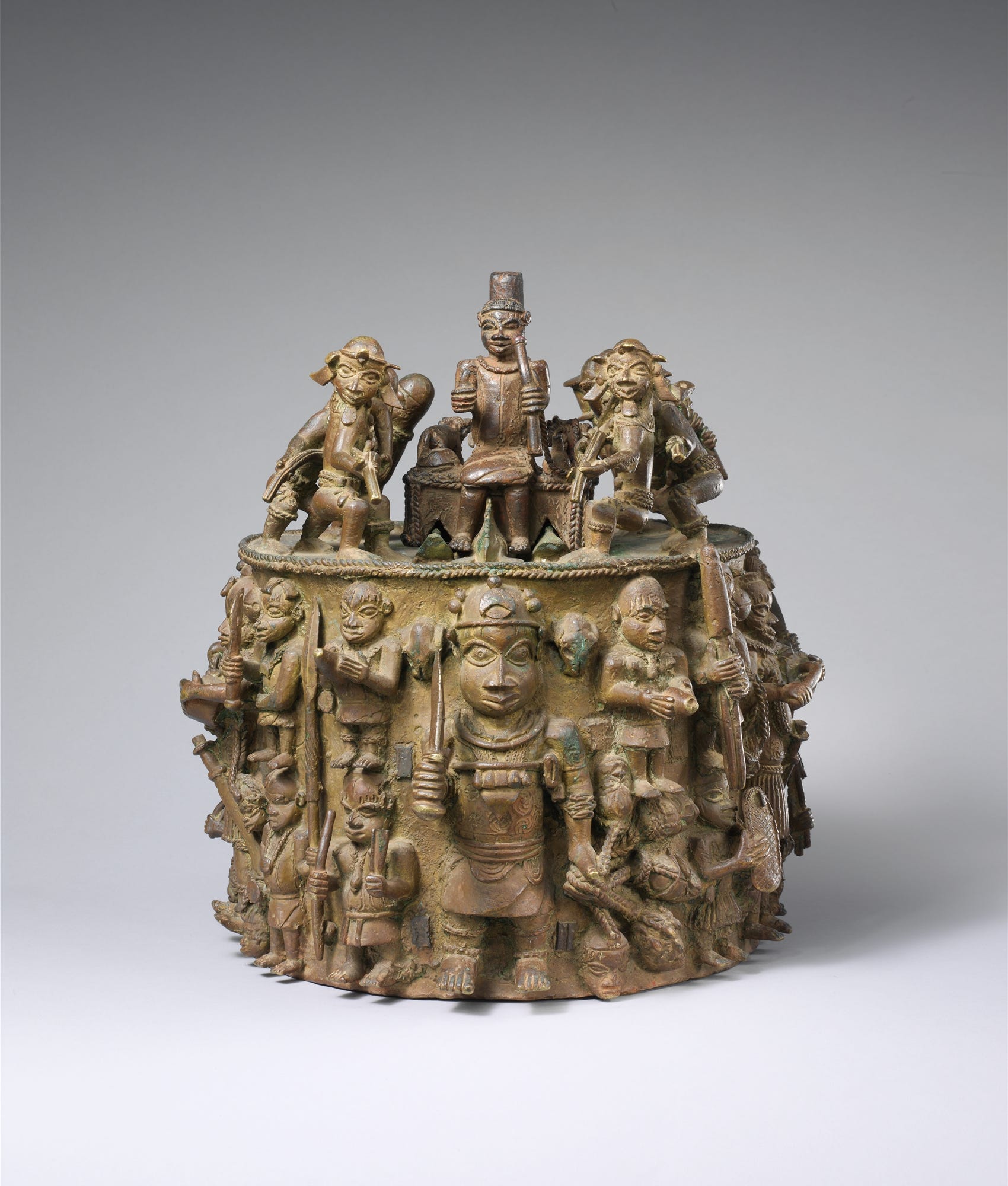
On a round brass base, a crowd of small figures presses around one man who stands far taller than any of them. He is dressed for war. Around him, at a smaller scale, stand soldiers, servants and priests, and above them run two rows of musketeers, some of them Portuguese soldiers.
The base is an Altar to the Hand, an ikegobo in Benin. The hand stood for action and work, the source of a man's wealth and rank, and an altar of the hand celebrated what someone had achieved by his own efforts. Depending on the rank of the man it honored, it was made of clay, of wood or of brass.
The tall man at the center earned his altar in war. Ehenua was the ezomo, the war chief, of Oba Akenzua I, who ruled from about 1713 to about 1740. When rebel chiefs challenged the king's power, Ehenua defeated them and restored order, and Akenzua honored his general with an altar of the hand.
The honor stayed in the family. Ehenua's heirs took the title of ezomo in turn, and the brass altar that survives was cast in the 19th century for one of them. His descendants went on using it, generation after generation, into the 1990s.
For me, the most surprising figures are in a small group cast separately and set in front of the warrior. It shows Oba Akenzua making a sacrifice to his ancestors so that his general would win. On the altar of the general, the king is the one making the offering, and he makes it for the general's victory.
At a Glance
Artist: Igun Eronmwon, the royal brass casters' guild of Benin
Made: 19th century, Benin City
Medium: Brass
Size: 33 × 35.6 × 35.6 cm (13 × 14 × 14 in)
Where to see it: The Metropolitan Museum of Art, New York
11. Bird of Prophecy (possibly 19th century)
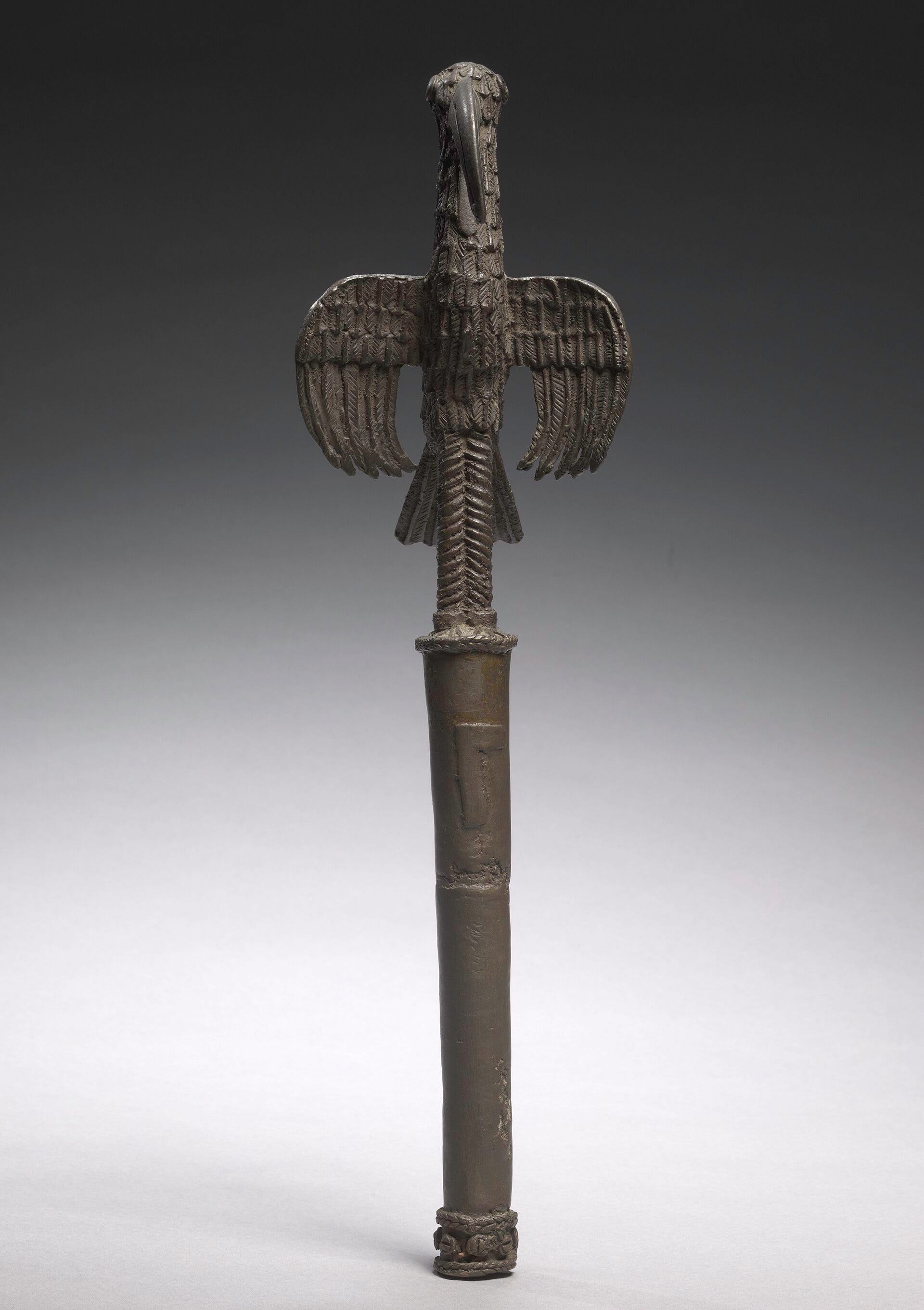
A brass bird stands upright on long legs, its wings spread wide and covered in long ridged feathers. In its beak it holds a small rounded lump. At the royal palace in Benin City, during a festival, chiefs still strike birds like this one with a metal rod, as a punishment.