
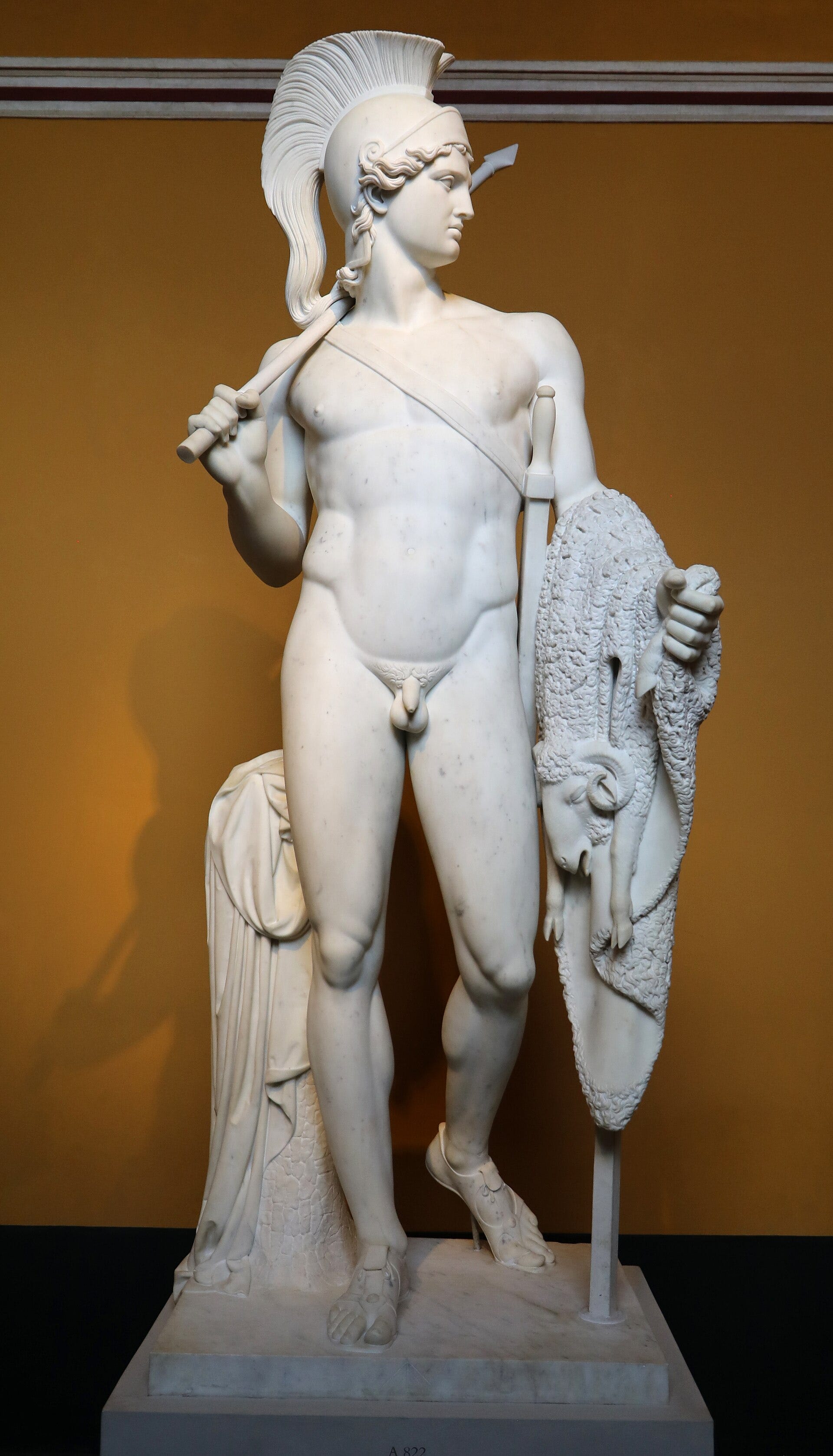
Bertel Thorvaldsen (1770 to 1844) was a Danish sculptor who lived forty years in Rome and became the most famous sculptor in Europe. He designed the Lion of Lucerne, in Switzerland, and made Jason with the Golden Fleece, now in Copenhagen.
Cool Stories About Art is a newsletter to learn art the fun way.
Join 200,000+ readers and get:
10 new art stories / month
The entire archive of content (140+ articles)
Comment, ask questions, and chat with other readers
Later in life, Thorvaldsen would make a pope's tomb in Rome and the Christ above the altar of Copenhagen's cathedral. Yet in 1803, at about thirty-two, he was a penniless student about to be sent home, and the one statue he cared about existed only in plaster.
Bertel Thorvaldsen was born in Copenhagen, the capital of Denmark. His father, an Icelander, carved figureheads in a shipyard, the wooden statues on the front of ships. His mother was the daughter of a parish clerk, a church assistant, in Jutland, the large peninsula of Denmark.
The family was poor. At eleven, Bertel entered the Royal Danish Academy of Fine Arts, the official art school of the kingdom, and he also helped his father carve wood.
At the Academy, Thorvaldsen won medal after medal, and finally the great gold medal, which came with a grant to study in Rome, where young artists from all over Europe copied the ancient statues.
Thorvaldsen entered Rome on March 8, 1797, and ever after he celebrated that day as his "Roman birthday." In 1800, he modeled a life-size Jason in clay. In Greek myth, Jason is the prince who sailed off to find the Golden Fleece, the wool of a magic ram.
Clay cracks as it dries. To keep a statue, a sculptor paid to have it cast in plaster, a hard copy from which a marble could later be carved. Thorvaldsen did not have the money, and by August 1801 he had destroyed his clay Jason himself.
He started again: a second Jason, one and a half times the size of a man. Late in 1802, Friederike Brun, a German writer staying in Rome, saw the unfinished clay and paid for the plaster cast. On March 19, 1803, she gave a party to celebrate the finished plaster, just as Thorvaldsen's grant from the Academy ran out.
Why would the statue that kept Thorvaldsen in Rome take 117 years to reach Copenhagen?
In the rest of the story
Who saved Thorvaldsen from going home, two days after the party.
Why the man who ordered one statue waited twenty-five years for it.
Why a Danish Protestant carved a pope's tomb in Rome's greatest church.
Where Thorvaldsen was sitting on the last evening of his life.