
For centuries in Europe, a black cat was bad news. Preachers tied it to heretics, then to witches, and its color alone was enough to condemn it. Then, within a few generations, the same cat went up over the door of a Paris bar, onto posters sold to tourists and into the arms of women at home.
Cool Stories About Art is a newsletter to learn art the fun way.
Join 200,000+ readers and get:
10 new art stories / month
The entire archive of content (140+ articles)
Comment, ask questions, and chat with other readers
Why Painters Kept the Black Cat
What do black cats symbolize in art? For most of their history, trouble. Medieval clergy linked them to heretics, later preachers to witches, and in 1843 a story published in Philadelphia made the black cat the figure of a murderer's guilt.
That reputation came with a practical problem for painters. A black body vanishes against a dark ground, so most of them keep only the outline and the eyes. The boldest turn the problem into the picture and let the cat sink into a dark curtain.
The twelve works here follow the black cat from accusation to affection. In every one, the cat carries the picture or takes a real part in the scene. Cats that only fill a corner stayed out.
12. Adolphe Willette, The Sign of Le Chat Noir (1881)
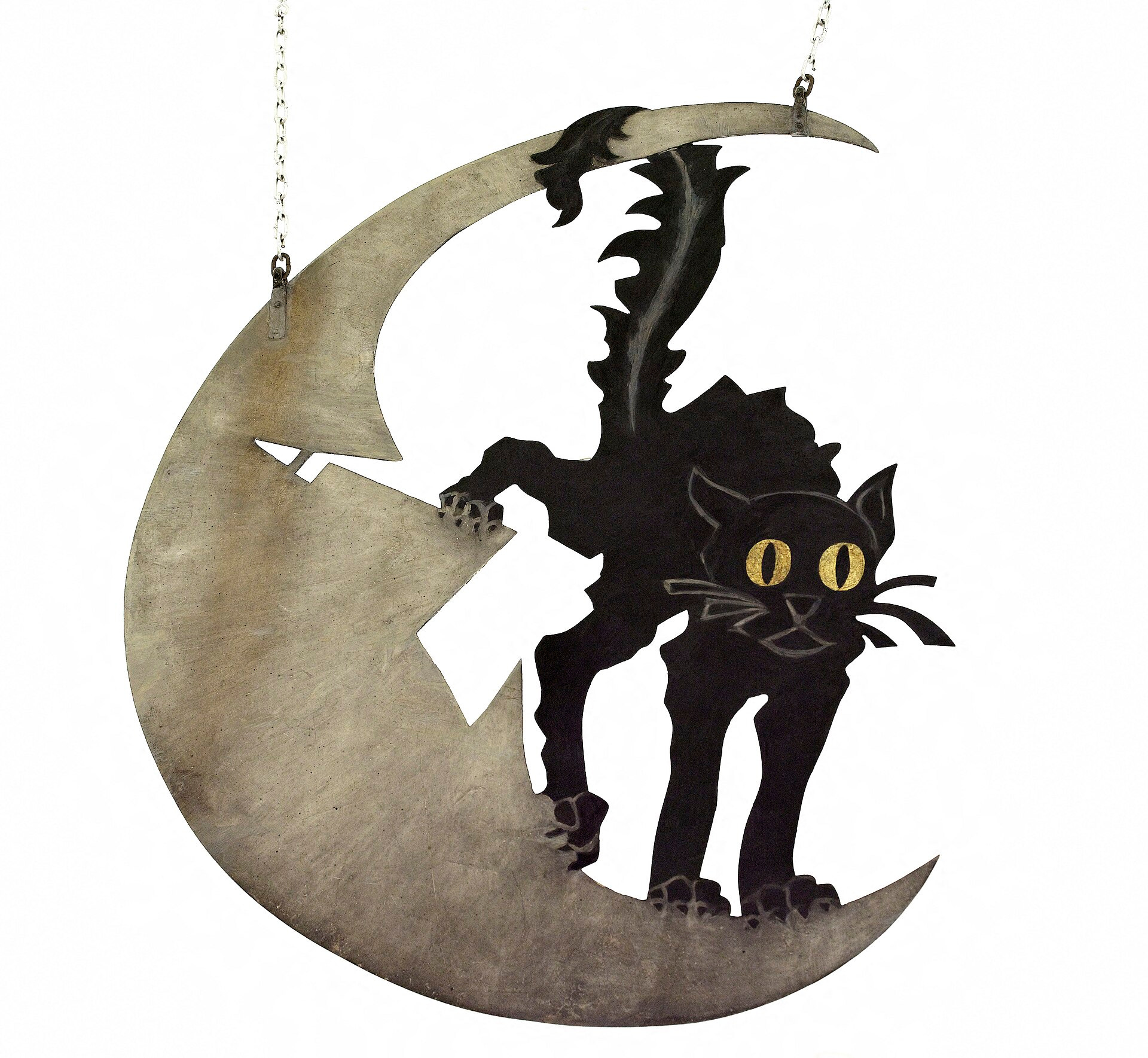
The cat's fur stands straight up along its spine. Back arched, tail stiff, it crouches on a crescent moon that has a face, and the face does not look pleased. The whole thing is cut from one sheet of iron and painted on both sides, so that people walking by could see it from either direction.
That double painting gives away its purpose: it was a shop sign. In November 1881, a new cabaret opened at 84 boulevard de Rochechouart, at the foot of Montmartre, the hill that rises over northern Paris. Its owner, Rodolphe Salis, a painter who had never found success, called it Le Chat Noir, the Black Cat, and a young illustrator, Adolphe Willette, drew its sign.
Willette told what came next in a memoir published in 1919. Everyone approved the design, it was cut out in sheet iron at once, and the cat with golden eyes went up over the entrance, where it swung in the wind. Its shadow, he wrote, danced cheerfully across the awning of the grocer next door, whom the whole cabaret regarded as its enemy.
The sign shared in the cabaret's success. Le Chat Noir became one of the most famous addresses in Paris, and when it moved in 1885 to a larger house on the rue de Laval, now the rue Victor-Massé, the iron cat moved with it.
Its life went on after the cabaret's. Five years after Salis died in 1897 and Le Chat Noir closed, the painter Edouard Detaille organized a contest of artistic shop signs at the Paris city hall. Willette entered his iron signs and won first prize. The cat had outlived both the man and the place it was made for.
At a Glance
Artist: Adolphe Willette (1857 to 1926), designer, made by an unknown ironworker
Made: 1881
Medium: Painted sheet iron, cut out and painted on both sides
Size: 130 × 96 cm (51 × 38 in)
Where to see it: Musée Carnavalet, Paris
About This Work
Why is Le Chat Noir so famous?
Because of what happened inside. Poets, songwriters and illustrators performed there every night, the cabaret published its own newspaper, and from 1885 it staged a shadow theater with zinc silhouettes that drew crowds for about eleven years. It is often described as the first modern artistic cabaret in Paris.
What does Le Chat Noir mean in French?
It means The Black Cat, the same words as the title of Edgar Allan Poe's story, from which the name probably comes.
11. Bible moralisée of Vienna, Heretics Kissing a Cat (about 1220s)
In a small medallion framed in gold, painted in Paris around 1220, a bearded man bends forward and kisses a cat under its tail. About ten years later, a pope described the very same gesture in a letter and turned it into an accusation.