Black Paintings: 12 Famous Works and the Story of the Color

The most famous black paintings run from Goya's Black Paintings series, painted straight onto the walls of his own house, to Whistler's Arrangement in Grey and Black and Rembrandt's darkest self portrait.

Black cost almost nothing to make, yet painters used it to say the things color could not, and these twelve pictures show how.

Black was the cheapest color on a painter's table, ground from charred bone or soot, yet painters spent it as carefully as gold. I have picked twelve pictures where black carries the whole picture, from a king's own house in Madrid to a courtroom scandal in Paris. If you want the full spectrum, color in art covers how painters use every hue, not just this one.

Why black is the most serious color in art:

  • The cheap color. Black came from charred bone and soot, the cheapest pigment on a painter's table, yet it reads as the most serious.

  • The house that became a gallery. Goya painted his darkest pictures straight onto the plaster walls of his own home, never meant to be sold.

  • The color of status. In the Dutch Golden Age, a plain black coat was the most expensive thing a rich man could wear.

  • The scandal. One black dress on a Paris society portrait caused a scandal that pushed the painter out of France.


Join 170,000 readers who get the secrets behind the paintings. Free.

1. Diego Velazquez, Pablo de Valladolid (about 1635)

Velazquez Pablo de Valladolid black portrait
Diego Velazquez, Pablo de Valladolid, about 1635, Museo del Prado, Madrid

Velazquez paints an actor of the royal court standing on a bare floor, with no wall, no shadow, no horizon, just gray and black around a single figure. He builds the whole picture from a handful of tones, letting a stroke of black define a boot, a sleeve, a hat, without ever drawing an outline around it.

The picture hung in the Prado without a settled subject for centuries. Edouard Manet saw it in Madrid in 1865 and called it the strangest and maybe the finest piece of painting ever done, then built his own Fifer directly from its example.

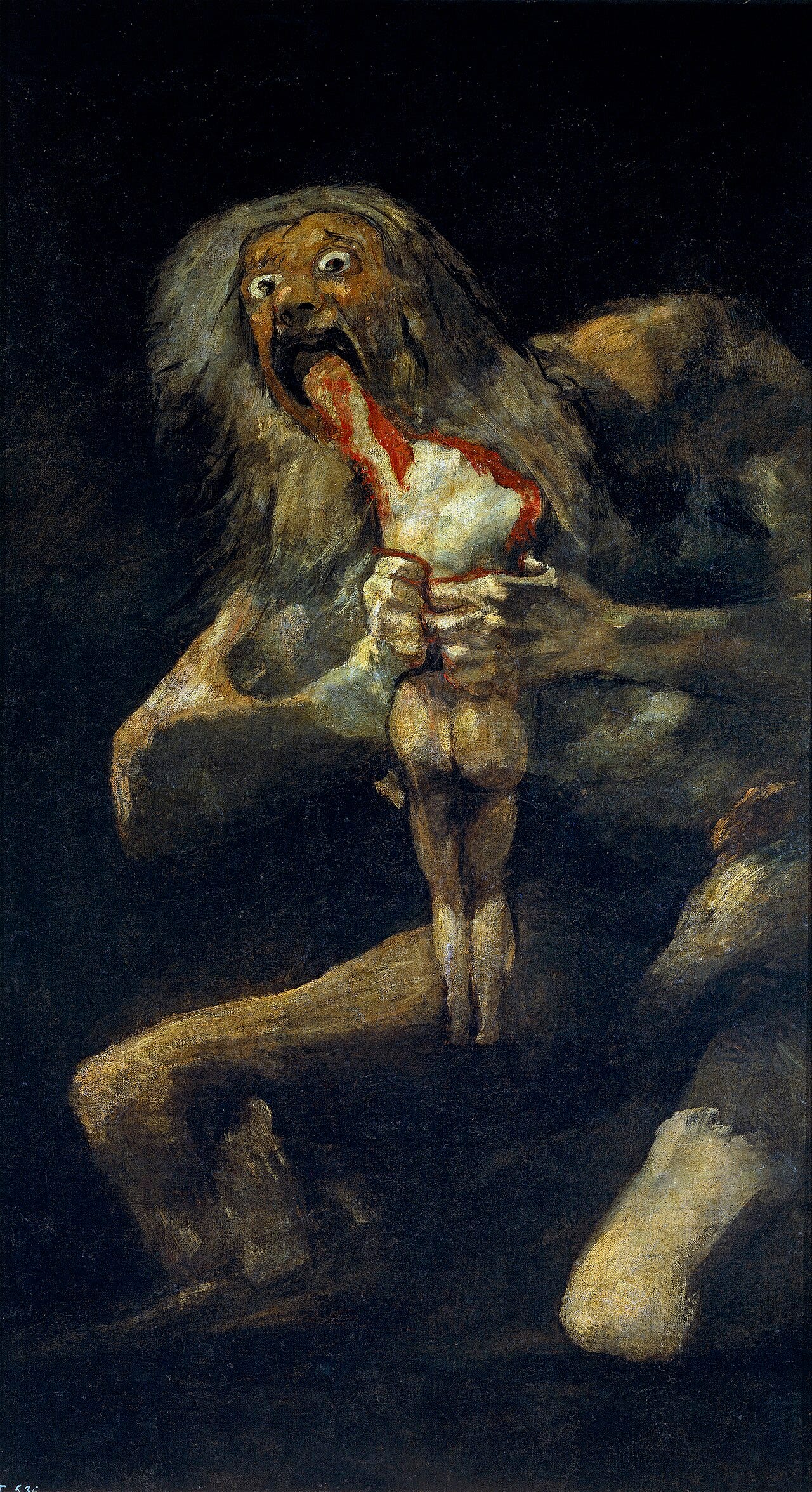
2. Francisco Goya, Saturn Devouring His Son (about 1820 to 1823)

Goya Saturn Devouring His Son black painting
Francisco Goya, Saturn Devouring His Son, about 1820 to 1823, Museo del Prado, Madrid

Goya painted this directly onto the plaster of his own dining room wall, in a house outside Madrid he had bought after recovering from a severe illness. He worked in oil straight onto the wall, with no commission, no buyer, and no title of his own choosing.

The fourteen pictures from these walls stayed there for close to fifty years after Goya's death, found only when a new owner had them detached and moved onto canvas in 1874. Goya never named this Black Paintings series himself, and nobody knows for certain if he ever showed the room to anyone at all.

3. Francisco Goya, The Dog (about 1820 to 1823)

Goya The Dog black painting
Francisco Goya, The Dog, about 1820 to 1823, Museo del Prado, Madrid

From the same set of wall paintings, this one shows almost nothing: a small dog's head, barely visible, sinking into an enormous field of ochre and shadow. Goya leaves most of the wall empty, which was almost unheard of in a period that filled every canvas.

Art historians still argue over what the dog is doing, drowning, climbing, or simply looking up at something outside the frame. The painting was trimmed at the edges when it moved from the wall to canvas in the 1870s, so the version in the Prado today is smaller than what Goya actually painted.

4. James McNeill Whistler, Arrangement in Grey and Black No. 1 (1871)

Whistlers Mother black portrait
James McNeill Whistler, Arrangement in Grey and Black No. 1, 1871, Musee d'Orsay, Paris

Whistler's mother sits in profile against a plain wall, dressed in black from collar to hem. Whistler gave the picture a title borrowed from music, an arrangement of tones, because he wanted people to look at the shapes and grays before they thought about who the sitter was.

The Musee d'Orsay bought the picture from Whistler in 1891, the first work by a living American artist to enter a French national collection. The image later appeared on a US postage stamp in 1934, printed for Mother's Day, though the stamp cropped part of the original composition to fit the format.

5. James McNeill Whistler, Arrangement in Black: Portrait of Pablo de Sarasate (about 1884)

Whistler Arrangement in Black Sarasate portrait
James McNeill Whistler, Arrangement in Black: Portrait of Pablo de Sarasate, about 1884, Carnegie Museum of Art, Pittsburgh

Whistler paints the Spanish violinist mid step, seeming to walk out of total darkness, his black coat almost swallowed by the black background around him. Only the pale hands, face, and violin scroll catch any light at all.

Whistler gave several of his portraits this same musical labeling: arrangement, harmony, nocturne, treating color relationships the way a composer treats notes. Sarasate himself considered the finished portrait an honest likeness and kept a copy of it in his own home in Spain.

6. Edouard Manet, The Fifer (1866)

Manet The Fifer black uniform painting
Edouard Manet, The Fifer, 1866, Musee d'Orsay, Paris

A boy in the black and red uniform of a French army band stands against a flat gray background, no floor, no shadow beneath his feet. Manet strips away almost every trace of depth and paints the figure like a flat cutout, with the black trouser stripes doing most of the modeling on the whole uniform.

The Paris Salon jury rejected the painting in 1866, calling it too flat to read as a real figure. Emile Zola defended it in print that same year, comparing the black and red patches directly to a Spanish playing card, and the comparison stuck.

7. Rembrandt van Rijn, Self Portrait with Two Circles (about 1665 to 1669)

Rembrandt late self portrait black background
Rembrandt van Rijn, Self Portrait with Two Circles, about 1665 to 1669, Kenwood House, London

Painted in the last years of his life, Rembrandt shows himself in a plain dark coat and white cap, most of the canvas given over to a near black background. Two faint circles are visible on the wall behind him, still debated by scholars, maybe a map, maybe a private symbol of the painter's own skill.

By this point Rembrandt had been declared insolvent and had sold his house and most of his possessions at auction. He kept painting himself anyway, in this dark, unglamorous register, right up to his death in 1669.

8. El Greco, The Burial of the Count of Orgaz (1586)

El Greco Burial of the Count of Orgaz black robed noblemen
El Greco, The Burial of the Count of Orgaz, 1586, Iglesia de Santo Tome, Toledo

El Greco fills the lower half of this enormous painting with Toledo noblemen dressed entirely in black, the fashion of Spain's court under Philip II, their faces the only pale note against the fabric. Above them, the picture opens into a crowded heaven that sits in total contrast to the black ranks below.

The painting has never left the small church it was made for. It still hangs today in the Iglesia de Santo Tome in Toledo, in the same side chapel El Greco painted it for in 1586, built around the burial legend of the local count it depicts.

9. Caravaggio, The Beheading of Saint John the Baptist (1608)

Caravaggio Beheading of Saint John black background
Caravaggio, The Beheading of Saint John the Baptist, 1608, St John's Co Cathedral, Valletta

Caravaggio paints the execution inside a shadowed prison courtyard, the black background taking up most of the canvas so the few lit figures seem caught in a single beam of light. He worked directly on the huge canvas with little underdrawing, scraping and repainting sections as he went.

It is the only painting Caravaggio ever signed, and he signed it in the blood pooling from the saint's neck. He had fled Rome after killing a man in a duel and painted this while seeking protection from the Knights of Malta, who expelled him from their order within the year after a separate violent incident.

10. Francisco de Zurbaran, Crucifixion (1627)

Zurbaran Crucifixion black background
Francisco de Zurbaran, Crucifixion, 1627, Art Institute of Chicago

Zurbaran paints Christ alone against total black, no thieves, no crowd, no landscape, just one lit figure suspended in darkness. The near total absence of any setting was unusual even for a period that favored dark backgrounds, and it makes the figure feel closer to sculpture than to painting.

The painting was made for a side chapel in a Dominican monastery in Seville and was considered so convincingly three dimensional that visitors reportedly touched it to check whether it was carved rather than painted. It left Spain in the 19th century and has been in Chicago since 1954.

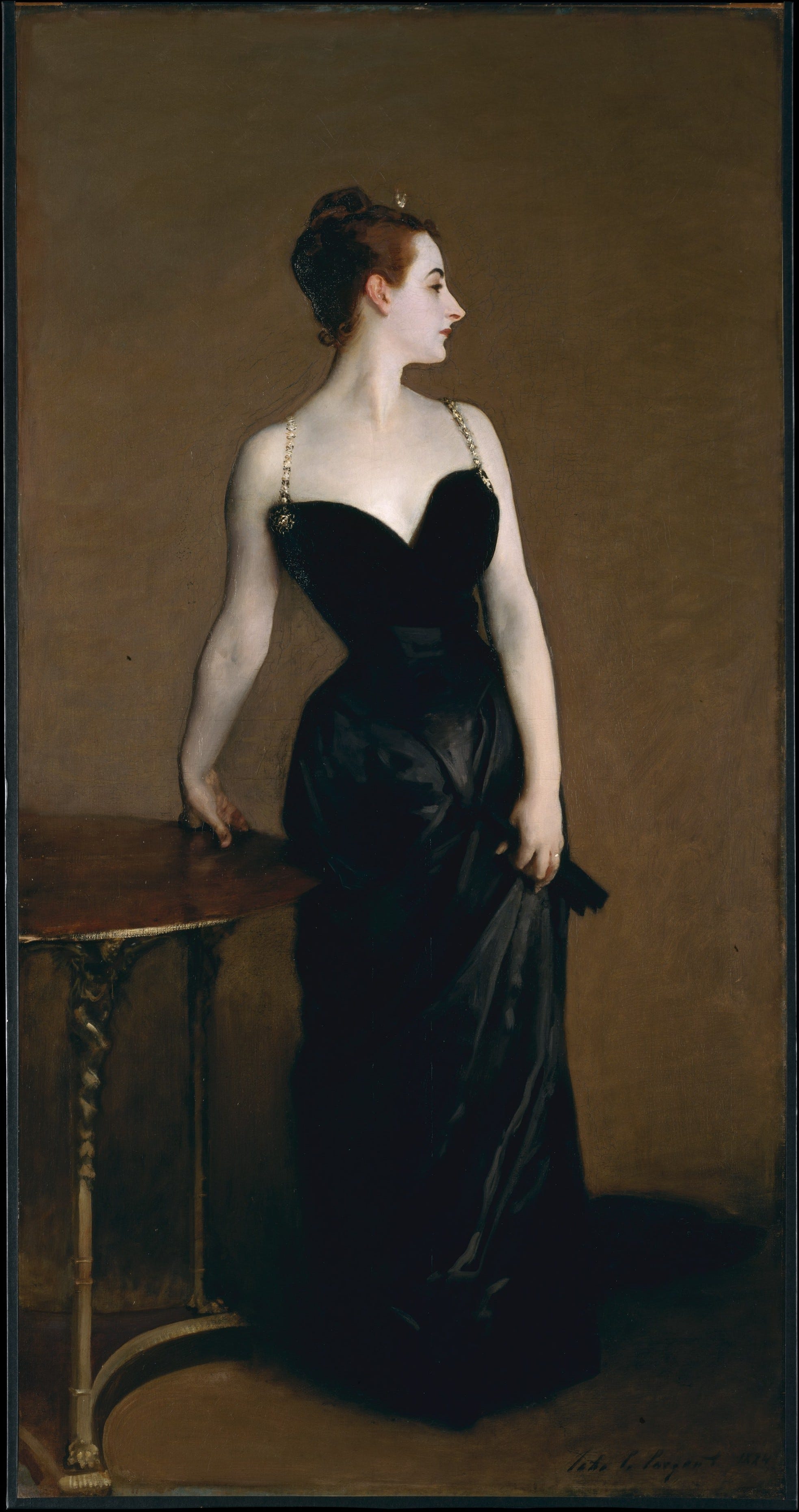
11. John Singer Sargent, Madame X (1884)

John Singer Sargent Madame X black gown portrait
John Singer Sargent, Madame X, 1884, Metropolitan Museum of Art, New York

Sargent paints Virginie Gautreau, a well known Paris society figure, in a black satin gown with one jeweled strap slipping off her shoulder, her skin powdered to a pale lavender white against the black dress and dark background.

The slipped strap caused a real scandal at the 1884 Paris Salon. Gautreau's family demanded Sargent withdraw the picture, and he later repainted the strap back onto her shoulder, but the damage to his Paris career was done, and he moved to London within the year. The Metropolitan Museum of Art bought the picture from Sargent directly in 1916, and he called it the best thing he had ever done.

12. Frans Hals, Malle Babbe (about 1633 to 1635)

Frans Hals Malle Babbe black clothing owl
Frans Hals, Malle Babbe, about 1633 to 1635, Gemaldegalerie, Berlin

Hals paints an older woman at a tavern table, gripping a beer tankard, an owl perched on her shoulder, her mouth caught wide open in a laugh or a shout. The paint is laid on loose and fast, with visible brushstrokes standing in for detail, especially across her plain dark clothing.

Research in Haarlem's own municipal archives later confirmed a real woman behind the nickname, Barbara Claes, recorded as a resident of the town's shelter for the destitute and mentally ill. Gustave Courbet admired the painting enough to travel and see it, then paint his own copy of it in 1869.


Join 170,000 readers who get the secrets behind the paintings. Free.

Where the blacks hang today

  • Velazquez, Pablo de Valladolid: the Museo del Prado, Madrid.

  • Goya, the Black Paintings: the Museo del Prado, Madrid.

  • Whistler, Arrangement in Grey and Black No. 1: the Musee d'Orsay, Paris.

  • Rembrandt, Self Portrait with Two Circles: Kenwood House, London.

  • Sargent, Madame X: the Metropolitan Museum of Art, New York.


Join 170,000 readers who get the secrets behind the paintings. Free.

Black without the confusion

  • What are Goya's Black Paintings? A set of fourteen pictures Goya painted directly onto the walls of his own house near Madrid, moved onto canvas decades after his death.

  • Why did painters use so much black? Black was cheap to make, easy to mix, and read instantly as serious or formal, especially in Dutch and Spanish portraits.

  • What is Whistler's Arrangement in Grey and Black? The formal title of the painting known as Whistler's Mother, now in the Musee d'Orsay in Paris.

  • Why did Madame X cause a scandal? A jeweled strap slipping off the sitter's shoulder was considered too suggestive for the 1884 Paris Salon, forcing Sargent to repaint it and eventually leave Paris.

  • What pigment made black paint? Painters used charred bone, charred vine wood, or soot mixed with oil, all far cheaper than pigments like ultramarine or vermillion.

The color that cost nothing and said everything

Line these twelve up and black stops looking like an absence of color and starts looking like a decision. Velazquez builds a whole portrait out of it, Goya paints his private nightmares in it on his own dining room wall, Sargent lets one black dress end his career in Paris.

The cheapest pigment on a painter's table turned out to carry the most weight. Zurbaran's Crucifixion still hangs in Chicago, mistaken for sculpture by visitors who wanted to touch it, close to four centuries after he mixed the black that made it look real.